What the Profit Margin Calculator Does
This calculator turns two simple numbers — your revenue and your costs — into three useful figures: your total profit, your profit margin, and your profit percentage (markup). It is designed for any business, freelancer, or product seller who wants a quick, accurate read on profitability. The dollar values shown here are generic and currency-neutral, so the same logic applies whether you trade in dollars, pounds, or euros.
The Two Inputs
- Revenue ($): The total money you bring in from sales before any costs are deducted. This must be greater than zero — the calculator will reject zero or negative revenue.
- Costs ($): The total expenses tied to generating that revenue, such as materials, production, and overhead.
The Formula Explained
Once you enter both values, the tool computes:
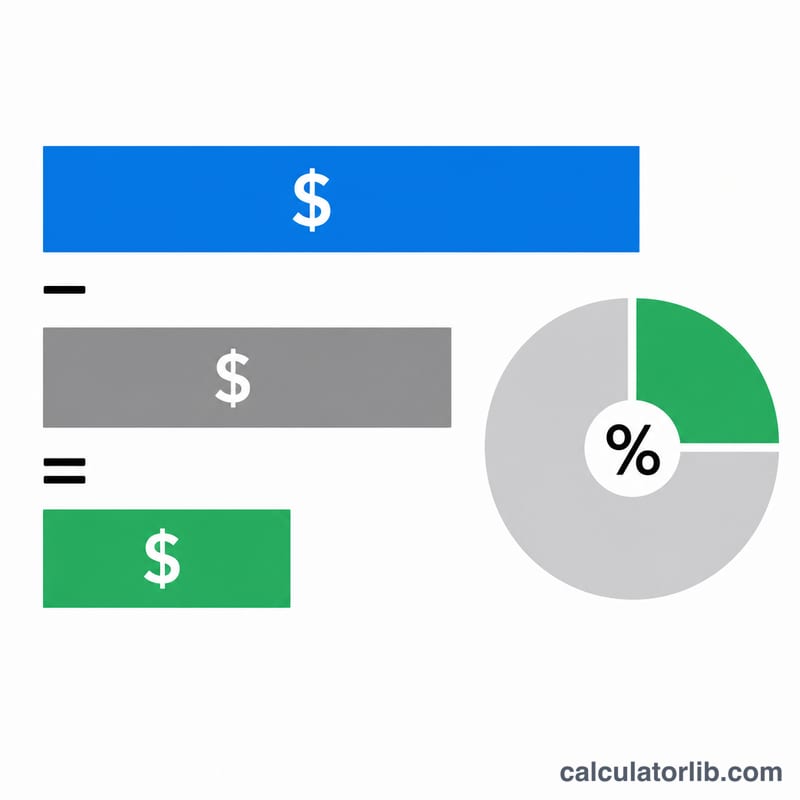
- Profit = Revenue − Costs
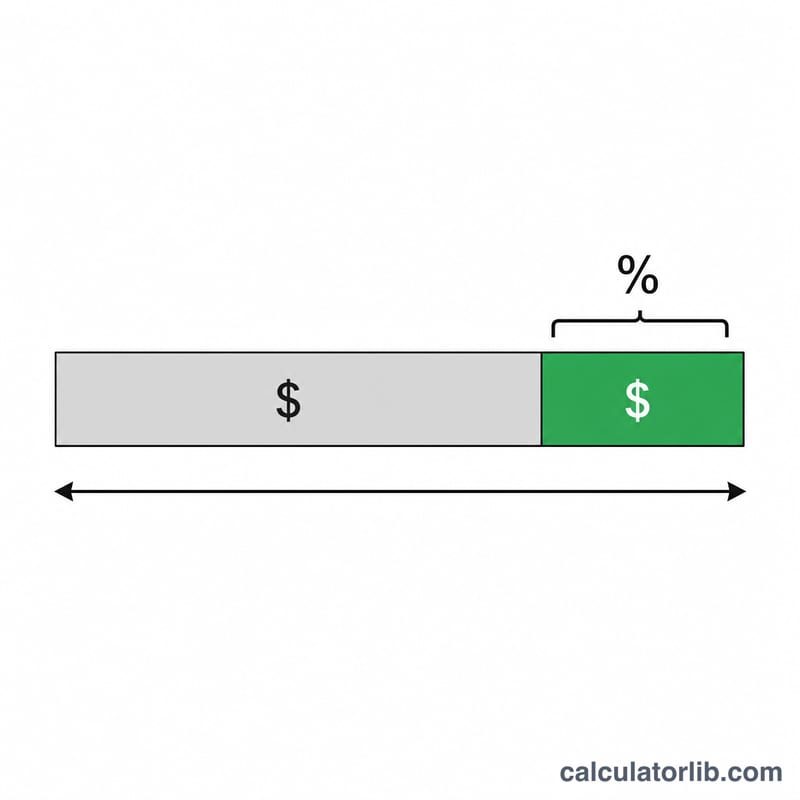
- Profit Margin (%) = (Profit ÷ Revenue) × 100 — profit as a share of revenue
- Profit Percentage (%) = (Profit ÷ Costs) × 100 — profit relative to cost, often called markup
The margin tells you how much of every revenue dollar you keep, while the profit percentage tells you how much return you earned on top of what you spent. They are different views of the same profit.
Worked Example
Suppose you enter Revenue = $1,000 and Costs = $600:
- Profit = 1,000 − 600 = $400
- Profit Margin = (400 ÷ 1,000) × 100 = 40%
- Profit Percentage = (400 ÷ 600) × 100 ≈ 66.67%
So you keep 40 cents of every revenue dollar, and your markup over cost is about 66.67%.
Margin vs. Markup Across Common Scenarios
Margin and markup both start from the same profit figure, but they divide it by different bases. Profit margin divides profit by revenue: \(\text{Margin} = \frac{R - C}{R} \times 100\%\). Markup divides profit by costs: \(\text{Markup} = \frac{R - C}{C} \times 100\%\). The table fixes revenue at $1,000 and varies costs.
| Revenue | Costs | Profit | Profit margin | Markup |
|---|---|---|---|---|
| $1,000 | $200 | $800 | 80% | 400% |
| $1,000 | $500 | $500 | 50% | 100% |
| $1,000 | $800 | $200 | 20% | 25% |
| $1,000 | $1,000 | $0 | 0% | 0% |
| $1,000 | $1,200 | -$200 | -20% | -16.67% |
Worked example for the $800 cost row: \(\frac{1000 - 800}{1000} \times 100\% = 20\%\) margin, while \(\frac{1000 - 800}{800} \times 100\% = 25\%\) markup. For the loss row: \(\frac{1000 - 1200}{1000} \times 100\% = -20\%\) margin and \(\frac{1000 - 1200}{1200} \times 100\% \approx -16.67\%\) markup.
Interpreting Your Profit Margin
- Positive margin: revenue is greater than costs, so there is a profit. A 20% margin means 20 cents of every revenue dollar is left after costs.
- 0% margin: revenue equals costs. This is the break-even point, with no profit and no loss.
- Negative margin: costs exceed revenue, which means a loss. A margin of -20% means the loss equals 20% of revenue.
- Margin vs. markup limits: when costs are zero or positive, profit margin cannot exceed 100%, because profit can never be more than revenue. Markup has no such cap. In the table above, $200 of costs against $1,000 of revenue gives a 400% markup but only an 80% margin.
- What the costs include: the result depends on what you enter as costs. Direct costs only (cost of goods sold) give a gross margin. All expenses, including overhead, interest and taxes, give a net margin. The same business can show quite different margins depending on the choice, so compare like with like.
- Industry differences: typical margins vary widely between industries. Businesses with high volume and thin pricing generally run lower margins than those selling software or specialised services. A margin only has meaning against a relevant benchmark and over a consistent period.
Key Terms: Margin, Markup, Gross and Net Profit
- Revenue: the total money received from sales before any costs are subtracted.
- Costs: the money spent to produce and sell the goods or services. Which expenses count depends on the measure being calculated.
- Profit: revenue minus costs. A negative result is a loss.
- Profit margin: profit divided by revenue, shown as a percentage: \(\frac{R - C}{R} \times 100\%\).
- Profit percentage / markup: profit divided by costs, shown as a percentage: \(\frac{R - C}{C} \times 100\%\). It shows how much is added on top of cost.
- Gross profit margin: revenue minus cost of goods sold (COGS), divided by revenue. It ignores overhead and financing.
- Net profit margin: profit after all expenses, including operating costs, interest and taxes, divided by revenue.
- Break-even: the point where revenue equals costs, giving zero profit and a 0% margin.
Frequently Asked Questions
What's the difference between profit margin and profit percentage? Profit margin divides profit by revenue, while profit percentage divides profit by costs. Margin is always the lower of the two for a profitable business, because revenue is larger than costs.
Can the result be negative? Yes. If your costs exceed your revenue, profit is negative, and both percentages become negative — a clear sign you are operating at a loss.
Why does revenue have to be above zero? The margin formula divides by revenue, so a revenue of zero would make the calculation undefined. The tool requires revenue greater than zero to return a valid result.