
What This Calculator Does
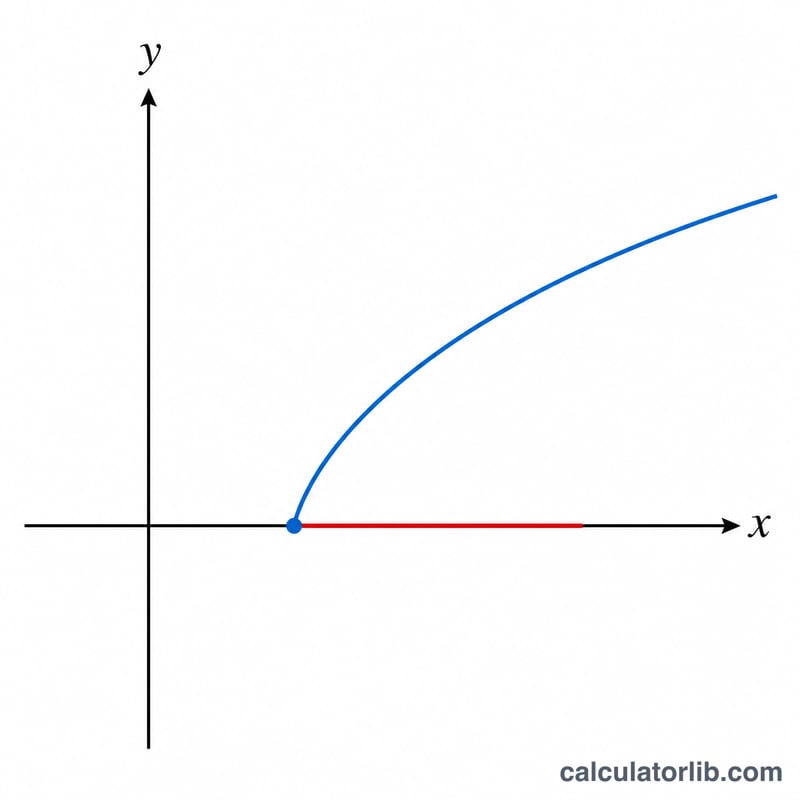
The domain of a function is the complete set of input values (x) for which the function produces a real output. For a square root function \(f(x) = \sqrt{ax + b}\), the quantity inside the radical — the radicand — must be greater than or equal to zero, because the square root of a negative number is not a real number. This tool solves that condition for you and reports the domain in both inequality and interval notation.
How to Use It
Enter the coefficient a and the constant b from your radicand \(ax + b\). The calculator solves \(ax + b \ge 0\). If a is positive, the domain is \(x \ge -\frac{b}{a}\). If a is negative, dividing flips the inequality, giving \(x \le -\frac{b}{a}\). If a equals zero, the radicand is just the constant b, so the domain is either all real numbers (\(b \ge 0\)) or empty (\(b < 0\)).
The Formula Explained
Start with \(ax + b \ge 0\). Subtract b: \(ax \ge -b\). Divide by a, remembering to reverse the inequality sign if a is negative: \(x \ge -\frac{b}{a}\) (for \(a > 0\)) or \(x \le -\frac{b}{a}\) (for \(a < 0\)). The value \(-\frac{b}{a}\) is the boundary point where the radicand equals zero.
$$\sqrt{ax + b} \;\Rightarrow\; ax + b \ge 0 \;\Rightarrow\; x \ge -\frac{b}{a}$$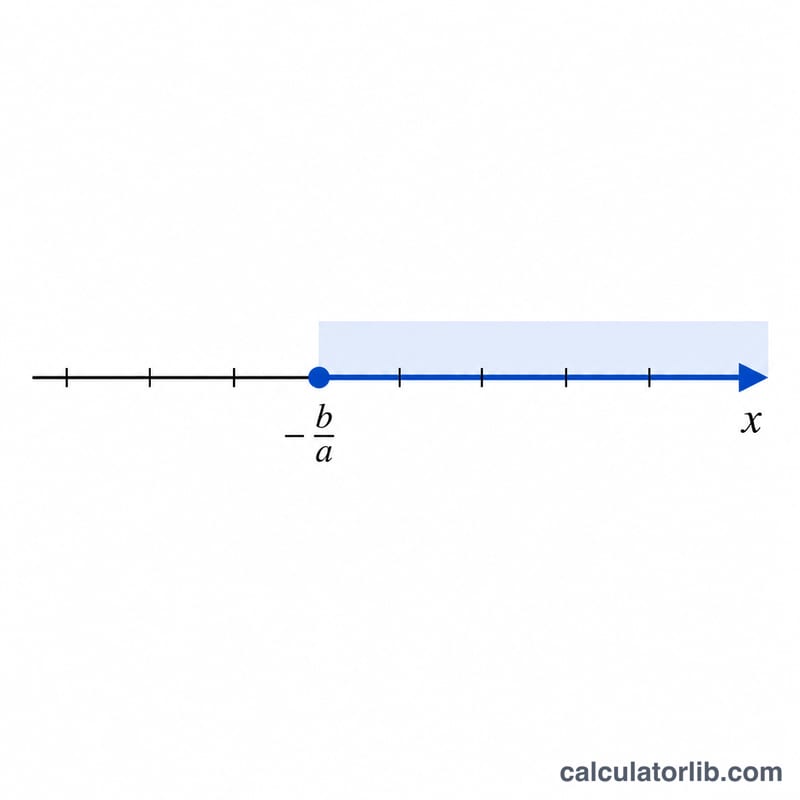
Worked Example
Consider \(f(x) = \sqrt{2x - 6}\), so \(a = 2\) and \(b = -6\). Solve \(2x - 6 \ge 0\), giving \(2x \ge 6\), so \(x \ge 3\). The boundary is
$$-\frac{b}{a} = \frac{6}{2} = 3$$and the domain is \([3, \infty)\).
FAQ
Why must the radicand be non-negative? In the real numbers, no value squared gives a negative result, so \(\sqrt{\text{negative}}\) is undefined.
What if a is negative? Dividing both sides of an inequality by a negative number flips the direction, so you get \(x \le -\frac{b}{a}\), an interval that extends to the left.
Does the boundary point belong to the domain? Yes. At \(x = -\frac{b}{a}\) the radicand is exactly zero, and \(\sqrt{0} = 0\) is a valid real output, so the boundary is included (closed bracket).