
What This Calculator Does
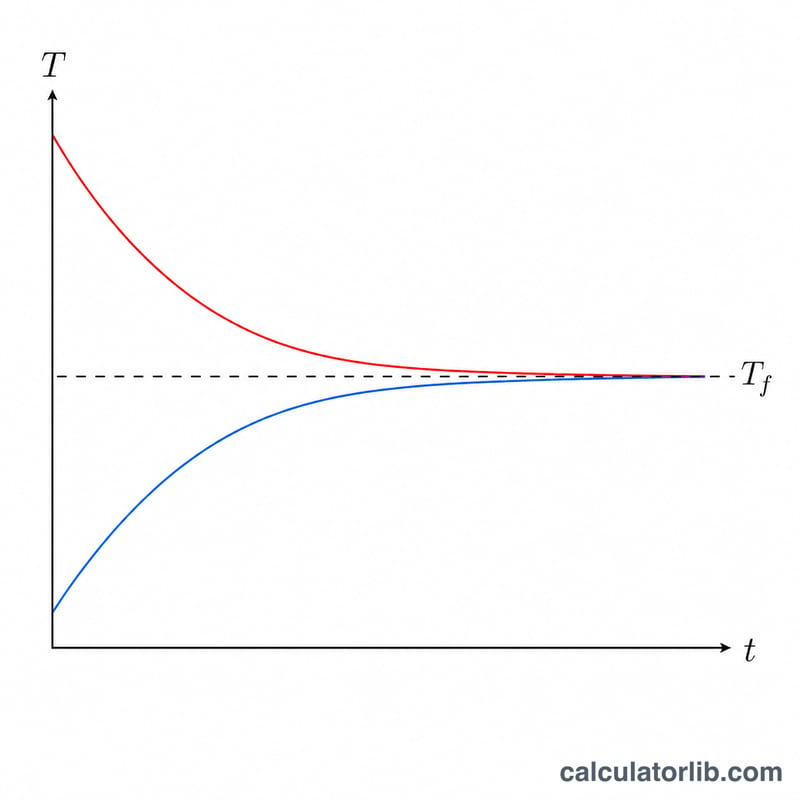
The Final Temperature Mixing Calculator finds the equilibrium temperature reached when two substances at different temperatures are brought into thermal contact—for example, hot and cold water mixed in an insulated container. It is based on the principle of calorimetry: in an isolated system, the heat lost by the hotter substance equals the heat gained by the cooler one, so the system settles to a single shared temperature.
The Formula Explained
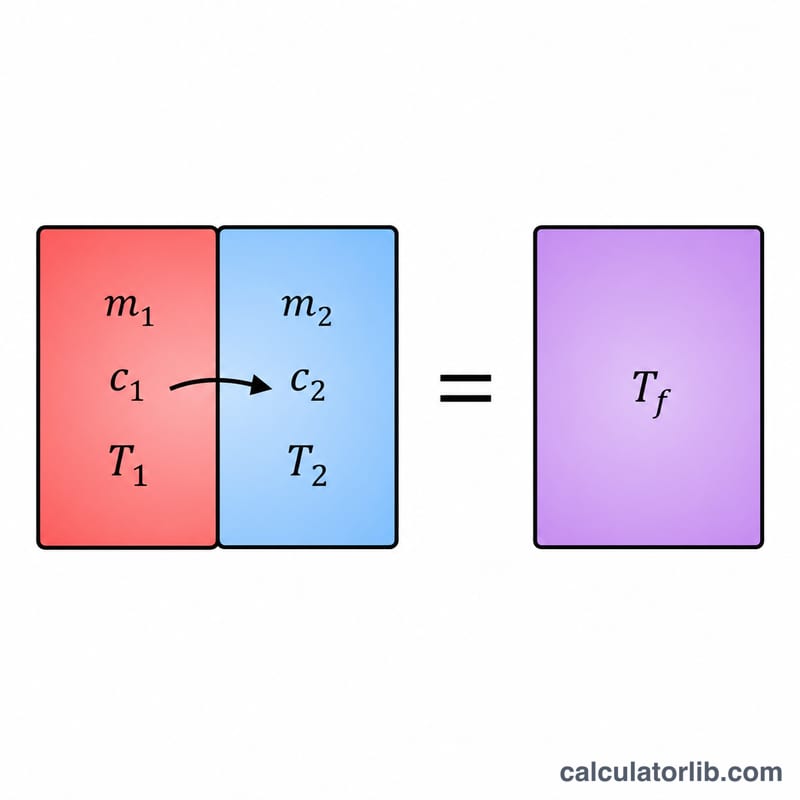
Each substance stores thermal energy proportional to its mass (\(m\)), its specific heat capacity (\(c\)), and its temperature (\(T\)). Setting total heat gained equal to total heat lost and solving for the final temperature gives:
$$T_f = \frac{m_1 c_1 T_1 + m_2 c_2 T_2}{m_1 c_1 + m_2 c_2}$$
The product \(m \cdot c\) is the heat capacity of each substance. The final temperature is simply the heat-capacity-weighted average of the two starting temperatures. The heat transferred by each substance is then \(Q = mc(T_f - T_i)\); a negative \(Q\) means that substance released heat.
How to Use It
Enter the mass (in grams), specific heat (in J/g·°C), and initial temperature (in °C) for each substance, then read the equilibrium temperature. Water has a specific heat of about 4.18 J/g·°C. Keep your units consistent across both substances.
Worked Example
Mix 100 g of water at 20 °C with 100 g of water at 80 °C (\(c = 4.18\) for both). $$T_f = \frac{100 \cdot 4.18 \cdot 20 + 100 \cdot 4.18 \cdot 80}{100 \cdot 4.18 + 100 \cdot 4.18} = \frac{8360 + 33440}{836} = 50 \ \text{°C}$$ As expected, two equal masses of the same liquid settle exactly halfway between their starting temperatures.
FAQ
Does this account for heat lost to the surroundings? No. It assumes a perfectly insulated (isolated) system, which is the ideal calorimetry case.
Can I use kilograms instead of grams? Yes, as long as both masses use the same unit and the specific heat is in matching units. The mass units cancel out.
Why is Q negative for one substance? A negative \(Q\) means that substance lost heat (cooled down), while the other gained an equal amount of heat.