What Is the Surface Area to Volume Ratio?
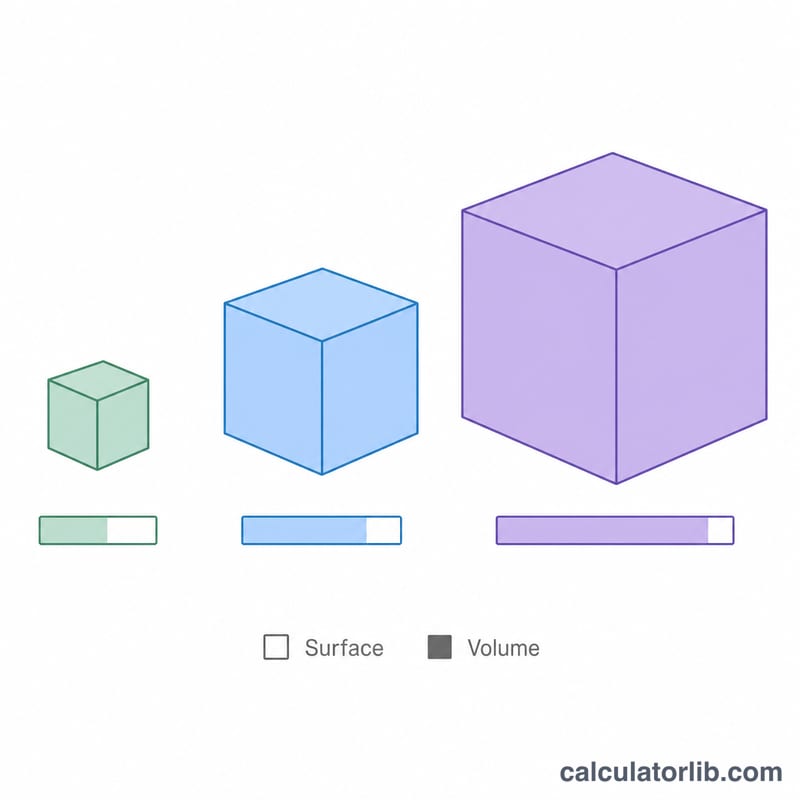
The surface area to volume ratio (often written SA:V or SA/V) measures how much exposed surface an object has relative to the space it occupies. It is found by dividing the total surface area by the volume. Because surface area scales with the square of length and volume with the cube, smaller objects have a much higher SA:V than larger objects of the same shape — a principle that shapes everything from cell biology to heat loss in engineering.
How to Use This Calculator
Enter the object's total surface area and its volume in any consistent units (for example cm² and cm³, or m² and m³). Click calculate and the tool returns the ratio. The result has units of inverse length (1/length), so if you used cm the ratio is per centimetre.
The Formula Explained
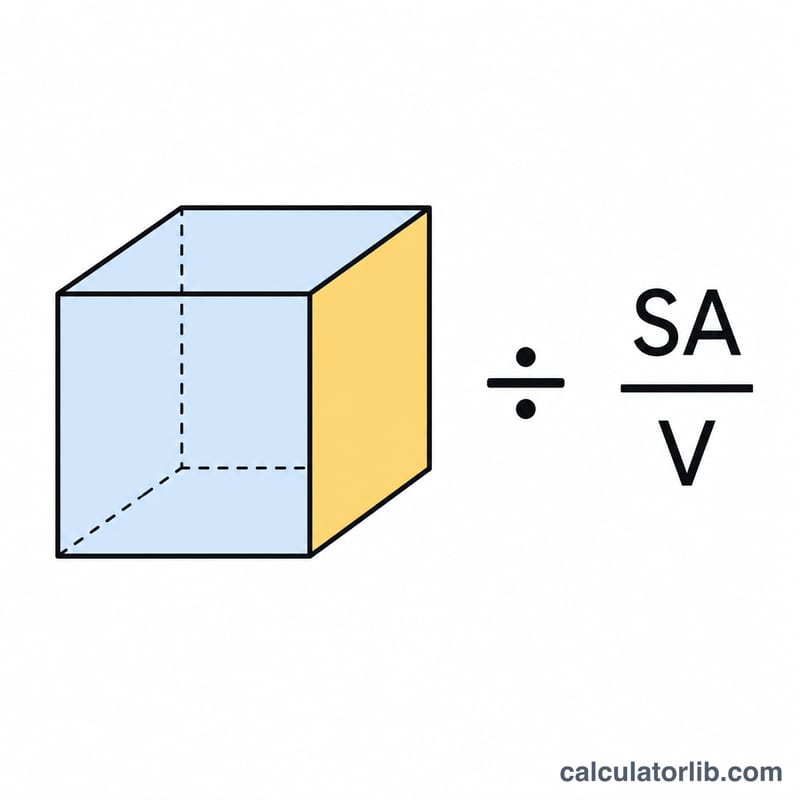
The equation is simply $$\text{SA:V} = \frac{\text{Surface Area}}{\text{Volume}}$$ A larger value means more surface relative to volume, which favors faster exchange of heat, gas, or nutrients across the boundary. A smaller value indicates a bulkier, more compact object that retains heat and resists diffusion.
Worked Example
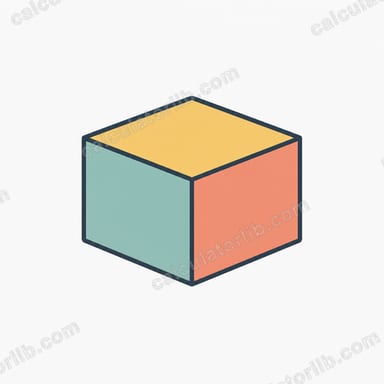
Consider a cube with side length 5. Its surface area is \(6 \times 5^2 = 150\) and its volume is \(5^3 = 125\). The SA:V ratio is $$150 \div 125 = \mathbf{1.2}$$ per unit length. A larger cube with side 10 would give \(600 \div 1000 = 0.6\) — half the ratio, showing how SA:V falls as size grows.
SA:V Comparison Across Shapes and Sizes
SA:V is surface area divided by volume, so it has units of 1/length (for example cm-1). For a given shape, doubling every length doubles the volume's length factor by 8 but the area's by only 4, so the ratio halves. The table uses arbitrary length units; for the cylinder, height equals radius (h = r).
| Shape | Size | Surface area | Volume | SA:V |
|---|---|---|---|---|
| Cube (SA = 6s², V = s³) | s = 1 | 6 | 1 | 6 |
| Cube | s = 5 | 150 | 125 | 1.2 |
| Cube | s = 10 | 600 | 1000 | 0.6 |
| Sphere (SA = 4πr², V = 4πr³/3) | r = 1 | 4π ≈ 12.566 | 4π/3 ≈ 4.189 | 3 |
| Sphere | r = 2 | 16π ≈ 50.265 | 32π/3 ≈ 33.510 | 1.5 |
| Sphere | r = 5 | 100π ≈ 314.159 | 500π/3 ≈ 523.599 | 0.6 |
| Cylinder, h = r (SA = 2πr(r + h), V = πr²h) | r = 1 | 4π ≈ 12.566 | π ≈ 3.142 | 4 |
| Cylinder, h = r | r = 2 | 16π ≈ 50.265 | 8π ≈ 25.133 | 2 |
| Cylinder, h = r | r = 5 | 100π ≈ 314.159 | 125π ≈ 392.699 | 0.8 |
Formulas behind the pattern: sphere \(\text{SA:V} = \frac{3}{r}\), cube \(\text{SA:V} = \frac{6}{s}\), cylinder \(\text{SA:V} = \frac{2}{r} + \frac{2}{h}\).
Same volume, different shape (V = 1000 cm³)
| Shape | Dimensions | Surface area (cm²) | SA:V (cm-1) |
|---|---|---|---|
| Cube | s = 10 | 600 | 0.6 |
| Cylinder (h = 2r) | r ≈ 5.419, h ≈ 10.839 | ≈ 553.6 | ≈ 0.554 |
| Sphere | r ≈ 6.204 | ≈ 483.6 | ≈ 0.484 |
For any fixed volume, the sphere has the smallest possible surface area and therefore the lowest SA:V of any shape.
Interpreting Your SA:V Result
A high SA:V means a lot of surface is exposed relative to the material inside; a low SA:V means most of the material is shielded in the interior. Because SA:V scales roughly as 1/length for a given shape, small objects have high ratios and large objects have low ones.
- Cells and diffusion: Nutrients, oxygen and wastes cross the cell surface, but demand scales with volume. As a cell grows, SA:V falls and diffusion alone eventually cannot supply the interior fast enough. This is one reason most cells stay microscopic, and why tissues such as the intestinal lining and lung alveoli use folds and tiny sacs to raise surface area.
- Heat loss in animals: Heat is produced roughly in proportion to body volume (or mass) and lost through the surface. Larger bodies with a lower SA:V lose heat more slowly relative to production. Bergmann's rule describes the general tendency, within many groups of warm-blooded species, for populations or relatives in colder climates to be larger-bodied. It is a broad trend with exceptions, not a strict law.
- Powders versus lumps: Reactions, dissolving and combustion occur at surfaces. Grinding a solid into powder greatly increases SA:V, so powders dissolve, react and burn faster than a single lump of the same mass. This is also why fine dust such as flour or grain dust can be an explosion hazard.
- Cooling fins and heat sinks: Fins add surface area for little added volume, raising SA:V so more heat transfers to the surrounding air or fluid. Radiators and CPU heat sinks work this way.
Units matter. SA:V carries units of inverse length, so its number depends on the length unit chosen. A 1 cm cube has SA:V = 6 cm-1, which is the same as 0.6 mm-1 or 600 m-1. Only compare ratios expressed in the same units, and enter the surface area and volume in matching units (for example cm² with cm³) in the calculator.
Also compare like with like: SA:V depends on shape as well as size, so a flat, elongated or irregular object has a higher ratio than a compact one of equal volume.
FAQ
What units does the ratio use? The ratio carries units of 1/length (inverse of whatever length unit your area and volume share).
Why is SA:V important in biology? Cells rely on diffusion across their membranes. A high SA:V lets nutrients and waste move efficiently, which is why cells stay small and divide rather than growing indefinitely.
Does shape affect the ratio? Yes. For a given volume, a sphere has the smallest possible surface area and therefore the lowest SA:V, while flat or branched shapes have much higher ratios.