What Is the Tornado EF Scale Calculator?
The Enhanced Fujita (EF) Scale is the system used in the United States (and adopted in several other countries) to rate tornado intensity based on the damage produced and the estimated 3-second peak gust wind speed. This calculator takes that estimated gust speed and tells you which EF category — from EF0 (weak) to EF5 (catastrophic) — the tornado falls into. It replaced the original Fujita (F) Scale in 2007 to better align wind-speed estimates with observed damage.
How to Use It
Enter the estimated 3-second gust wind speed and choose your unit (mph or km/h). The calculator converts km/h to mph if needed, then matches the speed against the official EF thresholds and returns the rating, the EF number, and the equivalent gust speed in mph.
The Formula Explained
The EF Scale uses fixed wind-speed bands measured as a 3-second gust: EF0 is 65–85 mph, EF1 is 86–110 mph, EF2 is 111–135 mph, EF3 is 136–165 mph, EF4 is 166–200 mph, and EF5 is any gust over 200 mph. Speeds below 65 mph are not classified as a tornado on this scale. Because these are damage-indicator estimates, a real-world rating is also adjusted by trained surveyors examining structural damage.
$$\text{EF} = \begin{cases} \text{Below EF0} & V < 65 \\ \text{EF0} & 65 \le V \le 85 \\ \text{EF1} & 85 < V \le 110 \\ \text{EF2} & 110 < V \le 135 \\ \text{EF3} & 135 < V \le 165 \\ \text{EF4} & 165 < V \le 200 \\ \text{EF5} & V > 200 \end{cases} \qquad V = \text{Wind Speed (mph)}$$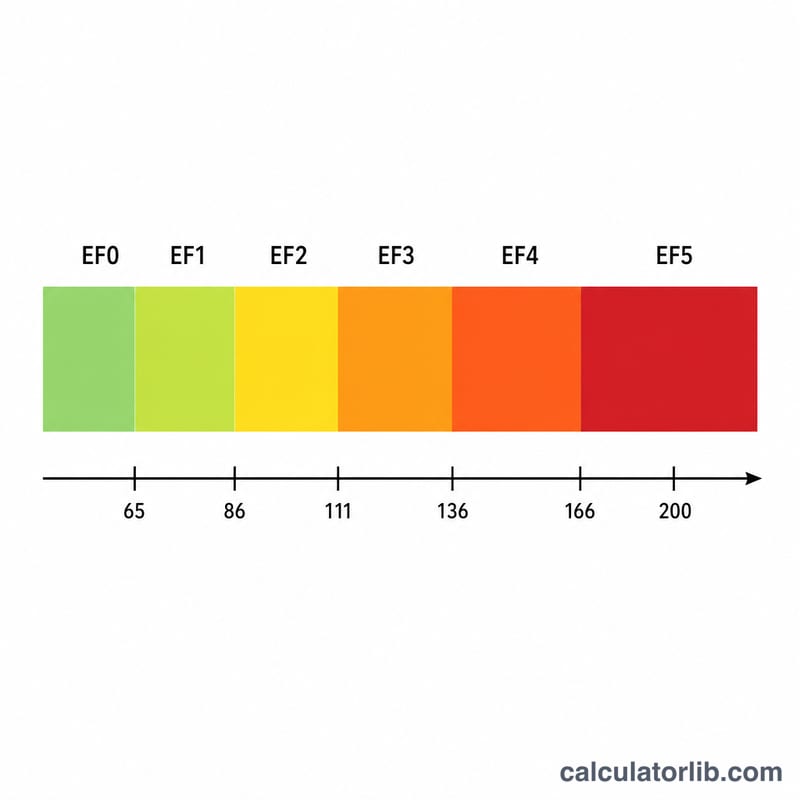
Worked Example
Suppose a tornado produces an estimated 3-second gust of 150 mph. That value falls in the 136–165 mph band, so the tornado is rated EF3 — a strong tornado capable of severe damage, including leveling well-constructed houses and uprooting trees. A 250 km/h gust converts to about 155.3 mph, which is also EF3.
$$\frac{250}{1.609344} \approx 155.3 \text{ mph}$$EF Scale Categories, Wind Speeds and Typical Damage
The Enhanced Fujita (EF) Scale is the system used by the U.S. National Weather Service (NWS) to rate tornado intensity. It has been in use in the United States since February 2007. The wind speeds below are estimated 3-second gusts. They are not measured values.
| EF rating | 3-second gust (mph) | Approx. km/h | Descriptor | Typical damage (NWS guidance, summarized) |
|---|---|---|---|---|
| EF0 | 65–85 | 105–137 | Weak | Light damage: shingles peeled off roofs, damage to gutters and siding, branches broken off trees, shallow-rooted trees pushed over. |
| EF1 | 86–110 | 138–177 | Weak | Moderate damage: roof surfaces badly stripped, mobile homes overturned or badly damaged, exterior doors lost, windows and glass broken. |
| EF2 | 111–135 | 178–217 | Strong | Considerable damage: roofs torn off well-constructed houses, frame homes shifted off foundations, mobile homes destroyed, large trees snapped or uprooted, cars lifted off the ground. |
| EF3 | 136–165 | 218–266 | Strong | Severe damage: entire stories of well-constructed houses destroyed, severe damage to large buildings such as shopping malls, trains overturned, heavy cars lifted and thrown. |
| EF4 | 166–200 | 267–322 | Violent | Devastating damage: well-constructed houses and whole frame houses leveled, cars thrown, large missiles generated. |
| EF5 | Over 200 | Over 322 | Violent | Incredible damage: strong frame houses swept away from their foundations, steel-reinforced concrete structures critically damaged, tall buildings collapse or are severely deformed, vehicles thrown considerable distances. |
Winds below 65 mph (about 105 km/h) fall below the EF0 threshold. The calculator reports them as "Below EF0". The km/h values are rounded conversions of the mph ranges.
Interpreting Your EF Rating
The EF categories are commonly grouped by severity:
- Weak (EF0–EF1): Gusts of about 65–110 mph. Damage is mostly to roofing, siding, trees and mobile homes. These are the most common tornadoes.
- Strong (EF2–EF3): Gusts of about 111–165 mph. Well-built homes can lose roofs or entire upper stories, and large trees are snapped or uprooted.
- Violent (EF4–EF5): Gusts above about 165 mph. Well-built homes can be leveled or swept away. These are rare but cause a disproportionate share of tornado deaths.
Keep these limits in mind when you use a wind-to-EF conversion:
- Official ratings come from damage, not wind measurement. NWS meteorologists survey the damage after the event. They compare it with a set of damage indicators and degrees of damage, and then assign the rating. Wind speed is almost never measured directly inside a tornado.
- The speeds are estimates. Each EF range is the wind speed estimated to cause the observed damage. Construction quality, tree health and debris can shift the result. A calculator can only tell you which category a given gust value falls in.
- The speed is a 3-second gust, not a sustained wind. It is a short peak value, so it is higher than the sustained wind speeds used for hurricane categories. The two scales should not be compared directly.
- The rating reflects maximum damage, not size. A tornado is rated by the most intense damage found anywhere along its path. The rating says nothing about the tornado's width, path length or duration. A narrow, short-lived tornado can be rated EF4, while a wide, long-track tornado can be rated EF1.
- The original Fujita (F) scale is not directly comparable. The F scale (1971) used different wind-speed estimates, which were later judged too high for the damage seen. For example, F5 was originally associated with winds of roughly 261–318 mph. Older F ratings therefore do not map one-to-one onto EF categories, and historical tornadoes should be compared with care.
The EF scale is the official system in the United States. Other countries may use different scales, such as the TORRO scale in the UK and Europe, or their own adaptations. This is general educational information. For safety decisions, follow guidance from your local weather authority.
FAQ
Is the EF Scale based on wind speed or damage? Both. Surveyors assess damage indicators, then assign the EF rating tied to the estimated wind speed that caused that damage.
What is the strongest possible rating? EF5, for gusts over 200 mph — these are extremely rare and devastating.
Does this apply worldwide? The EF Scale is the official standard in the US and Canada; other countries may use the original Fujita Scale or the international IF Scale, though the wind bands are similar.