
What this calculator does
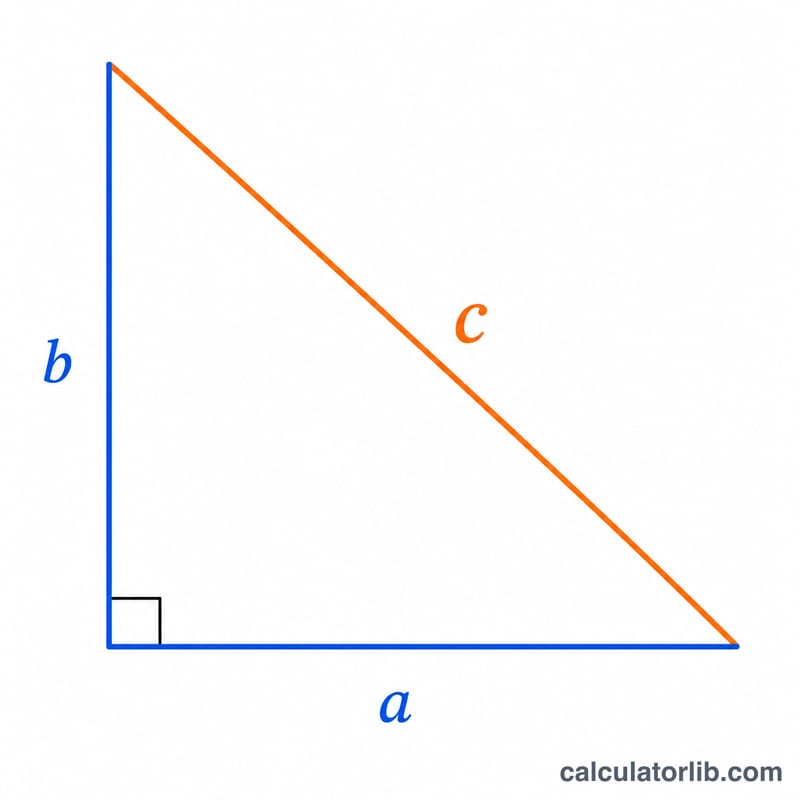
This tool finds the length of the missing leg of a right triangle when you already know the hypotenuse (the longest side, opposite the right angle) and one of the two legs. It rearranges the Pythagorean theorem to solve directly for the unknown side, giving you an exact result in a single step.
How to use it
Enter the hypotenuse c and the known leg a in the same units. The calculator returns the second leg b. Be sure the hypotenuse is the largest value — if the known leg is longer than or equal to the hypotenuse, no real right triangle exists and the result will be zero.
The formula explained
The Pythagorean theorem states that for a right triangle, \(a^2 + b^2 = c^2\). To isolate the missing leg, subtract \(a^2\) from both sides and take the square root:
$$b = \sqrt{c^2 - a^2}$$
Because we subtract the square of the known leg from the square of the hypotenuse, the value under the root must stay positive for a valid triangle.
Worked example
Suppose the hypotenuse is \(c = 5\) and the known leg is \(a = 3\). Then $$b = \sqrt{5^2 - 3^2} = \sqrt{25 - 9} = \sqrt{16} = 4.$$ This is the classic 3-4-5 right triangle.
FAQ
What if a is larger than c? The hypotenuse is always the longest side of a right triangle, so a leg cannot exceed it. If \(a \geq c\), the equation has no real solution and the calculator returns 0.
Can I use any units? Yes — centimeters, inches, meters, anything. Just keep both inputs in the same unit and the answer will be in that unit.
Does the order of the legs matter? No. The two legs are interchangeable; the formula simply solves for whichever leg you did not enter.