
What this calculator does
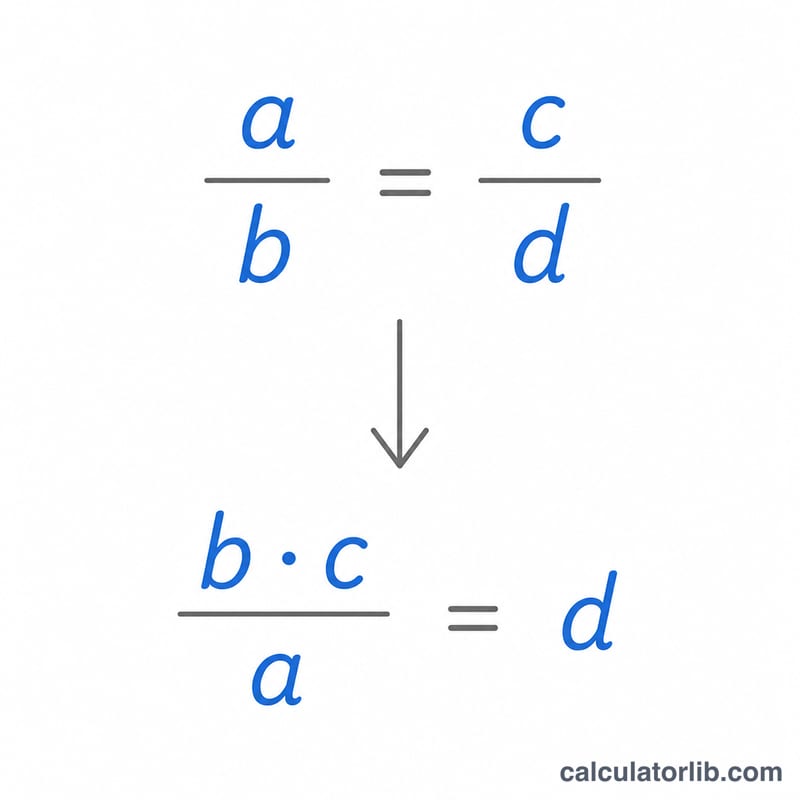
A proportion states that two ratios are equal: \(a/b = c/d\). This solver lets you choose which of the four terms is unknown, enter the other three, and instantly compute the missing value using cross-multiplication. It is a universal algebra tool useful for scaling recipes, converting units, working out map distances, mixing solutions, and solving similar-triangle problems.
How to use it
Pick the variable you want to solve for (a, b, c, or d). Fill in the three known values; the field for your chosen unknown can be left blank or contain any placeholder. Press calculate and the answer appears, along with the rearranged formula that was applied.
The formula explained
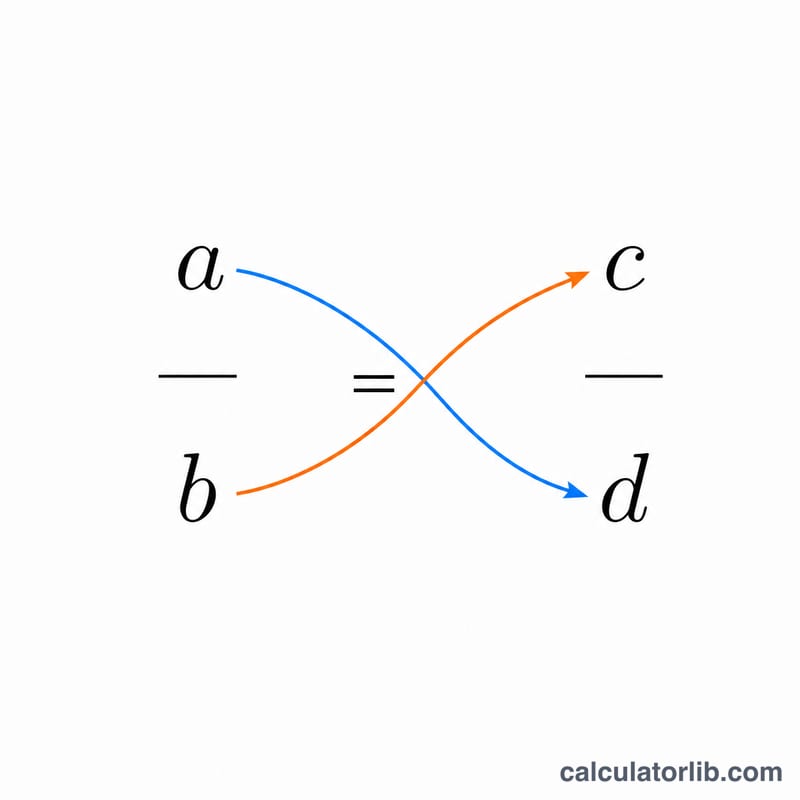
Every proportion \(a/b = c/d\) is equivalent to the cross-product equation \(a \cdot d = b \cdot c\) (the product of the extremes equals the product of the means). Solving that single equation for each variable yields:
- $$a = \frac{b \cdot c}{d}$$
- $$b = \frac{a \cdot d}{c}$$
- $$c = \frac{a \cdot d}{b}$$
- $$d = \frac{b \cdot c}{a}$$
The denominator in each case is the term diagonally opposite the unknown, so a zero there makes the answer undefined.
Worked example
Suppose \(3/4 = 6/d\) and you want d. Using $$d = \frac{b \cdot c}{a} = \frac{4 \cdot 6}{3} = \frac{24}{3} = 8$$ Check: \(3/4 = 0.75\) and \(6/8 = 0.75\), so the proportion holds.
FAQ
Can the numbers be decimals or negatives? Yes. The calculator accepts any real numbers, including fractions written as decimals and negative values.
Why do I get "Undefined"? The diagonal term used as the divisor is zero. For example, solving for a when \(d = 0\) is impossible because it would require dividing by zero.
Is this the same as cross-multiplying by hand? Exactly — it automates the cross-multiply-and-divide steps you would do manually, eliminating arithmetic mistakes.