What Is Wheel Offset?
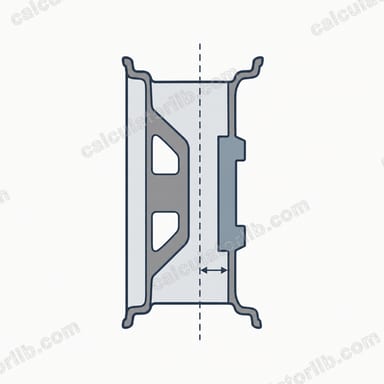
Wheel offset, often labeled ET (from the German Einpresstiefe), is the distance between the wheel's mounting hub face and its true centerline, measured in millimeters. A positive offset puts the hub mounting surface toward the front (street) side of the wheel, pulling the wheel inward. A negative offset pushes the wheel outward for a deep-dish, aggressive stance. Zero offset means the hub sits exactly on the centerline.

How to Use This Calculator
Enter your wheel's overall width in inches and its backspacing in inches (the distance from the back lip of the wheel to the hub mounting surface). The calculator converts both to millimeters and returns the offset in mm, the standard unit stamped on most wheels.
The Formula Explained
The centerline of a wheel sits at exactly half its overall width. Backspacing measures from the rear flange to the mounting face. So the offset is simply how far the mounting face lies from that centerline:
$$\text{Offset (mm)} = \text{Backspacing (mm)} - \left( \frac{\text{Wheel Width (mm)}}{2} \right)$$
Both inputs are multiplied by 25.4 to convert inches to millimeters before the subtraction.

Worked Example
Suppose you have a 9-inch-wide wheel with 4.5 inches of backspacing. Convert: width = \(9 \times 25.4 = 228.6\) mm; backspacing = \(4.5 \times 25.4 = 114.3\) mm. Half the width = 114.3 mm. Offset = \(114.3 - 114.3 = 0\)... but note that the overall stated width usually excludes the lip allowance. Using exact values: $$114.3 - \left( \frac{228.6}{2} \right) = 114.3 - 114.3 = 0 \text{ mm}$$ for the bare math; a 9in / 4.45in pairing gives \(-1.27\) mm, a slightly negative (outward) offset.
Typical Wheel Offset Ranges by Vehicle Type
The table shows commonly seen offset (ET) ranges in millimeters. They are general guidelines only. The vehicle manufacturer's specification for wheel size and offset always takes priority, because brakes, suspension geometry, fender clearance and load ratings differ by model.
| Vehicle type | Typical ET range (mm) |
|---|---|
| Most front-wheel-drive and economy cars | about +35 to +50 |
| Modern sport and performance cars | about +25 to +45 |
| Rear-wheel-drive muscle cars and classic cars | about 0 to +30 |
| Trucks and SUVs (stock) | about +10 to +35 |
| Lifted or off-road trucks and SUVs | roughly -44 to 0, or lower |
| Deep-dish or show fitments | about -20 to -50 or more |
A positive ET means the mounting surface sits toward the outside of the wheel's centerline, zero ET means it is exactly on the centerline, and a negative ET means it sits toward the inside.
Interpreting Your Offset Result
Offset is the distance in millimeters from the wheel's centerline to its hub mounting surface. Each 1 mm change in offset moves the wheel face 1 mm in or out relative to the hub.
- Lower offset (more negative) moves the wheel outward, toward the fender.
- Higher offset (more positive) moves the wheel inward, toward the suspension and brakes.
Worked example: an 8 in wide wheel with 5.5 in of backspacing gives \(ET = 25.4 \times (5.5 - \tfrac{8}{2}) = 25.4 \times 1.5 = \) 38.1 mm, a positive offset.
Effects to consider
- Clearance: too little offset can cause the tire to rub the fender or body. Too much can push the inner wheel or tire into the struts, springs, control arms or brake calipers.
- Scrub radius: moving the wheel outward generally increases scrub radius, which can add steering effort and sensitivity to bumps and braking forces. Moving it inward generally reduces it. The effect depends on the vehicle's steering geometry.
- Track width: the track width of an axle changes by twice the offset change, because both wheels move. A 10 mm lower ET widens the track by about 20 mm.
Comparing with stock
Subtract the new ET from the stock ET: \(\Delta = ET_{stock} - ET_{new}\). A positive result means the wheel face moves outward by that many mm. A negative result means it moves inward. If the new wheel is wider, the extra width is split evenly: half goes to the outboard side and half to the inboard side. For example, going from 7 in to 8 in wide (25.4 mm wider) at the same ET adds about 12.7 mm to each side. Always check the actual clearances before committing to a fitment.
Inches to Millimeters Conversion for Common Wheel Widths and Backspacing
1 in = 25.4 mm exactly, so multiply inches by 25.4 to get millimeters.
| Wheel width (in) | Width (mm) |
|---|---|
| 6 | 152.4 |
| 7 | 177.8 |
| 8 | 203.2 |
| 8.5 | 215.9 |
| 9 | 228.6 |
| 9.5 | 241.3 |
| 10 | 254.0 |
| 10.5 | 266.7 |
| 11 | 279.4 |
| 12 | 304.8 |
| Backspacing (in) | Backspacing (mm) |
|---|---|
| 4.0 | 101.6 |
| 4.5 | 114.3 |
| 5.0 | 127.0 |
| 5.5 | 139.7 |
| 6.0 | 152.4 |
| 6.5 | 165.1 |
| 7.0 | 177.8 |
Reverse relation
To find backspacing from a known offset:
$$\text{Backspacing (mm)} = ET + \frac{ \text{Width (mm)} }{2}$$
Example: a wheel 203.2 mm wide with ET +38.1 has backspacing \(38.1 + 101.6 = 139.7\) mm, which is 5.5 in.
FAQ
What's the difference between offset and backspacing? Backspacing is a physical distance from the back edge of the wheel; offset is measured from the centerline. They are related but not the same number.
Is a negative offset bad? Not at all — negative offsets create a wider, more aggressive track and deep-dish look, but they can increase fender clearance and steering load.
Why is offset in mm but width in inches? Wheel widths are traditionally quoted in inches, while offset (ET) is an industry standard expressed in millimeters.