
What This Calculator Does
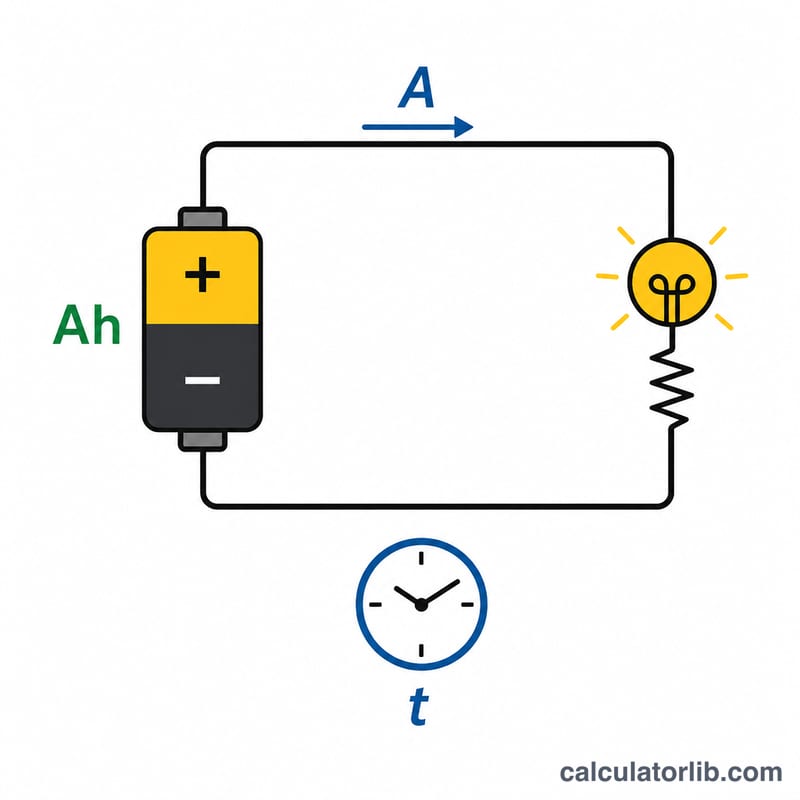
The Battery Discharge Time Calculator estimates how long a battery can power a constant load before it reaches its safe cutoff. It takes the battery capacity in amp-hours (Ah), the steady load current in amps (A), and the usable depth of discharge (DoD) as a percentage, then returns the expected runtime in hours and minutes.
How to Use It
Enter the rated capacity printed on the battery (for example 100 Ah). Enter the current your device draws in amps. Set the depth of discharge — most lead-acid batteries are limited to about 50% to protect their lifespan, while lithium (LiFePO4) packs commonly allow 80%–100%. Press calculate to see runtime.
The Formula Explained
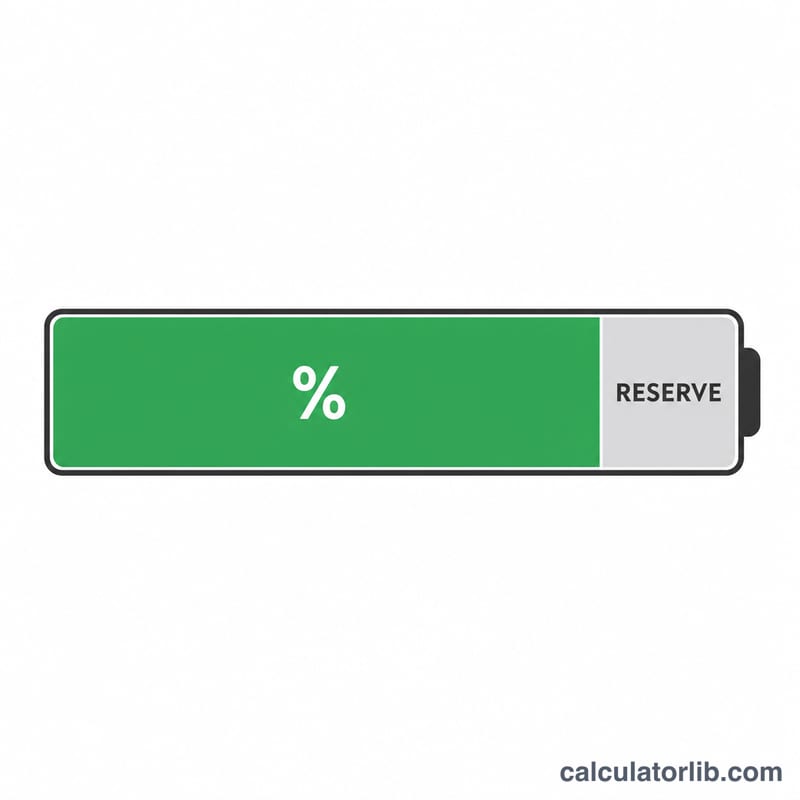
Runtime equals usable capacity divided by load current: $$t = \frac{\text{Capacity (Ah)} \times \dfrac{\text{DoD (\%)}}{100}}{\text{Load Current (A)}}$$ The DoD factor converts rated capacity into the energy you can actually use without harming the battery. For instance, draining a 100 Ah battery only to 80% gives 80 usable Ah.
Worked Example
A 100 Ah battery powers a 5 A load with an 80% usable DoD. Usable capacity = \(100 \times 0.80 = 80\) Ah. Runtime $$\frac{80}{5} = 16 \text{ hours}$$ The calculator reports 16 hours (16h 0m).
Recommended Depth of Discharge by Battery Type
Depth of discharge (DoD) is the percentage of a battery's rated capacity you can safely use on each cycle. Discharging deeper than recommended shortens cycle life dramatically, so usable capacity in the runtime formula \(t = \frac{Ah \times DoD}{A}\) should reflect the realistic DoD for your chemistry — not 100% of the nameplate amp-hours.
| Battery Type | Recommended Usable DoD | Typical Cycle-Life Impact |
|---|---|---|
| Flooded lead-acid | 50% | Regular discharges past 50% sharply reduce cycle count; shallow cycling extends life. |
| AGM (sealed lead-acid) | 50% (up to 80% occasional) | More tolerant than flooded, but routine 80% cycling still cuts lifespan. |
| Gel | 50–60% | Sensitive to deep discharge and high current; gentle cycling preferred. |
| LiFePO4 (lithium iron phosphate) | 80–100% | Handles deep cycling well; 2,000–5,000+ cycles even at high DoD. |
| Li-ion (NMC/Li-po) | 80–90% | Avoiding the top and bottom few percent extends overall life. |
For example, a 100 Ah flooded lead-acid bank only delivers about 10 hours at a 5 A load when limited to 50% DoD, whereas a 100 Ah LiFePO4 at 80% DoD runs noticeably longer.
Runtime Across Common Scenarios
The table below applies \(t = \frac{Ah \times DoD/100}{A}\) to several realistic setups. Usable energy is the rated capacity multiplied by the depth of discharge; runtime is that usable amp-hour figure divided by the load current.
| Capacity (Ah) | Load (A) | DoD | Usable (Ah) | Runtime (h) |
|---|---|---|---|---|
| 100 | 5 | 50% | 50 | 10.0 |
| 100 | 5 | 80% | 80 | 16.0 |
| 200 | 10 | 80% | 160 | 16.0 |
| 50 | 2 | 100% | 50 | 25.0 |
| 120 | 8 | 50% | 60 | 7.5 |
These figures are idealized. Real runtime is reduced by inverter losses, temperature, battery age, and the Peukert effect, which lowers effective lead-acid capacity at higher discharge currents. Add a 10–20% margin for planning.
Key Terms Explained
- Amp-hour (Ah)
- A measure of charge capacity equal to one ampere flowing for one hour. A 100 Ah battery can theoretically supply 100 A for 1 hour, 10 A for 10 hours, and so on.
- Load current (A)
- The steady current in amperes drawn by the connected devices. Higher current drains the battery faster and, for lead-acid, reduces effective capacity.
- Depth of discharge (DoD)
- The percentage of rated capacity actually used before recharging. A 30% DoD means 70% of the charge remains; deeper DoD gives more runtime but fewer lifetime cycles.
- State of charge (SoC)
- The remaining charge expressed as a percentage of full capacity — essentially the inverse of DoD. 100% SoC is full; 100% SoC minus 80% DoD leaves 20% SoC.
- Peukert effect
- The tendency of a battery (especially lead-acid) to deliver less usable capacity as the discharge current increases. It is described by Peukert's law, \(t = H\left(\frac{C}{I H}\right)^{k}\), where the exponent \(k\) is typically about 1.1–1.3 for lead-acid and near 1.0 for LiFePO4.
- C-rate
- A measure of discharge or charge current relative to capacity. A 1C rate discharges the full capacity in one hour, 0.5C in two hours, and 2C in half an hour. For a 100 Ah battery, 1C equals 100 A.
FAQ
Why is real runtime often shorter? The Peukert effect means high discharge rates reduce effective capacity, and temperature, age, and inverter losses also cut runtime. Treat this as an ideal estimate.
What DoD should I use? Use 50% for flooded/AGM lead-acid, and 80%–100% for lithium chemistries, depending on the manufacturer recommendation.
How do I convert watts to amps? Divide the device wattage by the battery voltage. A 60 W device on a 12 V battery draws \(60 \div 12 = 5\) A.