What is the Boat Capacity Calculator?
This calculator estimates the maximum number of people a small recreational boat can safely carry. It uses the widely quoted United States Coast Guard rule of thumb for monohull boats under 20 feet. It is a guideline for US waters; the capacity plate on your boat, which is set by the manufacturer, always takes precedence, and boats that are not monohulls or that exceed 20 feet follow different rules.
How to use it
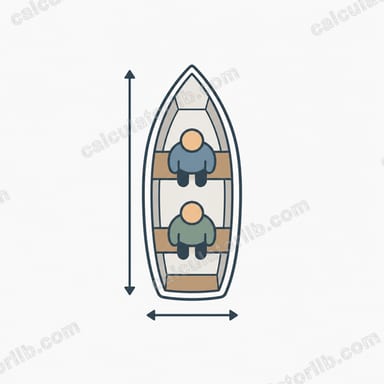
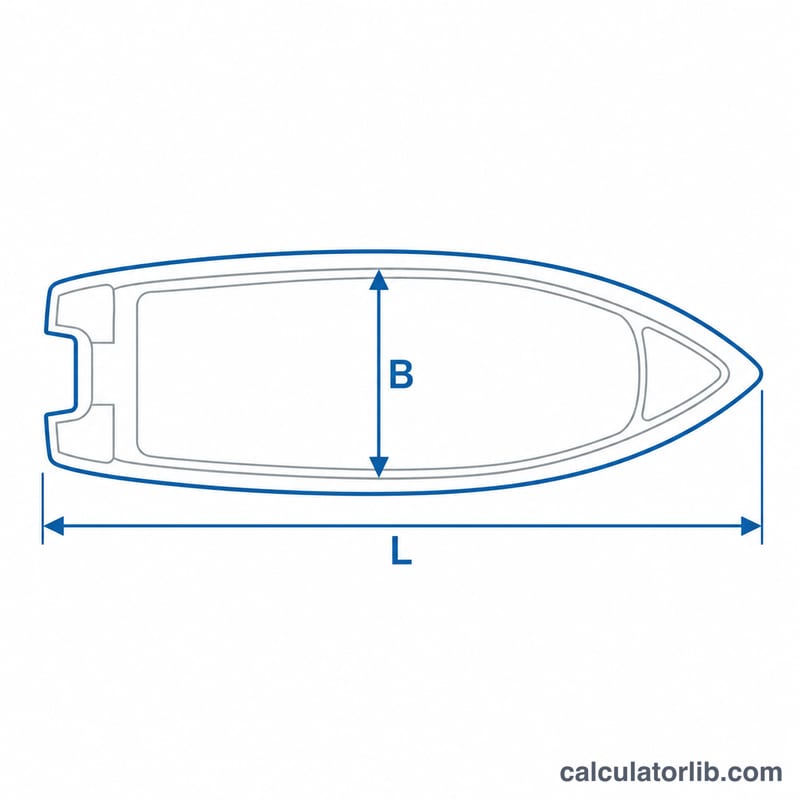
Choose feet or meters, then enter the overall boat length and the beam (the widest point). The tool converts metric values to feet, computes the deck area, divides by 15, and rounds down to a whole number of persons.
The formula explained
Let \(L\) be length in feet and \(B\) be beam in feet:
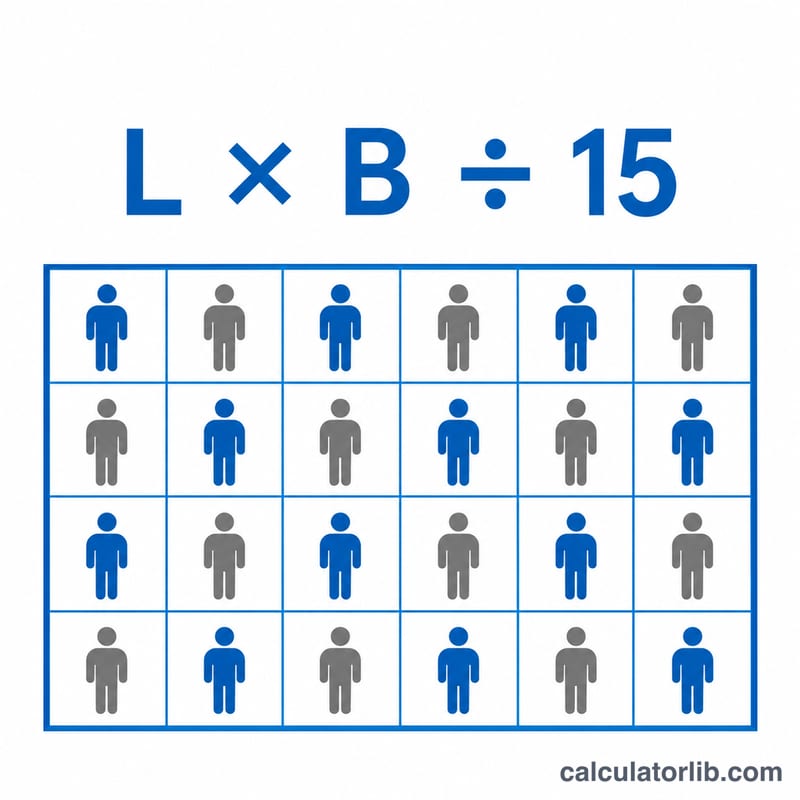
$$\text{Persons} = \left\lfloor \frac{L \times B}{15} \right\rfloor$$The result assumes an average of 150 lb per person, so the total weight is \(\text{Persons} \times 150\) lb. Rounding down keeps the estimate on the safe side.
Worked example
A boat is 16 ft long with a 6 ft beam:
$$\frac{16 \times 6}{15} = \frac{96}{15} = 6.4 \Rightarrow 6\ \text{persons}$$The total person weight is \(6 \times 150 = 900\) lb.
Capacity Estimates for Common Boat Sizes
This table applies the US Coast Guard rule of thumb, \(\text{Persons} = \lfloor L \times B \div 15 \rfloor\), with weight taken as 150 lb per person. Lengths and beams are in feet. The rule is an estimate for small monohull boats. A capacity plate on the boat, where one is fitted, always takes priority.
| Length × Beam (ft) | Deck area L×B (ft²) | L×B ÷ 15 (raw) | Persons (rounded down) | Weight at 150 lb/person (lb) |
|---|---|---|---|---|
| 12 × 5 | 60 | 4.00 | 4 | 600 |
| 14 × 5.5 | 77 | 5.13 | 5 | 750 |
| 16 × 6 | 96 | 6.40 | 6 | 900 |
| 18 × 7 | 126 | 8.40 | 8 | 1,200 |
| 19 × 7.5 | 142.5 | 9.50 | 9 | 1,350 |
Example: for a 16 ft × 6 ft boat, \(\frac{16 \times 6}{15} = \frac{96}{15} = 6.4\), which rounds down to 6 persons. The weight is \(6 \times 150 = 900\) lb. The result is always rounded down, never up, so a fractional seat is not counted.
Metric to Feet Conversion for Boat Dimensions
The rule of thumb is defined in feet. Metric dimensions are converted with 1 m = 3.28084 ft. Area converts with 1 m² = 10.7639 ft².
| Length (m) | Length (ft) |
|---|---|
| 3.5 | 11.48 |
| 4 | 13.12 |
| 5 | 16.40 |
| 5.5 | 18.04 |
| 6 | 19.69 |
| Beam (m) | Beam (ft) |
|---|---|
| 1.5 | 4.92 |
| 1.8 | 5.91 |
| 2 | 6.56 |
| 2.4 | 7.87 |
Worked example: a boat 5 m long and 2 m wide has a deck area of \(5 \times 2 = 10\) m², which is \(10 \times 10.7639 = 107.639\) ft². Then \(\frac{107.639}{15} \approx 7.18\), which rounds down to 7 persons.
Boating Terms Used in the Calculation
- Length overall (LOA): the length of the hull measured from the foremost point of the bow to the aftermost point of the stern. Outboard motors, brackets and similar attachments are normally not included. Use the hull length.
- Beam: the width of the boat at its widest point, measured across the hull from side to side.
- Monohull: a boat with a single hull, as opposed to a catamaran or trimaran. The rule of thumb is meant for small monohull powerboats and is not reliable for multihulls, pontoon boats or sailboats.
- Capacity plate (US Coast Guard): a label required in the United States on most monohull boats under 20 ft, with exceptions such as sailboats, canoes, kayaks and inflatables. It states the maximum persons capacity, the maximum weight capacity and, for powered boats, the maximum horsepower. The plate is a US rule. Other countries use their own standards, such as the EU Recreational Craft Directive/ISO 6185 and ISO 12217 ratings.
- Persons capacity vs. weight capacity: persons capacity is the number of people considered safe. Weight capacity is the total load of people, motor, fuel and gear. This calculator assumes 150 lb per person. Heavier passengers or extra gear reduce the safe number of people.
- Deck area: length × beam, in ft² (or m²). It is a simple rectangular approximation, because real hulls taper at the bow, so true usable area is smaller.
- How length and beam are measured for this rule: use length in feet and the widest beam in feet. For metric input, convert with 1 m = 3.28084 ft first. Then multiply the two values, divide by 15 and round down to a whole number of persons.
This is general information. Always follow the manufacturer's capacity plate and local boating regulations, and reduce loads in rough water or bad weather.
FAQ
Does this replace the capacity plate?
No. The plate on your boat reflects tested limits for weight, persons and engine power. Never exceed it.
Should I carry fewer people in rough water?
Yes. Rough weather, heavy gear, or heavier passengers mean you should carry fewer people than the formula suggests.
Does the formula work for pontoon or large boats?
It is intended for small monohulls under 20 ft. Pontoons, catamarans and larger vessels use different capacity criteria.