What is the Coffee Ratio Calculator?
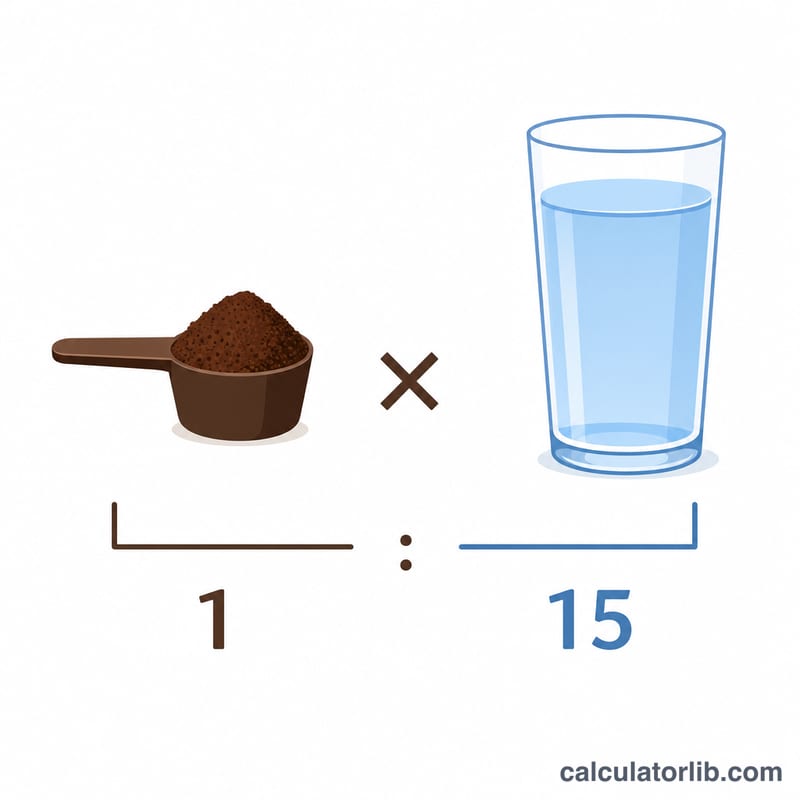
The Coffee Ratio Calculator turns your coffee dose and preferred brew ratio into the exact amount of water you should use. Baristas describe strength as a ratio of coffee to water, written as 1:X — for example 1:15 means one gram of coffee for every 15 grams of water. Because 1 ml of water weighs about 1 gram, the water figure in grams is essentially the same as millilitres.
How to use it
Enter the weight of coffee you plan to brew in grams, then enter your brew ratio (the X in 1:X). Common ranges are 1:15 to 1:17 for filter/pour-over, 1:13 to 1:15 for a stronger cup, and lower numbers for more intense brews. The calculator multiplies the two values and also estimates how many standard 8 oz cups that makes.
The formula explained
The math is simple: $$\text{Water} = \text{Coffee} \times \text{Ratio}$$. The ratio is dimensionless, so the answer comes out in the same unit as the coffee — grams. We then divide by 236.588 ml (one US cup) to give a rough cup count for serving.
Worked example
Suppose you weigh out 20 g of coffee and want a balanced 1:15 brew. $$\text{Water} = 20 \times 15 = \mathbf{300}\ \textbf{g}$$ of water, which is roughly 300 ml or about 1.27 standard cups. Pour 300 g of hot water over your 20 g of grounds and you have a clean, repeatable recipe.
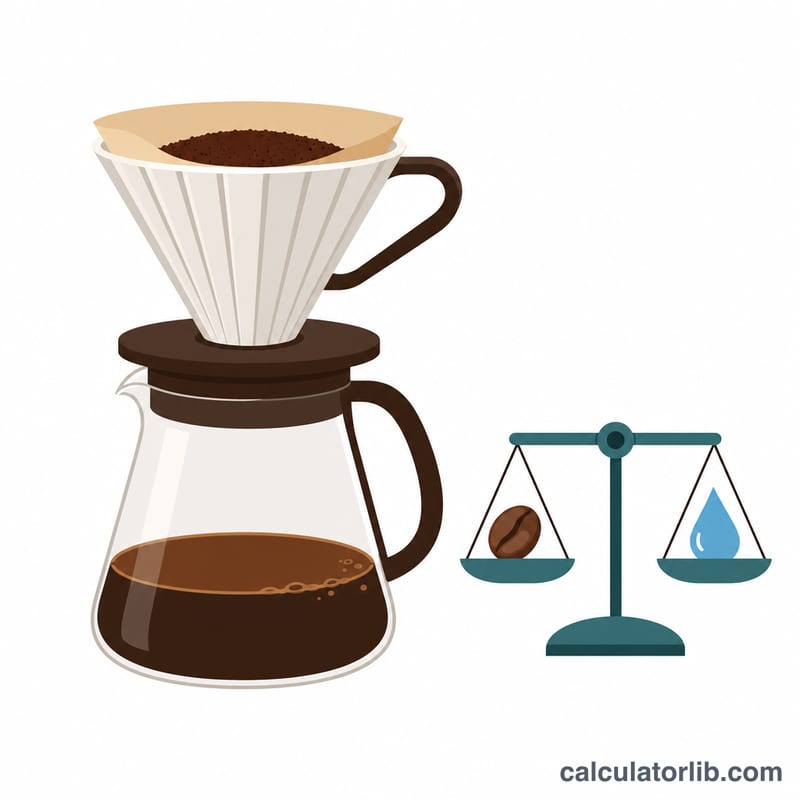
Typical Coffee-to-Water Ratios by Brew Method
A brew ratio of 1:X means 1 part coffee to X parts water by weight. Water (g) = coffee (g) × X. The ranges below are common starting points, not strict rules. Water amounts assume a 20 g coffee dose and are rounded to whole grams.
| Brew method | Typical ratio (1:X) | Water per 20 g coffee |
|---|---|---|
| Espresso | ~1:2 (range 1:1.5–1:3) | ~40 g (30–60 g) |
| Moka pot | ~1:7–1:10 | 140–200 g |
| AeroPress | ~1:6–1:15 | 120–300 g |
| Pour-over / V60 | ~1:15–1:17 | 300–340 g |
| Drip machine | ~1:15–1:18 | 300–360 g |
| French press | ~1:12–1:15 | 240–300 g |
| Cold brew concentrate | ~1:4–1:8 | 80–160 g |
| Cold brew ready-to-drink | ~1:8–1:12 | 160–240 g |
The Specialty Coffee Association (SCA) Golden Cup standard uses about 55 g of coffee per liter of water, which is roughly 1:18. Its acceptable range for filter coffee is roughly 1:15 to 1:18. Espresso, moka pot and concentrates are brewed far stronger and are meant to be diluted or drunk in small volumes.
Scenario Comparison: Dose and Ratio Side by Side
Water in grams is coffee dose × ratio. Approximate US cups are water (g) ÷ 236.588, using 1 g of water ≈ 1 mL and 1 US cup = 236.588 mL. Values are rounded to two decimals. Brewed volume will be somewhat lower than the water you pour, because the grounds absorb some of it.
| Coffee dose | 1:15 | 1:16 | 1:17 |
|---|---|---|---|
| 15 g | 225 g ≈ 0.95 cups | 240 g ≈ 1.01 cups | 255 g ≈ 1.08 cups |
| 20 g | 300 g ≈ 1.27 cups | 320 g ≈ 1.35 cups | 340 g ≈ 1.44 cups |
| 30 g | 450 g ≈ 1.90 cups | 480 g ≈ 2.03 cups | 510 g ≈ 2.16 cups |
| 60 g | 900 g ≈ 3.80 cups | 960 g ≈ 4.06 cups | 1020 g ≈ 4.31 cups |
Worked example: 20 g of coffee at 1:16 gives \(20 \times 16 = 320\) g of water, and \(320 \div 236.588 \approx 1.35\) US cups.
Interpreting Your Ratio: Strength and Taste
The ratio mainly sets how concentrated the brew is. A lower X, such as 1:13, uses more coffee per unit of water. It usually tastes stronger, heavier and more intense. A higher X, such as 1:17 to 1:18, gives a lighter, more delicate and often tea-like cup. Moving one or two points in either direction is a simple way to fine-tune a recipe.
The SCA brew control chart describes a balanced filter brew as having about 1.15–1.35% total dissolved solids (TDS) and an extraction yield of about 18–22%. TDS measures strength, meaning how much dissolved coffee is in the cup. Extraction yield measures how much of the dry coffee mass ended up in the water. Changing the ratio mostly moves you along the strength axis of this chart.
- Grind size: finer grinds extract more, and coarser grinds extract less.
- Brew time: longer contact usually raises extraction.
- Water temperature: hotter water generally extracts faster.
- Agitation, roast level and coffee freshness also change the result.
Ratio alone does not determine taste. Two brews at the same 1:16 can taste sour and thin (under-extracted) or bitter and harsh (over-extracted) if the other variables differ. A practical approach is to pick a ratio, keep it fixed, and adjust grind and time until the cup tastes balanced. Then change the ratio in small steps to match your preferred strength.
FAQ
Is grams of water the same as ml? Practically yes — water has a density of ~1 g/ml at brewing temperatures, so 300 g ≈ 300 ml.
What ratio should I start with? 1:16 is a great all-rounder for pour-over. Lower the number for stronger coffee, raise it for a lighter cup.
Does this work for espresso? Espresso uses much tighter ratios (around 1:2). You can enter a ratio of 2 to size an espresso shot, though brew temperature and pressure matter too.