What Is Cost Per Unit?
Cost per unit, also called unit price, tells you how much you pay for a single item, ounce, gram, or any other unit of a product. It's the simplest and most powerful tool for comparison shopping: a larger package isn't always the better deal, and a "sale" price doesn't always beat the regular size. By reducing every option to a single per-unit figure, you can compare apples to apples in seconds.
How to Use This Calculator
Enter the total price you pay for the package or batch, then enter the quantity — the number of units it contains (e.g. number of cans, kilograms, liters, or sheets). Click calculate and you'll instantly see the cost per unit. Repeat for a competing product and compare the two unit prices: the lower number is the better value.
The Formula Explained
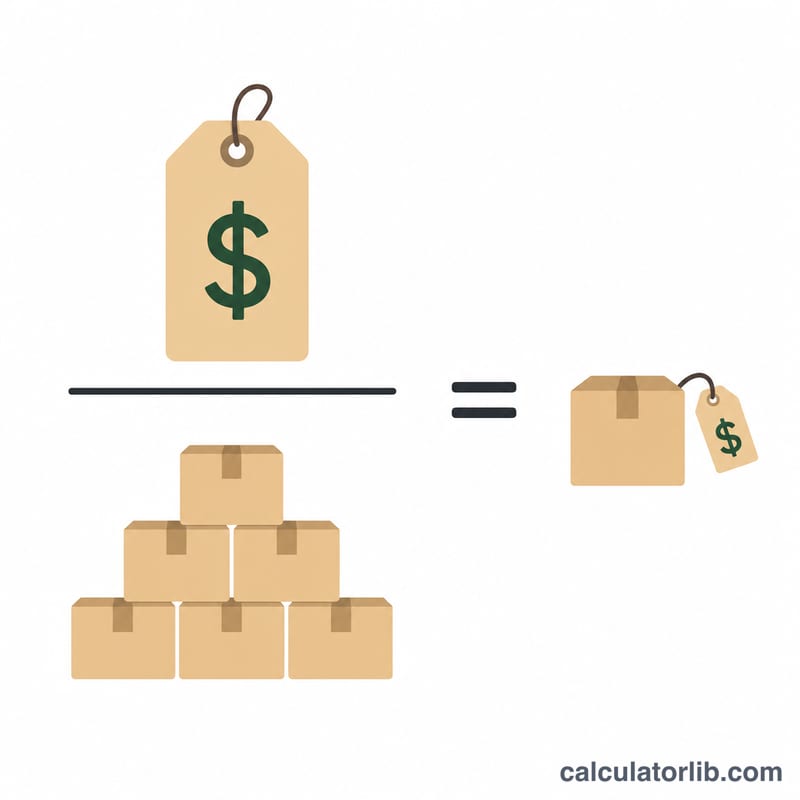
The math is straightforward:
$$\text{Unit Price} = \frac{\text{Total Price}}{\text{Quantity}}$$
If a 6-pack of soda costs $12.99, the unit price is \(12.99 \div 6 = \$2.165\) per can. Keep your units consistent — if you measure quantity in grams, the result is cost per gram; if in liters, it's cost per liter.
Worked Example
You're comparing two bags of rice. Bag A costs $8.50 for 5 kg, giving \(8.50 \div 5 = \$1.70\) per kg. Bag B costs $15.00 for 10 kg, giving \(15.00 \div 10 = \$1.50\) per kg. Even though Bag B has a higher sticker price, it's cheaper per kilogram, making it the smarter buy.
Unit Price Comparison Scenarios
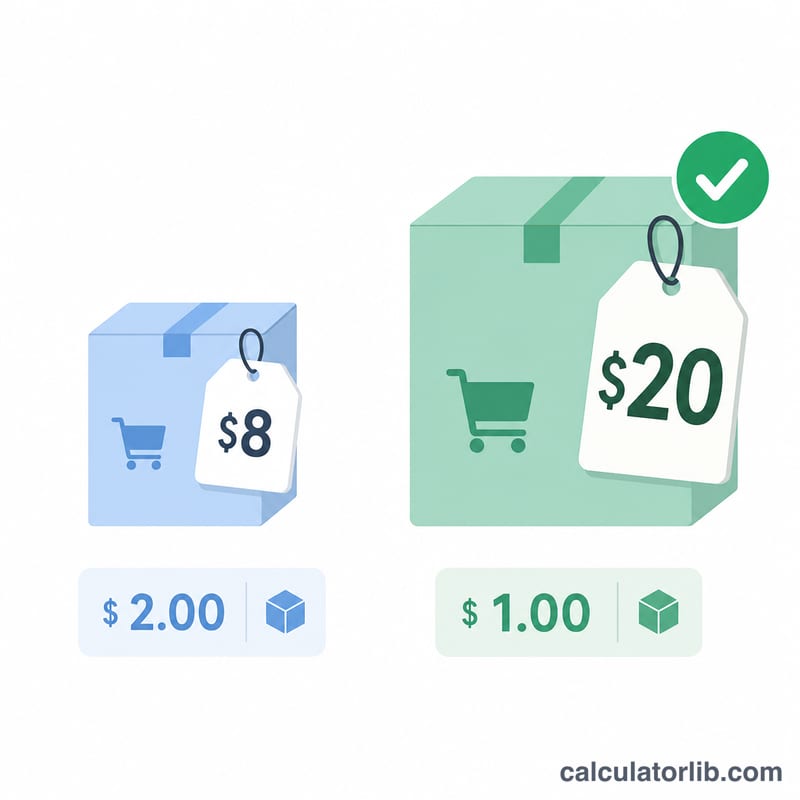
Each pair below is computed with the same formula, \( \text{Cost Per Unit} = \text{Total Price} \div \text{Quantity} \). The Quantity column states the number of units entered, and the unit basis is named for every row — a unit price is meaningless until you know whether it is per can, per 100 g, per roll, per litre or per pound. Prices shown are illustrative examples, not current market prices.
| Product / Option | Total Price | Quantity (with unit) | Unit Price | Better Value? |
|---|---|---|---|---|
| Soda, 6-pack cans | $12.99 | 6 cans | $2.1650 per can | No |
| Soda, 12-pack cans | $22.99 | 12 cans | $1.9158 per can | Yes — $0.2492/can less |
| Coffee, 500 g bag | $11.00 | 5 × 100 g | $2.20 per 100 g | No |
| Coffee, 1 kg bag | $19.50 | 10 × 100 g | $1.95 per 100 g | Yes — $0.25/100 g less |
| Paper towel, 12 rolls | $14.99 | 12 rolls | $1.2492 per roll | Yes — $0.1658/roll less |
| Paper towel, 6 rolls | $8.49 | 6 rolls | $1.4150 per roll | No |
| Juice, 2 L bottle (bigger is not cheaper) | $5.49 | 2 L | $2.7450 per L | No |
| Juice, 1 L bottle | $2.19 | 1 L | $2.1900 per L | Yes — $0.5550/L less |
| Rice, 10 lb bulk bag (regular price) | $12.99 | 10 lb | $1.2990 per lb | No |
| Rice, 2 lb bag on promotion | $1.99 | 2 lb | $0.9950 per lb | Yes — a discounted small size beats the bulk bag by $0.3040/lb |
Two substitutions in full, so the arithmetic is visible:
$$\text{12-pack soda} = \frac{\$22.99}{12\ \text{cans}} = \$1.9158\ \text{per can}$$
$$\text{2 L juice} = \frac{\$5.49}{2\ \text{L}} = \$2.7450\ \text{per L} \;>\; \frac{\$2.19}{1\ \text{L}} = \$2.1900\ \text{per L}$$
The last two pairs are the reason to compute rather than assume: the larger juice bottle and the bulk rice bag both carry the higher unit price in these examples. Package size and unit price are independent — only the division settles it.
Unit Conversions for Price Comparison
Dividing price by quantity only produces comparable figures when both options are expressed in the same unit. Convert first, then divide. The factors below are exact or standard definitions; the US customary volume units (fluid ounce, quart, gallon) differ from UK imperial units of the same name, so the US values are labelled as such.
| Quantity type | Conversion |
|---|---|
| Mass | 1 lb = 16 oz = 453.592 g |
| Mass | 1 kg = 1000 g = 2.20462 lb = 35.274 oz |
| Volume (US) | 1 US fl oz = 29.5735 mL |
| Volume (US) | 1 US gallon = 128 US fl oz = 3.78541 L |
| Volume | 1 L = 1000 mL = 33.814 US fl oz |
| Volume (US) | 1 US quart = 0.946353 L |
| Area | 1 ft² = 144 in² = 0.092903 m² |
Per-unit bases retailers commonly print on shelf tags
- Per 100 g and per 100 mL — typical for packaged food and drink in the EU, UK, Australia and much of Asia.
- Per kg and per L — used for larger packs and loose produce in metric markets.
- Per oz, per lb, per fl oz, per quart — typical on US shelf tags.
- Per count / per each / per roll / per sheet / per ft² — used for discrete items such as eggs, nappies, batteries, paper towels and flooring.
Convert before comparing — one-line example
A 16 oz bag versus a 500 g bag: convert the imperial pack first, \( 16\ \text{oz} \times 28.3495\ \text{g/oz} = 453.6\ \text{g} \), so if that bag costs $4.29 its price is \( \$4.29 \div 4.536 = \$0.9458 \) per 100 g, which you then compare against the 500 g bag's \( \$4.75 \div 5 = \$0.9500 \) per 100 g — a gap of less than half a cent per 100 g that is invisible until both are on the same basis.
Practical tip for entering values: to get a price per 100 g, enter the quantity in hundreds of grams (500 g → 5); to get a price per kg, enter kilograms (500 g → 0.5). The formula does not know your unit, so the unit of the answer is always whatever unit you typed into the quantity field.
Interpreting Your Unit Price
The number this calculator returns is a ratio: total price divided by quantity. It is comparable between two options only when three things match.
- The same unit basis. $0.95 per 100 g and $9.50 per kg are the same price; $0.95 per 100 g and $0.95 per oz are not. Normalise with the conversion factors above before comparing.
- The same measured quantity type. Net weight, drained weight and count are different quantities. A 400 g tin of beans with 240 g drained weight costs far more per gram of beans than its net-weight figure suggests, and comparing a net-weight tag against a drained-weight tag silently compares water to food.
- The same product state. Concentrated versus ready-to-drink, dry versus cooked, and single-ply versus double-ply rolls all change what one unit delivers.
Why store tags may not match your figure
Unit pricing on shelf tags is mandated by regulation in several jurisdictions, and each one fixes its own reference unit. In the United States, unit-price disclosure is governed by state and local weights-and-measures laws (adopted largely from NIST Handbook 130 model regulations) with advertising oversight by the Federal Trade Commission; US tags therefore often show price per ounce, per pound or per 100 count. In the European Union, Directive 98/6/EC on consumer protection in the indication of prices requires the selling price and the price per standard unit of measurement to be shown, which is why EU tags commonly read per 100 g, per 100 mL, per kg or per L. If you entered quantity in a different unit than the tag uses, the two numbers will differ even though both are arithmetically correct — they are the same price on different bases. Neither rule applies worldwide, so check the convention used where you are shopping.
What the figure does and does not include
A lower unit price indicates cost efficiency per unit of product, nothing more. Unless you build them into the total price you enter, the result excludes:
- sales tax, VAT or GST;
- shipping, delivery and bottle or packaging deposits;
- membership or warehouse-club fees;
- coupons, loyalty discounts and rebates applied at checkout;
- spoilage and waste on quantities larger than you will use before expiry;
- storage, freezer or shelf-space cost, and the cash tied up in inventory.
Because of those exclusions, the output is a cost-per-unit measurement, not a verdict on which purchase is better overall. A bulk pack with the lowest unit price still delivers a worse outcome if a third of it is discarded.
Reading a small difference as arithmetic
Small per-unit gaps are easiest to judge by scaling them over the quantity you actually buy. For a $0.02 per-unit difference on 3 units bought weekly:
$$\text{Annual difference} = \$0.02/\text{unit} \times 3\ \text{units/week} \times 52\ \text{weeks} = \$3.12$$
Change the volume and the same $0.02 gap scales linearly: at 10 units per week it is \( \$0.02 \times 10 \times 52 = \$10.40 \) per year, and at 50 units per week it is \( \$0.02 \times 50 \times 52 = \$52.00 \) per year. This is the arithmetic consequence of the gap, stated so you can weigh it yourself; it is not a claim that the difference is or is not worth acting on, and spoilage, storage and the exclusions listed above are not in it.
FAQ
What units can I use? Any consistent unit — pieces, ounces, grams, liters, square feet. The result is always "price per that unit."
Does a lower unit price always mean better value? Usually, but consider quality, shelf life, and whether you'll actually use the larger quantity before it expires.
How is this different from total cost? Total cost is what you pay overall; unit price normalizes it per item so you can compare differently sized packages fairly.