What the Cylinder Height Calculator Does
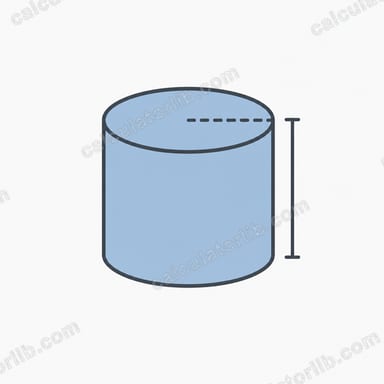
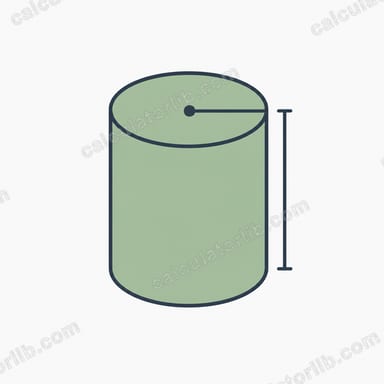
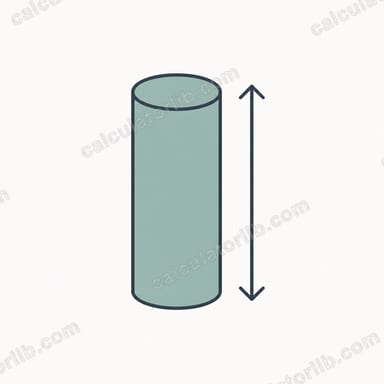
This calculator finds the height of a cylinder when you already know its volume and the radius of its circular base. Instead of rearranging the volume formula by hand, you enter two numbers and get the vertical dimension instantly — along with several useful extras the tool computes automatically: the base area, the total surface area, and the lateral (side) surface area.
It is handy for engineers, designers, students and anyone sizing tanks, pipes, columns, containers or storage vessels where the capacity is fixed but you need to know how tall the shape must be.
The Inputs You Enter
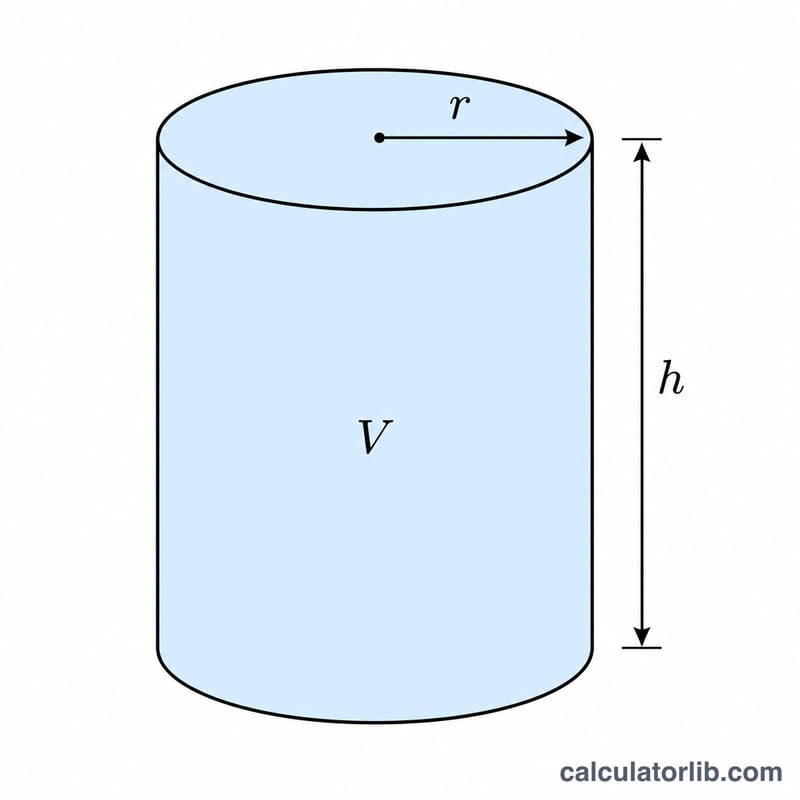
- Cylinder Volume — the total capacity of the cylinder in cubic units (for example cubic metres, cubic centimetres or cubic inches).
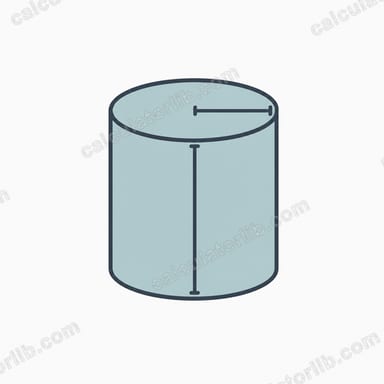
- Cylinder Radius — the distance from the centre of the circular base to its edge, in matching linear units.
Keep your units consistent: if the volume is in cubic centimetres, enter the radius in centimetres so the resulting height comes out in centimetres.
The Formula Explained
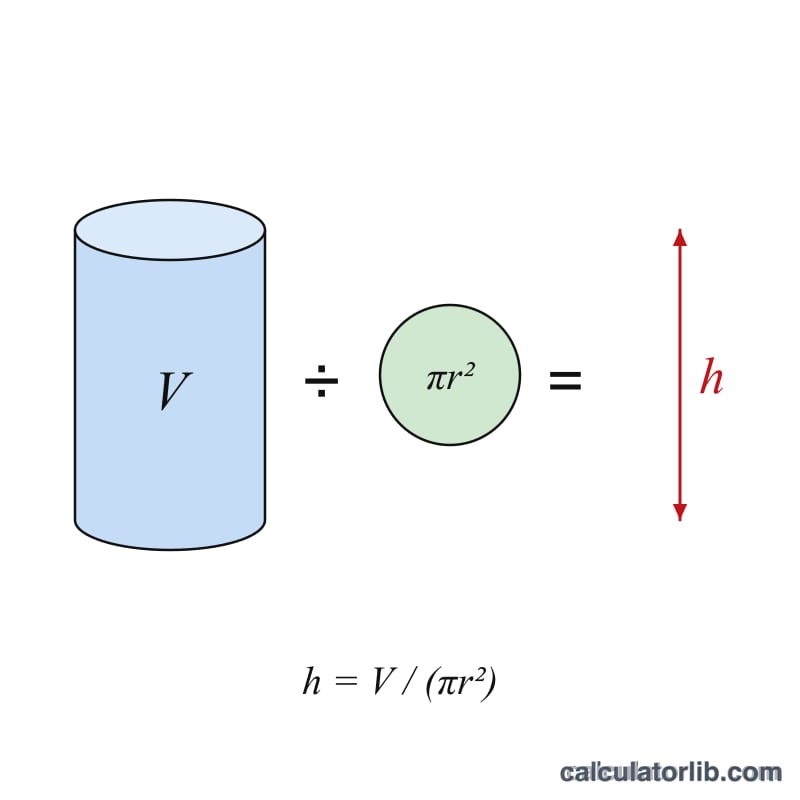
The volume of a cylinder is V = πr²h. Solving that for height gives the formula this tool uses:
h = V / (π × r²)
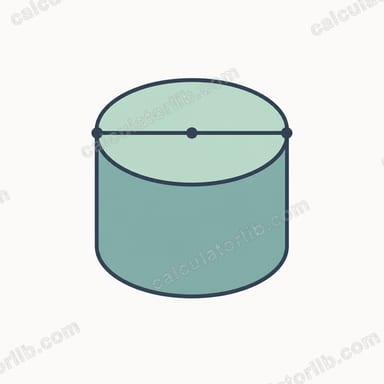
The denominator πr² is simply the area of the circular base. So height is just the volume divided by the base area — pour a known volume into a known footprint and this tells you how high it stacks. The calculator also reports:
- Base area = πr²
- Lateral surface area = 2πr × h
- Total surface area = 2πr × (r + h)
Worked Example
Suppose a cylindrical tank holds a volume of 500 cubic units and has a radius of 5 units.
- Base area = π × 5² = 78.54 square units
- Height = 500 / 78.54 = 6.37 units
- Lateral surface area = 2 × π × 5 × 6.37 = 200.1 square units
- Total surface area = 2 × π × 5 × (5 + 6.37) = 357.2 square units
So a 500-unit cylinder with a 5-unit radius must be about 6.37 units tall.
Volume and Length Unit Conversions
The formula \(h = \frac{V}{\pi r^{2}}\) is unit-neutral, but it only gives a correct answer when the volume unit and the radius unit belong to the same length base. A volume in cubic centimetres must be paired with a radius in centimetres; a volume in cubic metres with a radius in metres. The resulting height then comes out in that same linear unit.
Volume conversions
| Unit | Equivalents |
|---|---|
| 1 litre (L) | 1,000 cm³ = 0.001 m³ |
| 1 cubic metre (m³) | 1,000 L = 1,000,000 cm³ |
| 1 US liquid gallon | 3.78541 L = 231 in³ (exactly 231 in³) |
| 1 imperial (UK) gallon | 4.54609 L |
| 1 cubic foot (ft³) | 1,728 in³ = 28.3168 L |
The US liquid gallon and the imperial gallon are different units — the imperial gallon (used in the UK and some Commonwealth countries) is about 20% larger. Always check which gallon a drawing or spec sheet means before converting.
Length conversions
| Unit | Equivalents |
|---|---|
| 1 metre (m) | 100 cm = 1,000 mm = 39.3701 in |
| 1 foot (ft) | 12 in = 30.48 cm |
| 1 inch (in) | 25.4 mm = 2.54 cm |
Matching the volume unit to the radius unit
| Volume entered as | Enter the radius in | Height comes out in | Note |
|---|---|---|---|
| m³ | metres (m) | metres | Direct match — no conversion needed. |
| cm³ | centimetres (cm) | centimetres | Direct match — the most convenient pair for everyday container sizes. |
| litres (L) | centimetres (cm) | centimetres | Convert first: multiply litres by 1,000 to get cm³. |
| in³ | inches (in) | inches | Direct match. For gallons, convert to in³ first (US gallon × 231). |
| ft³ | feet (ft) | feet | Direct match. A radius given in inches must be divided by 12. |
Example of the litre case: a 2 L bottle body with a 4 cm radius becomes \(V = 2{,}000\ \text{cm}^3\), so \(h = \frac{2{,}000}{\pi \times 4^{2}} = \frac{2{,}000}{50.265} = 39.79\ \text{cm}\).
How Height Changes with Radius: Scenario Comparison
Because the radius appears squared in the denominator of \(h = \frac{V}{\pi r^{2}}\), height is highly sensitive to radius. The table below holds the volume fixed at 1,000 cm³ (1 litre) and varies only the radius. The lateral (side wall) area is \(2\pi r h\), which for a fixed volume simplifies to \(\frac{2V}{r}\) — so a wider cylinder always needs less side-wall material.
Fixed volume: 1,000 cm³ (1 L)
| Radius r (cm) | Base area \(\pi r^{2}\) (cm²) | Height \(h = V/(\pi r^{2})\) (cm) | Lateral area \(2\pi r h\) (cm²) | Shape |
|---|---|---|---|---|
| 2 | 12.57 | 79.58 | 1,000.0 | Tall, narrow tube |
| 3 | 28.27 | 35.37 | 666.7 | Slim bottle |
| 5 | 78.54 | 12.73 | 400.0 | Balanced can |
| 8 | 201.06 | 4.97 | 250.0 | Wide, shallow tin |
| 10 | 314.16 | 3.18 | 200.0 | Flat disc |
Note the inverse-square behaviour explicitly: doubling the radius cuts the height to one quarter. Going from r = 2 cm to r = 4 cm would drop the height from 79.58 cm to 19.89 cm; in the table, r = 5 cm gives 12.73 cm while r = 10 cm gives 3.18 cm — exactly one quarter. Halving the radius, conversely, makes the cylinder four times taller.
Fixed radius: 5 cm (base area 78.54 cm²)
With the radius held constant, the denominator never changes, so height scales linearly with volume — double the volume, double the height.
| Volume V (cm³) | Height \(h = V/78.54\) (cm) | Relative height |
|---|---|---|
| 250 | 3.18 | 1× |
| 500 | 6.37 | 2× |
| 1,000 | 12.73 | 4× |
| 2,000 | 25.46 | 8× |
Worked check for the last row: \(h = \frac{2{,}000}{\pi \times 5^{2}} = \frac{2{,}000}{78.5398} = 25.465\ \text{cm}\). Practical takeaway: when you can choose the radius, small changes in diameter reshape the design far more than changes in volume do — which is why shortening a tank or silo usually means widening it only slightly.
Frequently Asked Questions
Why is the radius squared? Because the base is a circle, and a circle's area grows with the square of its radius. Doubling the radius quadruples the base area and therefore quarters the required height for the same volume.
What if I only know the diameter? Divide the diameter by two to get the radius before entering it. The formula always uses the radius.
What units does the height come out in? The same linear unit as your radius, provided your volume uses the cube of that unit (e.g. radius in inches and volume in cubic inches gives height in inches).