What the Discount Rate Calculator Does
This calculator tells you what percentage you save when an item drops from its original price to a sale price. You enter just two numbers—the Original Price and the Price After Discount—and it instantly returns four results: the discount percentage (percent off), the dollar amount saved, the savings rate as a decimal, and the discount multiplier. It works with any currency, since the math is purely proportional.
The Inputs Explained
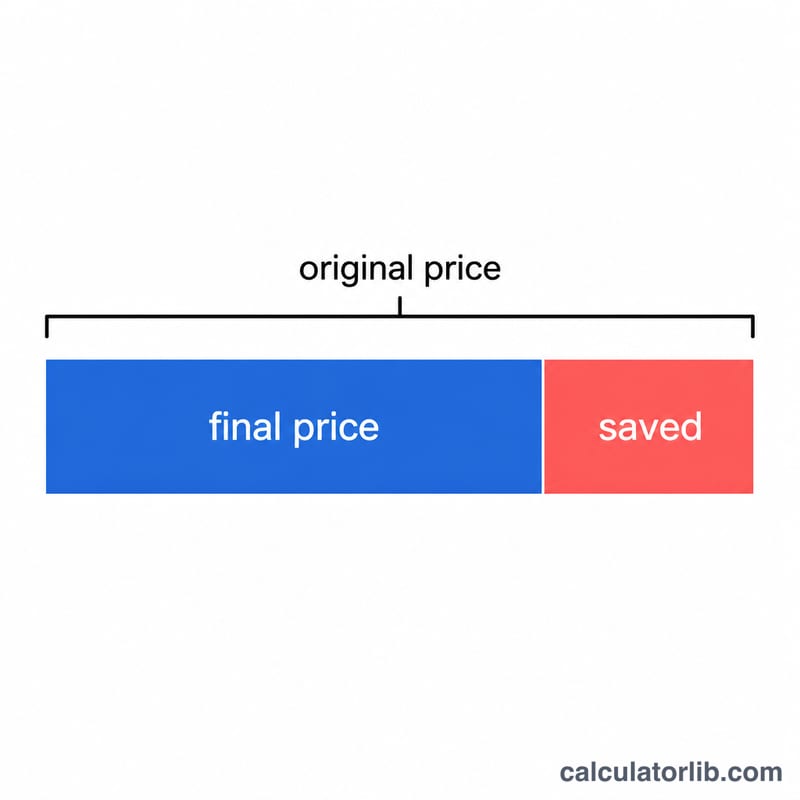
- Original Price – the regular, pre-sale price of the item (Po).
- Price After Discount – the price you actually pay at checkout (Pf).
If you leave the original price at zero or below, the calculator safely returns 0% instead of dividing by zero.
The Formula
The core calculation is:
r = (Po − Pf) ÷ Po × 100
From this single formula the tool derives all four outputs:
- Discount amount = Po − Pf (how much money you save).
- Discount percentage = the result of the formula above.
- Savings rate = the same value expressed as a decimal (percentage ÷ 100).
- Discount multiplier = 1 − (percentage ÷ 100), the factor you multiply the original price by to get the sale price.
Worked Example
Suppose a jacket is marked down from an original price of 120 to a sale price of 90.
- Discount amount = 120 − 90 = 30 saved.
- Discount percentage = (120 − 90) ÷ 120 × 100 = 25% off.
- Savings rate = 0.25.
- Discount multiplier = 1 − 0.25 = 0.75 (so 120 × 0.75 = 90, confirming the sale price).
More Worked Examples
Each example uses the same formula, where \(P_o\) is the original price and \(P_f\) is the final (sale) price:
$$r = \frac{P_o - P_f}{P_o} \times 100$$The other three results come from the same two inputs:
- Discount amount: \(P_o - P_f\)
- Savings rate: \((P_o - P_f) \div P_o\), which is the percentage written as a decimal
- Discount multiplier: \(P_f \div P_o\), which also equals \(1 - \text{savings rate}\)
The examples work in any currency, so no currency symbol is shown.
Example 1: A discount that doesn't come out even
An item is reduced from 79.99 to 59.99.
- Discount amount: \(79.99 - 59.99 = 20.00\)
- Savings rate: \(20.00 \div 79.99 = 0.250031\ldots\)
- Percentage: \(0.250031\ldots \times 100 = 25.0031\ldots\%\)
- Multiplier: \(59.99 \div 79.99 = 0.749969\ldots\)
Rounding: Do all the arithmetic first and round only the final answers. To two decimal places, 25.0031…% becomes 25.00%, which you can call 25% off. To four decimal places, the savings rate is 0.2500 and the multiplier is 0.7500. As a check, the rounded savings rate and multiplier add up to 1.0000.
$$r = \frac{79.99 - 59.99}{79.99} \times 100 = \frac{20.00}{79.99} \times 100 \approx 25.00\%$$Example 2: Two discounts in a row
A 200 item gets 20% off, and then a further 10% off the reduced price. Apply the two multipliers one after the other:
$$P_f = 200 \times 0.8 \times 0.9 = 160 \times 0.9 = 144$$Now put 200 and 144 into the formula:
- Discount amount: \(200 - 144 = 56\)
- Savings rate: \(56 \div 200 = 0.2800\)
- Percentage: \(0.28 \times 100 = 28\%\)
- Multiplier: \(144 \div 200 = 0.7200\), which also equals \(0.8 \times 0.9\)
The total discount is 28%, not 30%. The second 10% is taken off 160, not off the original 200, so it saves only 16. Stacked discounts multiply. They do not add.
Example 3: A negative result
A price goes from 50 to 55.
- Discount amount: \(50 - 55 = -5\)
- Savings rate: \(-5 \div 50 = -0.1000\)
- Percentage: \(-0.1 \times 100 = -10\%\)
- Multiplier: \(55 \div 50 = 1.1000\)
A negative discount means the price went up. Here it rose by 10%. Any multiplier above 1 means you pay more than the original price.
Common Discounts and Their Multipliers
Every row follows two rules:
- Multiplier = 1 − percent ÷ 100
- Sale price = 100 × multiplier
To find the sale price of any item, multiply its original price by the multiplier in the table.
| Percent Off | Savings Rate (decimal) | Discount Multiplier | Sale Price of a 100 Item |
|---|---|---|---|
| 5% | 0.05 | 0.95 | 95.00 |
| 10% | 0.10 | 0.90 | 90.00 |
| 15% | 0.15 | 0.85 | 85.00 |
| 20% | 0.20 | 0.80 | 80.00 |
| 25% | 0.25 | 0.75 | 75.00 |
| 30% | 0.30 | 0.70 | 70.00 |
| 33⅓% | 0.3333 (exactly 1/3) | 0.6667 (exactly 2/3) | 66.67 |
| 40% | 0.40 | 0.60 | 60.00 |
| 50% | 0.50 | 0.50 | 50.00 |
| 60% | 0.60 | 0.40 | 40.00 |
| 70% | 0.70 | 0.30 | 30.00 |
| 75% | 0.75 | 0.25 | 25.00 |
For the 33⅓% row, the exact values are fractions. They are rounded here to four decimal places, and the sale price to two. For example, \(100 \times \tfrac{2}{3} = 66.666\ldots \approx 66.67\).
Note: Percentages and multipliers have no units, so this table works in any currency, whether dollars, euros, pounds, yen or another. Only the sale price column assumes an original price of 100 in whatever currency you use.
Frequently Asked Questions
What is the discount multiplier used for? It is a quick shortcut: multiply any original price by the multiplier to get the sale price. A 0.75 multiplier means you pay 75% of the listed price.
Can the discount percentage be negative? Yes. If the "after discount" price is higher than the original, the formula returns a negative percentage, signalling a price increase rather than a saving.
Does the currency matter? No. Because the result is a ratio, it works identically whether your prices are in dollars, euros, pounds, or any other currency—just keep both inputs in the same units.