What Is Earned Run Average (ERA)?
Earned Run Average (ERA) is the most common statistic used to measure a baseball or softball pitcher's effectiveness. It expresses the average number of earned runs a pitcher allows per nine innings pitched. A lower ERA indicates a more effective pitcher. Earned runs exclude runs that score as a result of fielding errors or passed balls — only runs that result from a pitcher's own performance count.
How to Use This Calculator
Enter the total number of earned runs the pitcher has allowed and the total innings pitched. Innings can be a decimal — in baseball notation, ".1" means one out (one-third of an inning) and ".2" means two outs (two-thirds), but for this calculator you may simply enter the decimal equivalent (e.g. 6.67 for 6⅔). Click calculate to see the ERA instantly.
The Formula Explained
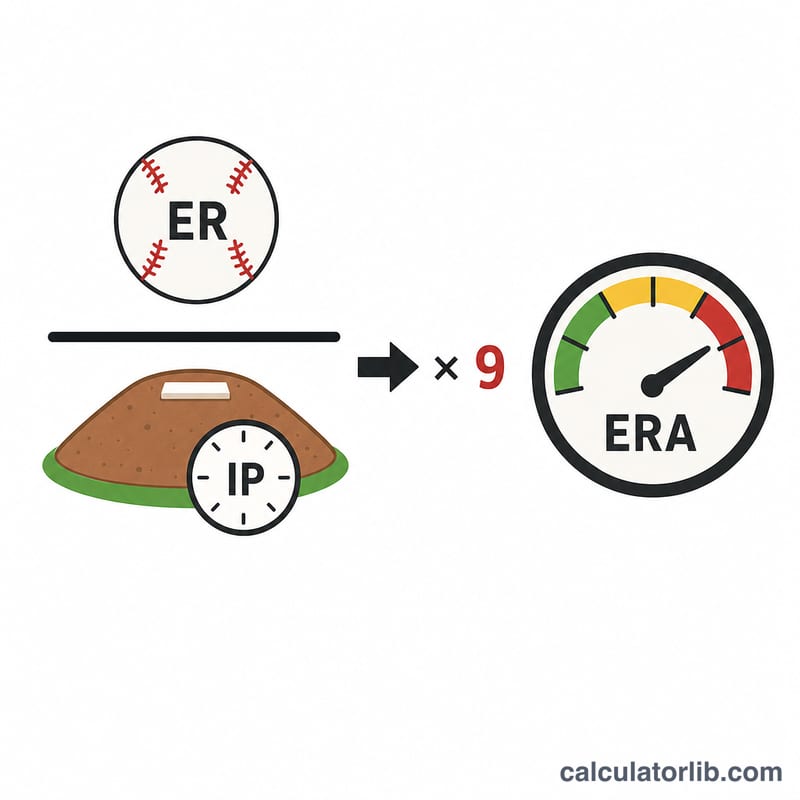
The formula is $$\text{ERA} = \frac{\text{Earned Runs}}{\text{Innings Pitched}} \times 9$$. We divide earned runs by innings pitched to get earned runs per inning, then multiply by 9 to scale the figure to a standard nine-inning game. This normalization lets you compare starters and relievers on the same scale regardless of how many innings they have thrown.
Worked Example
Suppose a pitcher has allowed 30 earned runs over 180 innings pitched. $$\text{ERA} = (30 \div 180) \times 9 = 0.1667 \times 9 = \mathbf{1.50}$$ An ERA of 1.50 is excellent — elite starting pitchers often finish a season in the 2.00–3.00 range.
Converting Baseball Innings Notation to Decimals
Baseball box scores write partial innings as a decimal-looking number, but the digit after the point counts outs, not tenths. An inning has three outs, so .1 means one out (1/3 of an inning) and .2 means two outs (2/3). The calculator needs the true decimal value, so convert before entering it.
| Baseball notation | Meaning | Decimal to enter |
|---|---|---|
| .0 | 0 extra outs | 0.000 |
| .1 | 1 extra out | 0.333 |
| .2 | 2 extra outs | 0.667 |
| Box score IP | Enter in calculator |
|---|---|
| 6.1 | 6.333 |
| 6.2 | 6.667 |
| 100.1 | 100.333 |
| 200.2 | 200.667 |
Do not enter 6.2 literally. The value 6.2 would mean six and two-tenths innings, which is less than 6⅔ innings and would make the ERA too high.
Example: a pitcher allows 3 earned runs in 6.2 innings (6⅔). Enter 6.667: \(\text{ERA} = \frac{3}{6.667} \times 9 \approx \) 4.05.
Typical ERA Ranges
These tiers are commonly used to describe MLB (Major League Baseball) starting pitchers over a full season. They are informal conventions, not official standards.
| ERA | Typical description |
|---|---|
| Below 2.00 | Elite / historic |
| 2.00–3.00 | Excellent (ace level) |
| 3.00–4.00 | Above average to solid |
| 4.00–5.00 | Average to below average |
| Above 5.00 | Poor |
League-average ERA changes with the season and era; in recent MLB seasons it has roughly ranged from about 3.9 to 4.5. A lower ERA is better, and the same number can mean different things in a high-scoring versus a low-scoring year. Other levels of play (college, youth, other countries' leagues) usually have different norms, and games shorter than nine innings still use the ×9 scaling in the formula.
ERA Comparison Across Scenarios
| Scenario | Earned runs | Innings pitched | ERA |
|---|---|---|---|
| Historic full season | 20 | 180 | 1.00 |
| Ace-level full season | 60 | 180 | 3.00 |
| Average-ish partial season | 75 | 150 | 4.50 |
| Single start | 3 | 6 | 4.50 |
| Small-sample reliever | 2 | 1 | 18.00 |
Example substitution: \(\frac{60}{180} \times 9 = 0.333 \times 9 = 3.00\).
Small samples: ERA is very sensitive when innings are few. A single bad inning can send a reliever's ERA to 18.00 or higher, while a few scoreless innings produce 0.00. ERA becomes more reliable as innings accumulate, so compare pitchers over similar, larger workloads.
FAQ
What is a good ERA? Generally, an ERA below 3.00 is considered very good, 3.00–4.00 is solid, and above 5.00 is poor at the major-league level.
What counts as an earned run? A run charged to a pitcher that scored without the aid of a fielding error or passed ball.
Does this work for softball? Yes, but softball games are typically 7 innings, so some leagues multiply by 7 instead of 9. This calculator uses the standard baseball factor of 9.