What is enthalpy?
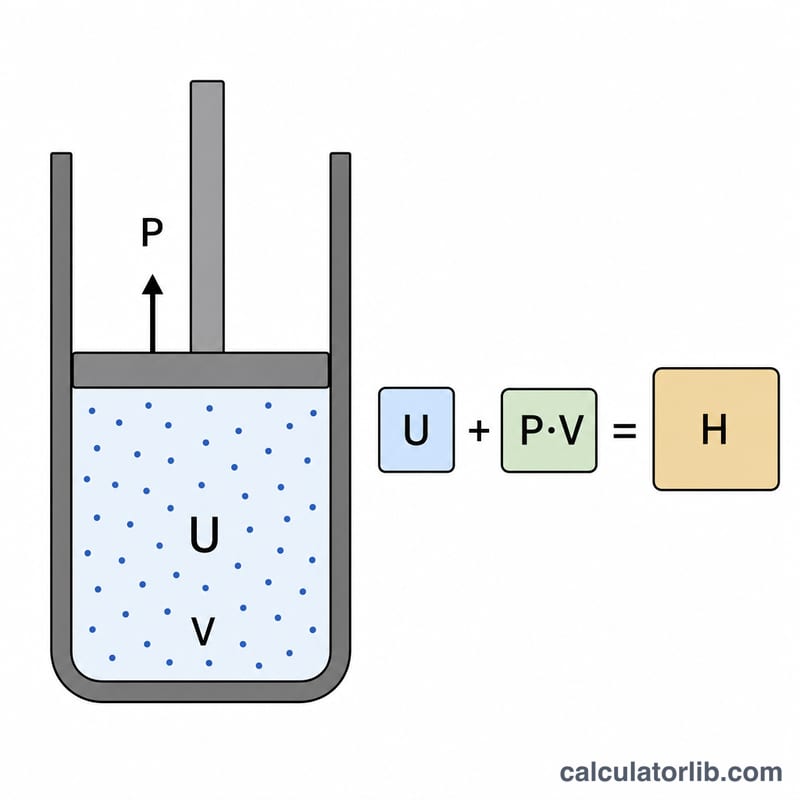
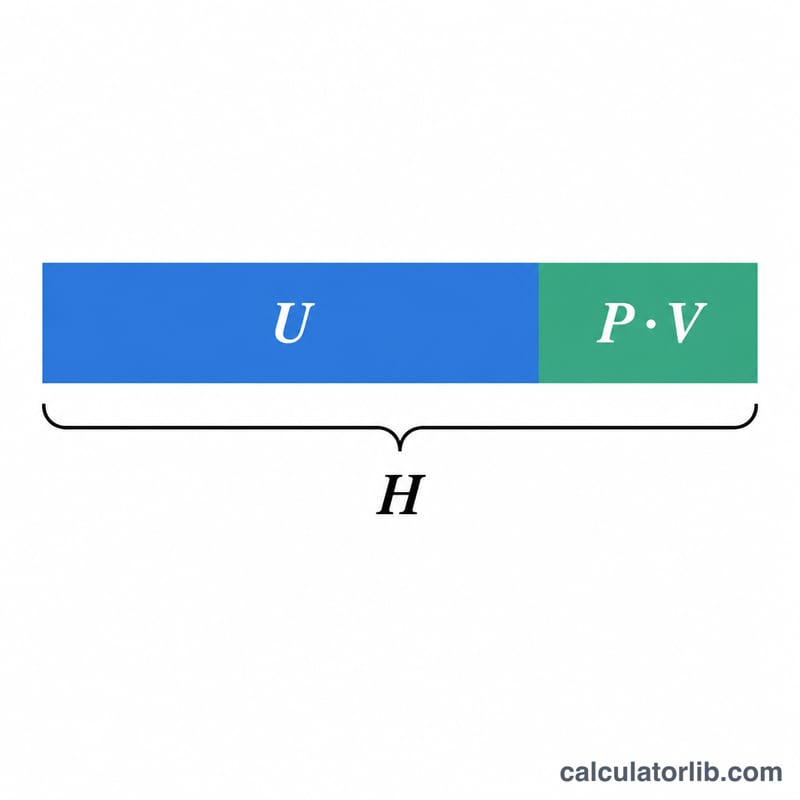
Enthalpy (H) is a thermodynamic state function that measures the total heat content of a system. It is defined as the system's internal energy (U) plus the product of its pressure (P) and volume (V). Enthalpy is especially useful in chemistry and engineering because, at constant pressure, the change in enthalpy equals the heat exchanged with the surroundings.
How to use this calculator
Choose a mode. Use Enthalpy (H = U + PV) to find the absolute enthalpy from a system's internal energy, pressure and volume. Use Change in enthalpy (ΔH = ΔU + PΔV) for a constant-pressure process — here enter the change in internal energy and the change in volume. Enter values in SI units: internal energy in joules (J), pressure in pascals (Pa) and volume in cubic metres (m³). The result is returned in joules.
The formula explained
The defining equation is $$H = U + P\cdot V$$ The term \(P\cdot V\) represents the flow work — the energy needed to make room for the system at pressure \(P\). For a process at constant pressure the differential form becomes $$\Delta H = \Delta U + P\cdot \Delta V$$ which is why \(\Delta H\) is the heat of reaction at constant pressure.
Worked example
Suppose a gas has internal energy \(U = 1000 \text{ J}\) at pressure \(P = 101{,}325 \text{ Pa}\) occupying volume \(V = 0.01 \text{ m}^3\). The pressure-volume term is $$101{,}325 \times 0.01 = 1013.25 \text{ J}$$ so the enthalpy is $$H = 1000 + 1013.25 = \mathbf{2013.25 \text{ J}}$$
Unit Conversions for Pressure, Volume and Energy
The calculator works in SI units: internal energy in joules (J), pressure in pascals (Pa) and volume in cubic metres (m³). Convert your inputs with the factors below before entering them.
Pressure (to Pa)
| Unit | Equivalent in Pa |
|---|---|
| 1 atm | 101,325 Pa |
| 1 bar | 100,000 Pa |
| 1 kPa | 1,000 Pa |
| 1 psi | ≈ 6,894.76 Pa |
| 1 mmHg | ≈ 133.322 Pa |
Volume (to m³)
| Unit | Equivalent in m³ |
|---|---|
| 1 L | 0.001 m³ |
| 1 mL | 1×10⁻⁶ m³ |
| 1 cm³ | 1×10⁻⁶ m³ |
| 1 ft³ | ≈ 0.0283168 m³ |
Energy (to J)
| Unit | Equivalent in J |
|---|---|
| 1 kJ | 1,000 J |
| 1 cal | 4.184 J |
| 1 L·atm | 101.325 J |
| 1 BTU | ≈ 1,055.06 J |
Note: 1 Pa·m³ = 1 N·m⁻²·m³ = 1 N·m = 1 J, so pressure in pascals multiplied by volume in cubic metres gives the PV term directly in joules.
Comparing Enthalpy Across Scenarios
Each row uses \(H = U + PV\). Pressure is in pascals, volume in cubic metres, and energies in joules.
| Scenario | U (J) | P (Pa) | V (m³) | PV (J) | H (J) |
|---|---|---|---|---|---|
| Original example (about 1 atm) | 1,000 | 101,325 | 0.01 | 1,013.25 | 2013.25 |
| Higher pressure (10 bar) | 1,000 | 1,000,000 | 0.01 | 10,000 | 11,000 |
| Small volume | 1,000 | 101,325 | 0.001 | 101.325 | 1,101.325 |
Worked substitution for the original example: \(H = 1000 + 101325 \times 0.01 = 1000 + 1013.25 = 2013.25\ \text{J}\).
Change in enthalpy at constant pressure
Here \(\Delta H = \Delta U + P\,\Delta V\) with \(P = 101{,}325\) Pa and \(\Delta U = 1000\) J.
| Process | ΔU (J) | P (Pa) | ΔV (m³) | PΔV (J) | ΔH (J) |
|---|---|---|---|---|---|
| Expansion (ΔV > 0) | 1,000 | 101,325 | +0.002 | +202.65 | 1,202.65 |
| Compression (ΔV < 0) | 1,000 | 101,325 | −0.002 | −202.65 | 797.35 |
Expansion: \(1000 + 101325 \times 0.002 = 1000 + 202.65 = 1202.65\ \text{J}\). Compression: \(1000 + 101325 \times (-0.002) = 1000 - 202.65 = 797.35\ \text{J}\).
Interpreting Your Result
- Sign of ΔH: a positive ΔH means the process is endothermic (heat is absorbed at constant pressure). A negative ΔH means it is exothermic (heat is released).
- Reference state: absolute enthalpy depends on the chosen reference state, so only changes in enthalpy (ΔH) are usually physically meaningful. A single H value is best compared with another H computed on the same basis.
- The PΔV term: in \(\Delta H = \Delta U + P\,\Delta V\), the term \(P\,\Delta V\) is the expansion (pressure–volume) work. When a system expands against constant pressure it does work on its surroundings, so the heat absorbed must exceed ΔU by that amount. When it is compressed, the surroundings do work on it and the PΔV term is negative.
- Units: the result is in joules. Divide by 1000 to get kilojoules (kJ).
- Limits: ΔH equals the heat exchanged q only at constant pressure and when there is no non-expansion work (such as electrical work). Outside those conditions, ΔH is still defined as ΔU + Δ(PV) but it is not simply the heat transferred.
This is general educational information; check your assumptions (ideal behaviour, constant pressure, consistent units) before using results in design or coursework.
FAQ
What units should I use? Use SI units (J, Pa, m³) for a result in joules. If you mix units (e.g. atm and litres) you must convert first.
Why can enthalpy values be large? Because pressures in pascals are large numbers; \(1 \text{ atm} \approx 101{,}325 \text{ Pa}\), so even small volumes produce significant \(P\cdot V\) terms.
Does ΔH equal heat? At constant pressure with no non-expansion work, \(\Delta H\) equals the heat absorbed or released by the system.