What Is the Excavation Volume Calculator?
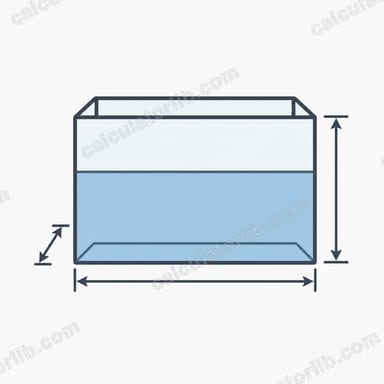
This calculator estimates how much soil or material you need to dig out for a project such as a foundation, trench, footing, pool, or pond. By entering the length, width, and depth of the excavation in feet, you instantly get the volume in cubic yards — the unit most often used by contractors and dump trucks — along with cubic feet and cubic meters.
How to Use It
Measure the rectangular pit you plan to dig. Enter the length, width, and depth in feet. The tool multiplies the three dimensions to find the total cubic feet, then divides by 27 to convert to cubic yards. Use the cubic-yard figure when ordering removal trucks or estimating disposal costs.
The Formula Explained
Volume is length \(\times\) width \(\times\) depth. Because all three are in feet, the product is in cubic feet. A cubic yard is \(3\ \text{ft} \times 3\ \text{ft} \times 3\ \text{ft} = 27\) cubic feet, so dividing the cubic feet by 27 gives cubic yards.
$$\text{Cubic Yards} = \frac{\text{Length (ft)} \times \text{Width (ft)} \times \text{Depth (ft)}}{27}$$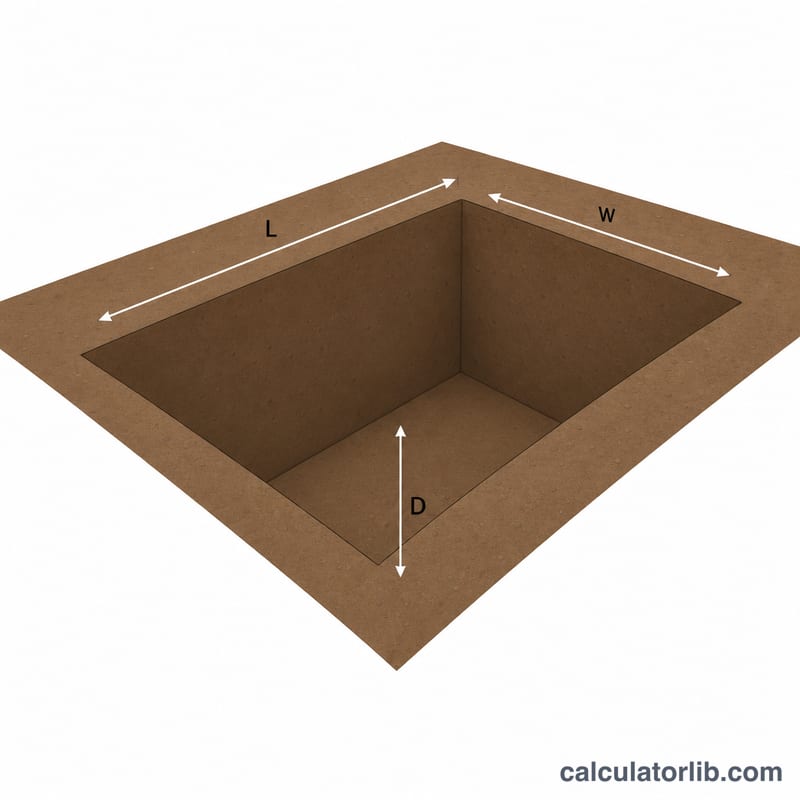
Worked Example
Suppose you dig a foundation 20 ft long, 10 ft wide, and 3 ft deep. Volume = \(20 \times 10 \times 3 = 600\) cubic feet. Cubic yards = \(600 \div 27 \approx\) 22.22 cubic yards. You would need to remove roughly 22.2 yards of soil.
$$\text{Cubic Yards} = \frac{20 \times 10 \times 3}{27} = \frac{600}{27} \approx 22.22$$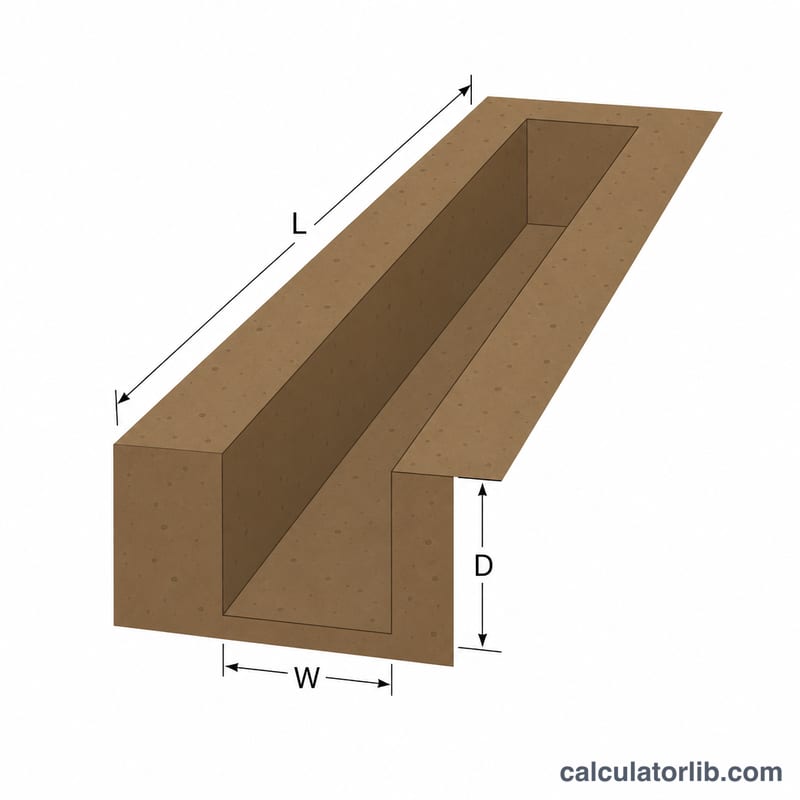
Soil Swell (Bulking) and Shrinkage Factors by Soil Type
The calculator returns bank volume, which is the soil measured in place, before it is disturbed. Once dug, soil loosens and takes up more space. This increase is called swell (or bulking). When the soil is later compacted as fill, it can occupy less space than it did in the bank. Truck loads, spoil piles and import quantities depend on these factors.
| Soil type | Typical swell | Load factor | Typical compacted (shrinkage) factor* |
|---|---|---|---|
| Sand | about 10–15% | about 0.89 | about 0.90–0.95 |
| Gravel | about 10–15% | about 0.89 | about 0.90–0.95 |
| Loam / common earth | about 25% | about 0.80 | about 0.90 |
| Clay | about 30–40% | about 0.71–0.77 | about 0.85–0.90 |
| Rock (blasted or broken) | about 50–60% | about 0.63–0.67 | varies; compacted rock fill often does not shrink below bank volume |
*Compacted factor = compacted volume ÷ bank volume. All values are rough, commonly published approximations. Actual figures vary with moisture content, grain size, how the soil is dug and how heavily it is compacted. Use a geotechnical report or your contractor's figures for real projects.
Converting bank yards to loose yards
Load factor and swell are related by \(\text{Load factor} = \frac{1}{1 + \text{swell}}\). To convert, multiply the bank volume by \(1 + \text{swell}\):
$$\text{Loose CY} = \text{Bank CY} \times (1 + \text{swell}) = \frac{ \text{Bank CY} }{ \text{Load factor} }$$
Example: A trench is 30 ft long, 3 ft wide and 4 ft deep in loam (about 25% swell).
- Bank volume: \(\frac{30 \times 3 \times 4}{27} = \frac{360}{27} =\) 13.33 cubic yards.
- Loose volume: \(13.33 \times 1.25 = 16.67\) cubic yards to haul.
- With a 10 cubic yard truck: \(16.67 \div 10 = 1.67\), so plan on 2 loads.
Practical Tips for Estimating Excavation
- Add swell before booking trucks. Haul and stockpile volumes are loose yards, not bank yards. Multiply the calculator result by \(1 + \text{swell}\) for your soil type.
- Round up to whole loads. Trucks are booked in whole loads, and a partial load still costs a trip. Divide the loose volume by the truck's rated capacity and round up. Heaped capacity is often not achievable with wet or sticky soil.
- Allow for sloped or benched sides. The length × width × depth formula assumes vertical walls. Deeper cuts usually need sloped or benched sides, or shoring, depending on soil type and local safety rules. These add volume, so calculate the wider top dimensions or split the pit into sections and add them.
- Include over-excavation. If the plan calls for a gravel base, a footing, a slab thickness or topsoil removal, dig that extra depth. For example, a 6 in gravel base adds 0.5 ft to the depth.
- Add working space. Foundation walls, waterproofing and formwork usually need extra room around the footprint, often a foot or more per side. Include it in length and width.
- Plan the fill. Backfill and import quantities depend on compaction. Compacted soil can occupy less volume than it did in the bank, so you may need more fill than the hole's volume suggests.
- Add a contingency. Many estimators add a modest margin (for example 5–10%) for uneven bottoms, overdig and measurement error.
- Check utilities first. Locate buried gas, electric, water, sewer and communication lines before digging. In the US, call 811; other countries have their own one-call or utility-locate services.
- Check disposal rules. Local rules may restrict where excavated soil can go. Contaminated soil, or soil from some sites, can require testing and approved disposal. Some landfills charge by weight, so ask whether pricing is per ton or per yard.
This is general information, not engineering or professional advice. Deep trenches, unstable soils and high groundwater need a qualified professional and compliance with local safety regulations.
FAQ
Do I need to add for soil swell? Yes — excavated soil expands. Add 15–30% extra volume when ordering trucks to account for "bulking" of loosened earth.
Can I use inches? Convert inches to feet first (divide by 12). For example, \(18\) inches \(= 1.5\) ft.
How many cubic yards fit in a dump truck? A standard tandem dump truck holds about 10–14 cubic yards, so a 22-yard job needs two loads.