What is the Factoring Calculator?
This tool takes any whole number and finds everything you need to know about its divisibility: the complete list of positive factors, all of its factor pairs, its prime factorization, and whether it is prime or composite. Factoring is a core skill in arithmetic, algebra, and number theory, and this calculator does the trial division for you instantly.
How to use it
Type an integer into the "Find the Factors of:" box and submit. Negative numbers are accepted - the calculator factors the absolute value, since factors are positive by convention. Decimals are rounded to the nearest integer. The results panel shows the prime factorization as the headline, with the factor count, full factor list, and factor pairs below.
The formula explained
To find every factor of \(N\), we only need to test possible divisors up to the square root of \(N\). For each divisor \(i\) that divides \(N\) evenly, both \(i\) and \(N/i\) are factors. This means we only check
$$i \le \lfloor \sqrt{N} \rfloor$$This is far faster than checking every number up to \(N\). The prime factorization repeatedly divides out the smallest prime (2, then 3, 5, 7, ...) until only 1 remains, recording each prime and how many times it appears as an exponent.
$$N = p_1^{a_1} \times p_2^{a_2} \times \cdots \times p_k^{a_k}$$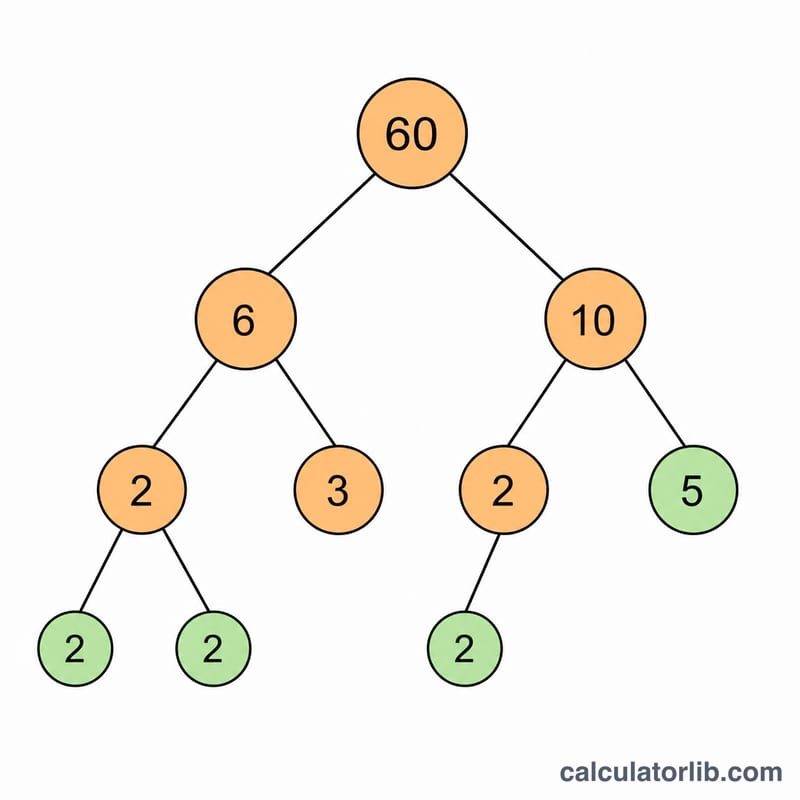
Worked example: 21
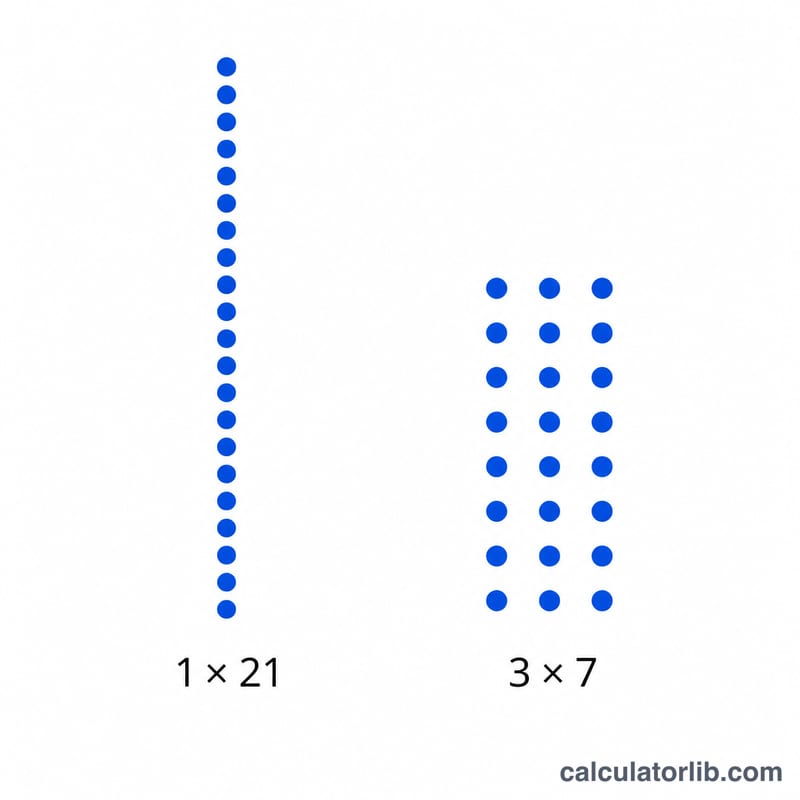
The square root of 21 is about 4.58, so we test 1, 2, 3, 4. We find \(21 = 1 \times 21\) and \(21 = 3 \times 7\), giving factors 1, 3, 7, 21 (four factors) and pairs (1, 21) and (3, 7). Dividing 21 by 3 leaves 7, which is prime, so
$$21 = 3 \times 7$$Because it has more than two factors, 21 is composite.
More Worked Examples: 36, 60 and 97
Each example uses the same method as the calculator: test whole-number divisors \(d\) up to \(\sqrt{N}\), pair each with \(N/d\), then count the factors from the prime exponents.
Example 1: N = 36 (a perfect square)
- \(\sqrt{36} = 6\), so test \(d = 1\) to \(6\).
- Divisors that work: 1, 2, 3, 4, 6. (5 does not: \(36 \bmod 5 = 1\).)
- Factor pairs: (1, 36), (2, 18), (3, 12), (4, 9), (6, 6). The pair (6, 6) repeats the same factor because 36 is a perfect square.
- All factors: 1, 2, 3, 4, 6, 9, 12, 18, 36.
- Prime factorization: \(36 = 2^{2} \cdot 3^{2}\).
- Count: \((2+1)(2+1) = 9\) factors, which matches the list. Perfect squares always have an odd number of factors: 9.
Example 2: N = 60
- \(\sqrt{60} \approx 7.75\), so test \(d = 1\) to \(7\).
- Divisors that work: 1, 2, 3, 4, 5, 6. (7 does not: \(60 = 8 \cdot 7 + 4\).)
- Factor pairs: (1, 60), (2, 30), (3, 20), (4, 15), (5, 12), (6, 10). That is six pairs.
- Prime factorization: \(60 = 2^{2} \cdot 3^{1} \cdot 5^{1}\).
- Count: \((2+1)(1+1)(1+1) = 3 \cdot 2 \cdot 2 = 12\) factors, and six pairs × 2 = 12.
- All factors: 1, 2, 3, 4, 5, 6, 10, 12, 15, 20, 30, 60.
Example 3: N = 97 (a prime)
- \(\sqrt{97} \approx 9.85\), so only divisors up to 9 need testing. Testing the primes 2, 3, 5, 7 is enough, since any other divisor up to 9 is a multiple of one of them.
- \(97 = 48 \cdot 2 + 1\) (remainder 1), \(97 = 32 \cdot 3 + 1\) (remainder 1), \(97 = 19 \cdot 5 + 2\) (remainder 2), \(97 = 13 \cdot 7 + 6\) (remainder 6).
- No divisor other than 1 divides 97, so its only factor pair is (1, 97).
- Prime factorization: \(97 = 97^{1}\), so the count is \((1+1) = 2\) factors. 97 is prime.
Prime Numbers and Divisibility Rules Reference
The 25 primes up to 100
| Range | Primes |
|---|---|
| 1–25 | 2, 3, 5, 7, 11, 13, 17, 19, 23 |
| 26–50 | 29, 31, 37, 41, 43, 47 |
| 51–75 | 53, 59, 61, 67, 71, 73 |
| 76–100 | 79, 83, 89, 97 |
That is 9 + 6 + 6 + 4 = 25 primes. The number 2 is the only even prime.
Divisibility rules
| Divisor | Rule | Example |
|---|---|---|
| 2 | Last digit is even (0, 2, 4, 6, 8) | 418 ends in 8, so it is divisible by 2 |
| 3 | Digit sum is divisible by 3 | 123: 1+2+3 = 6, so divisible by 3 |
| 4 | Last two digits form a number divisible by 4 | 516: 16 = 4 · 4, so divisible by 4 |
| 5 | Last digit is 0 or 5 | 735 ends in 5 |
| 6 | Divisible by both 2 and 3 | 138 is even and 1+3+8 = 12, so divisible by 6 |
| 8 | Last three digits form a number divisible by 8 | 3,128: 128 = 16 · 8, so divisible by 8 |
| 9 | Digit sum is divisible by 9 | 729: 7+2+9 = 18, so divisible by 9 |
| 10 | Last digit is 0 | 470 ends in 0 |
| 11 | Alternating digit sum is divisible by 11 (including 0) | 2,728: 2 − 7 + 2 − 8 = −11, so divisible by 11 |
Factoring Terms Explained
- Factor (divisor)
- A positive integer that divides a number exactly, with no remainder. 4 is a factor of 12 because \(12 \bmod 4 = 0\).
- Multiple
- The result of multiplying a number by an integer. 12, 24 and 36 are multiples of 12. If \(a\) is a factor of \(b\), then \(b\) is a multiple of \(a\).
- Factor pair
- Two factors whose product is the number, such as (3, 20) for 60. Checking divisors up to \(\sqrt{N}\) finds every pair.
- Prime number
- An integer greater than 1 with exactly two positive factors: 1 and itself (for example 2, 3, 5, 97).
- Composite number
- An integer greater than 1 with more than two positive factors (for example 12 or 91).
- Prime factorization
- Writing a number as a product of primes, such as \(60 = 2^{2} \cdot 3 \cdot 5\). By the fundamental theorem of arithmetic, it is unique apart from the order of the factors.
- Perfect square
- An integer that is the square of an integer (such as 36 = 6²). In its prime factorization every exponent is even, and it has an odd number of factors.
- Unit (1)
- The number 1 is a factor of every integer. It is neither prime nor composite, which keeps prime factorization unique.
- Coprime
- Two integers whose only common positive factor is 1, i.e. their greatest common divisor is 1 (for example 8 and 15). Coprime numbers need not be prime themselves.
- Number of factors
- If \(N = p_{1}^{a_{1}} \cdot p_{2}^{a_{2}} \cdots p_{k}^{a_{k}}\), the number of positive factors equals the product of (exponent + 1) over all primes: \((a_{1}+1)(a_{2}+1)\cdots(a_{k}+1)\).
FAQ
Is 1 prime or composite? Neither. By definition a prime has exactly two distinct factors; 1 has only one, so it is a unit.
What about 0? Every integer divides 0, so it is undefined for factoring and reported as neither prime nor composite.
Why do perfect squares have an odd number of factors? Because the square root pairs with itself (for 36, the pair is (6, 6)), so that factor is counted once instead of twice.