What it is
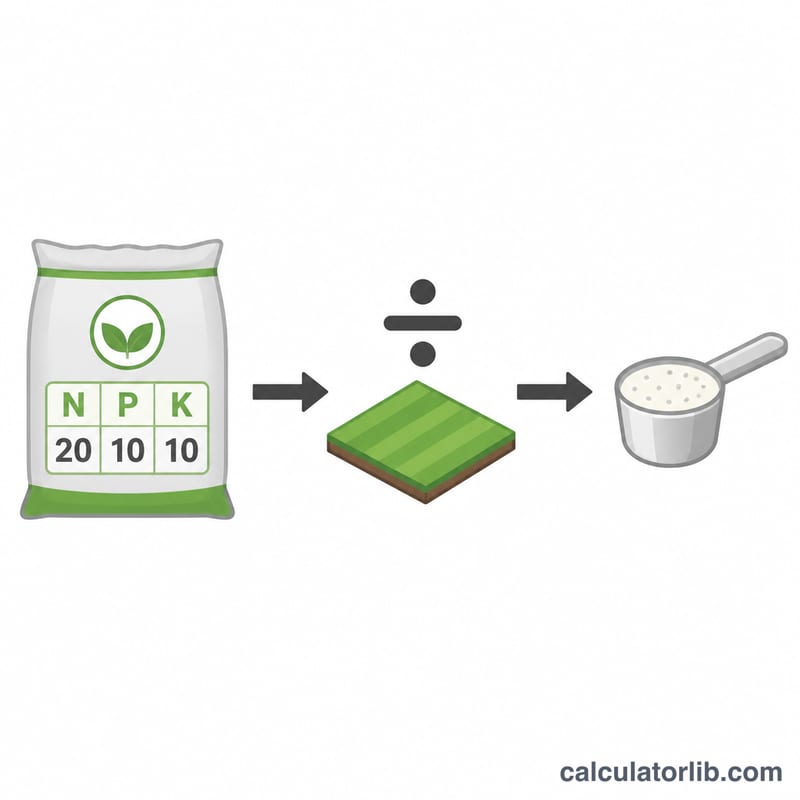
The Fertilizer Application Rate Calculator converts a target nutrient rate into the actual amount of fertilizer product you need to spread. Fertilizer bags are labeled with a guaranteed analysis (the N-P-K numbers), which tells you the percentage of each nutrient by weight. Because the product is not 100% nutrient, you must apply more product than the nutrient rate alone suggests.
The formula
The amount of product per acre is the target nutrient rate divided by the decimal fraction of that nutrient in the product:
$$\text{Product}_{\text{acre}} = \frac{\text{Nutrient Rate}}{\text{Analysis}/100}$$where \(\text{Nutrient Rate}\) = desired pounds of nutrient per acre and \(\text{Analysis}\) = the nutrient percentage from the bag. The total for the field is \(\text{Total} = \text{Product}_{\text{acre}} \times \text{Area}\).
How to use it
Enter your target nutrient rate in pounds per acre (for example, a soil test recommending 50 lbs of nitrogen), the analysis percentage of the nutrient in your product (46 for urea, 46-0-0), and the number of acres to treat. The calculator returns pounds of product per acre and the total pounds required.
Worked example
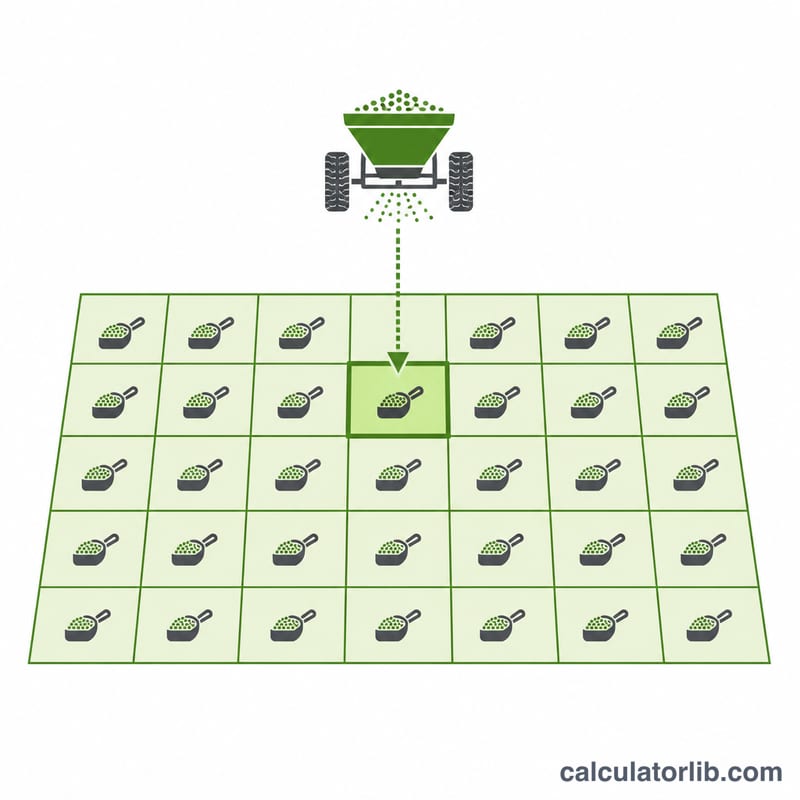
Suppose you want \(50\) lbs of nitrogen per acre using urea at \(46\%\) N across \(10\) acres:
$$\text{Product}_{\text{acre}} = \frac{50}{46/100} = 108.70\,\text{lbs/acre}$$$$\text{Total} = 108.70 \times 10 = 1086.96\,\text{lbs}$$So you would apply about 108.7 lbs of urea on each acre, and roughly 1,087 lbs for the whole field.
Common Fertilizer Analyses (N-P-K Reference)
Fertilizer bags carry a guaranteed analysis printed as three numbers: nitrogen (N), phosphorus as \(\text{P}_2\text{O}_5\), and potassium as \(\text{K}_2\text{O}\) — the standard N-P-K grade used on labels in the United States and most other markets. When you run the calculator, enter the percentage from the column that matches the nutrient you are targeting (for example, use the N column for a nitrogen rate, the \(\text{P}_2\text{O}_5\) column for a phosphate rate). Some products also supply a secondary nutrient such as sulfur (S), noted below.
| Fertilizer | Grade (N-P2O5-K2O) | N % | P2O5 % | K2O % | Read this column | Other |
|---|---|---|---|---|---|---|
| Urea | 46-0-0 | 46 | 0 | 0 | N | — |
| Ammonium nitrate | 34-0-0 | 34 | 0 | 0 | N | — |
| Ammonium sulfate | 21-0-0 | 21 | 0 | 0 | N | 24% S |
| Diammonium phosphate (DAP) | 18-46-0 | 18 | 46 | 0 | P2O5 (or N) | — |
| Monoammonium phosphate (MAP) | 11-52-0 | 11 | 52 | 0 | P2O5 (or N) | — |
| Triple superphosphate (TSP) | 0-46-0 | 0 | 46 | 0 | P2O5 | — |
| Muriate of potash (KCl) | 0-0-60 | 0 | 0 | 60 | K2O | Cl |
| Sulfate of potash (SOP) | 0-0-50 | 0 | 0 | 50 | K2O | ~18% S |
| Potassium nitrate | 13-0-44 | 13 | 0 | 44 | K2O (or N) | — |
For a product that supplies two nutrients (such as DAP, which carries both N and \(\text{P}_2\text{O}_5\)), size the application to your limiting nutrient, then account for the second nutrient it also delivers so you do not over-apply. Note that \(\text{P}_2\text{O}_5\) and \(\text{K}_2\text{O}\) are oxide forms; if your soil test reports elemental P or K, convert before comparing (\(\text{P}_2\text{O}_5 \times 0.436 = \text{P}\), \(\text{K}_2\text{O} \times 0.830 = \text{K}\)).
Practical Recommendations
The calculator returns the product to apply per acre from your target nutrient rate and the analysis:
$$\text{Product}_{\text{acre}} = \frac{\text{Nutrient Rate}}{\text{Analysis} \div 100}$$For a worked example, targeting 100 lb N/acre with urea (46% N) gives:
$$\text{Product}_{\text{acre}} = \frac{100}{46 \div 100} = \frac{100}{0.46} = 217.39\ \text{lb/acre}$$So each acre needs 217.39 lb of urea, and over a 40-acre field the total is 8,695.65 lb. Use these numbers as follows:
- Convert the total to whole bags and round up. Divide the field total by the bag weight — common sizes are 50 lb bags (widely sold in the United States) and 40 kg or 25 kg bags (common in metric markets). At 50 lb, 8,695.65 lb ÷ 50 = 173.9, so buy 174 bags. You cannot buy a partial bag, so always round up.
- Add ~5–10% extra. Spreader overlap, calibration loss, and product left in the hopper mean actual use exceeds the theoretical total. Buying about 5–10% more (roughly 183–191 bags in the example above) avoids a return trip mid-application.
- Calibrate the spreader to the per-acre rate before you spread. Set and verify the spreader (catch-test or a measured pass) so it actually delivers the target per-acre product amount; a spreader that is off by 15–20% will under- or over-fertilize the whole field.
- Split large nitrogen rates into multiple applications. High single-shot N rates increase losses (leaching, volatilization) and the risk of foliar/seedling burn; splitting N across two or more timings usually improves uptake. Follow the split-timing guidance for your crop and region.
- Check the other nutrients in a blend. If the product supplies more than one nutrient (for example DAP delivers both N and \(\text{P}_2\text{O}_5\)), calculate the incidental amount of each and credit it against your other nutrient targets so you neither double-apply nor short a nutrient.
This is general information, not agronomic advice for your specific field. Base your target nutrient rates on a current soil test and any applicable local nutrient-management rules, and follow the product label.
FAQ
Which analysis number do I use? Use the percentage for the nutrient you are targeting: the first number for nitrogen (N), the second for phosphate (P2O5), the third for potash (K2O).
What if my product is a blend? Run the calculation for the limiting nutrient, then check the other nutrients supplied by that same product rate.
Can I use kilograms and hectares? Yes, the ratio is unit-agnostic as long as the rate and area share consistent units.