What is the Kbps to Mbps Converter?
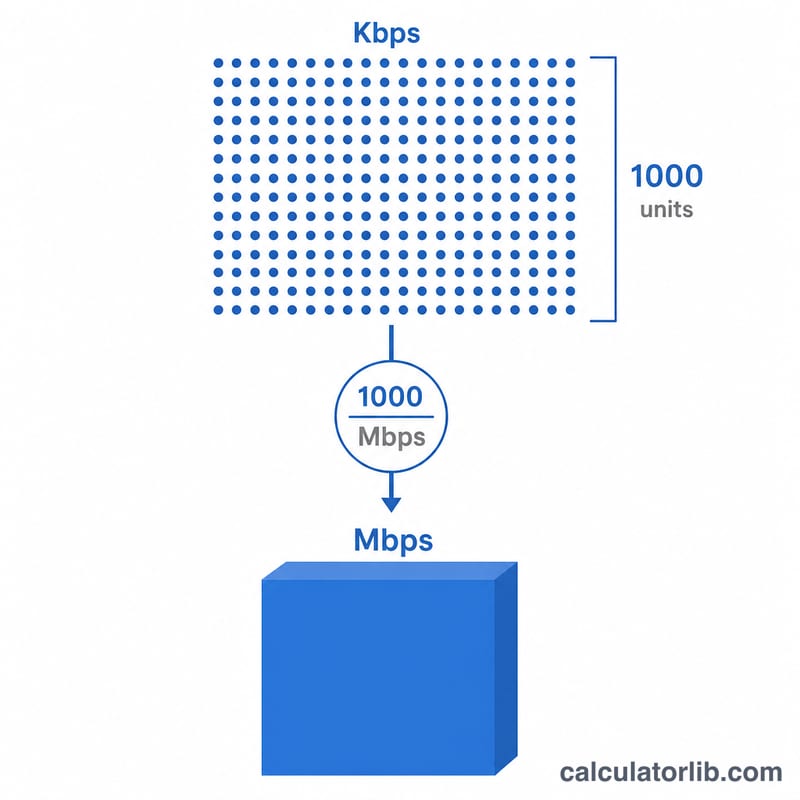
This tool converts a data transfer rate expressed in kilobits per second (Kbps) into megabits per second (Mbps). Both are common units for measuring bandwidth, internet speed, and media bitrates. Because 1 megabit equals 1,000 kilobits in the decimal (SI) convention used by networking, the conversion is a simple division by 1,000.
How to use it
Enter your bitrate in the Kbps field and the calculator instantly displays the equivalent value in Mbps. For example, a 5,000 Kbps video stream is the same as 5 Mbps. This is useful when comparing streaming quality settings, ISP advertised speeds, or audio/video encoder outputs that report numbers in different units.
The formula explained
The conversion is $$\text{Mbps} = \frac{\text{Kbps}}{1000}$$ The "kilo" prefix means one thousand and "mega" means one million, so a megabit is one thousand kilobits. Networking and storage marketing almost always use this decimal base-10 convention (\(1\text{ Mbps} = 1000\text{ Kbps}\)), as opposed to the binary base-2 convention (1024) sometimes used for file sizes.
Worked example
Suppose a stream is encoded at 8,000 Kbps. Dividing by 1,000 gives $$8000 \div 1000 = 8 \text{ Mbps}$$ Likewise, 256 Kbps audio equals $$256 \div 1000 = 0.256 \text{ Mbps}$$
Typical Bitrates for Audio, Video and Connections
The table below lists commonly published, approximate bitrates and converts them with \(\text{Mbps} = \text{Kbps} / 1000\) (decimal convention, where 1 Mbps = 1,000 Kbps). Real bitrates vary by codec, content, and service, so treat these as typical values, not exact ones. Video rows are given in Mbps and converted to Kbps.
| Use case | Approx. Kbps | Approx. Mbps |
|---|---|---|
| MP3 audio, standard quality | 128 | 0.128 |
| MP3 audio, higher quality | 192 | 0.192 |
| MP3 audio, high quality | 320 | 0.32 |
| Streaming audio, low tier (Spotify-style, about 24 Kbps) | 24 | 0.024 |
| Streaming audio, normal tier (about 96 Kbps) | 96 | 0.096 |
| Streaming audio, high tier (about 160 Kbps) | 160 | 0.16 |
| Streaming audio, very high tier (about 320 Kbps) | 320 | 0.32 |
| VoIP call (codec plus packet overhead, roughly 64–100 Kbps) | 64–100 | 0.064–0.1 |
| 480p (SD) video streaming, roughly 1–3 Mbps | 1,000–3,000 | 1–3 |
| 720p (HD) video streaming, roughly 2.5–5 Mbps | 2,500–5,000 | 2.5–5 |
| 1080p (Full HD) video streaming, roughly 5–8 Mbps | 5,000–8,000 | 5–8 |
| 4K (Ultra HD) video streaming, roughly 15–25 Mbps | 15,000–25,000 | 15–25 |
For reference, Netflix has published recommended connection speeds of about 3 Mbps for SD, 5 Mbps for HD, and 15 Mbps for 4K. Those are connection speeds, so actual video bitrates are often somewhat lower. Streaming-service tiers and recommendations change over time, so check the provider's current documentation.
FAQ
Is 1 Mbps equal to 1000 or 1024 Kbps? For data rates the SI standard is \(1000\text{ Kbps} = 1\text{ Mbps}\), which is what this calculator uses.
What about megabytes (MB)? Bits and bytes differ by a factor of 8. To get megabytes per second, divide Mbps by 8.
Does this work for download speeds? Yes — ISP speeds are quoted in Mbps and use the same decimal convention.