
What this calculator does
This tool analyzes the classic projectile-motion quadratic \(h(t) = -16t^{2} + vt + s\), where height is measured in feet and time in seconds. The constant 16 comes from the imperial gravity term (½ × 32 ft/s²). Enter the initial upward velocity v and the launch height s, and the calculator returns the maximum height, the time it takes to reach that peak, and the time the object hits the ground.
How to use it
Type the initial velocity in feet per second and the initial height in feet, then read the results. The "maximum height" is the vertex of the parabola, the "time to peak" is the axis of symmetry, and "time when it lands" is the positive root of the equation.
The formula explained
Because the parabola opens downward, its vertex is the highest point. The axis of symmetry is at \(t = -b/(2a) = v/32\). Plugging that time back in gives the maximum height \(h_{\max} = s + v^{2}/64\). To find when the object lands, set \(h = 0\) and apply the quadratic formula to \(-16t^{2} + vt + s = 0\); the physically meaningful answer is the positive root, \(t = (v + \sqrt{v^{2} + 64s}) / 32\).
$$h(t) = -16\,t^{2} + \text{v}\,t + \text{s}$$ $$\text{where}\quad \left\{ \begin{aligned} t_{\max} &= \dfrac{\text{v}}{32} \\ h_{\max} &= \text{s} + \dfrac{\text{v}^{2}}{64} \\ t_{\text{land}} &= \dfrac{\text{v} + \sqrt{\text{v}^{2} + 64\,\text{s}}}{32} \end{aligned} \right.$$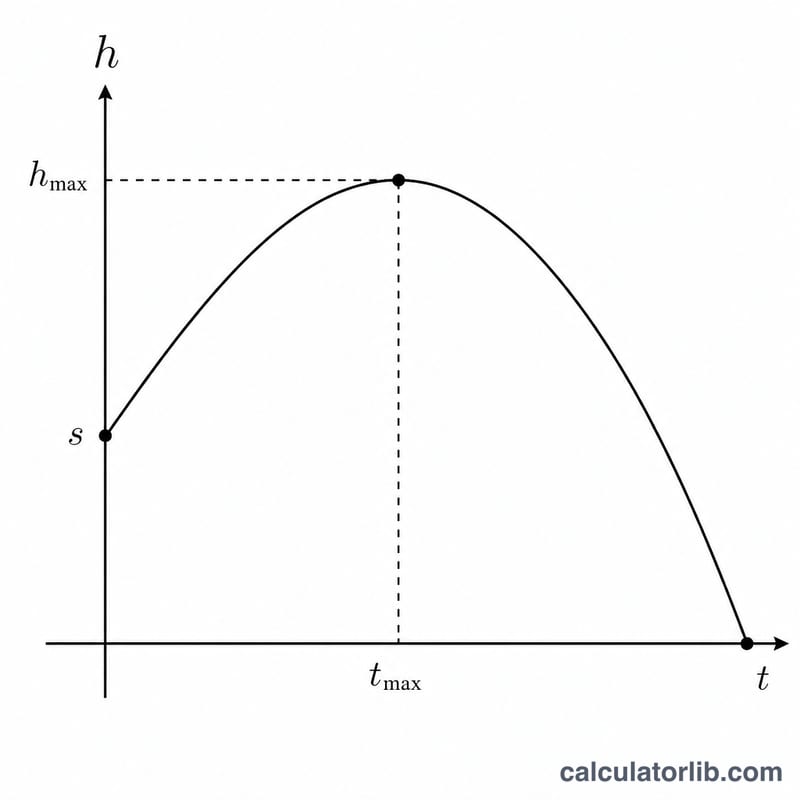
Worked example
Launch with \(v = 64\) ft/s from \(s = 80\) ft. Time to peak \(= 64/32 = 2\) s. Max height \(= 80 + 64^{2}/64 = 80 + 64 = 144\) ft. Landing:
$$t = \frac{64 + \sqrt{4096 + 5120}}{32} = \frac{64 + \sqrt{9216}}{32} = \frac{64 + 96}{32} = 5 \text{ s}$$FAQ
Why 16 instead of 9.8? The 16 uses feet and the gravity value 32 ft/s². For metric problems with meters use \(-4.9t^{2}\).
What if there is no real landing time? If \(v^{2} + 64s\) is negative the object never reaches the ground at \(h = 0\) within real numbers; here that only happens with negative starting height and small velocity.
Is the peak always at \(t = v/32\)? Yes, the axis of symmetry depends only on \(v\) and the \(-16\) coefficient, not on \(s\).