What is the Luggage Volume Calculator?
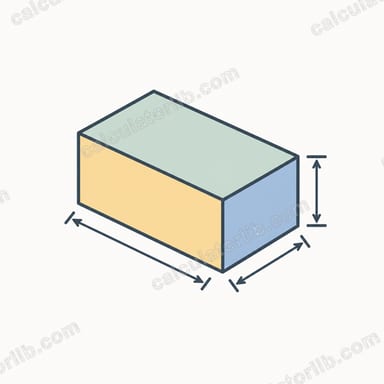
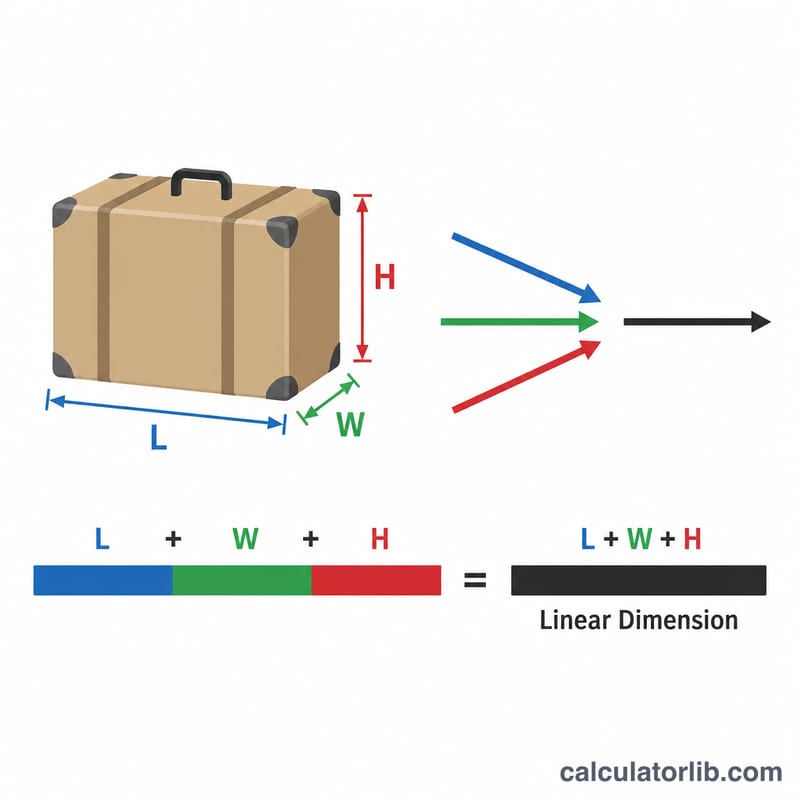
This tool converts the three outside dimensions of a suitcase, backpack or box into a usable capacity figure in litres, the unit most luggage brands quote. It also adds up the length, width and height to give the linear dimension, the single number most airlines use to decide whether a bag counts as carry-on or checked baggage. Enter measurements in centimetres and you instantly see both numbers.
How to use it
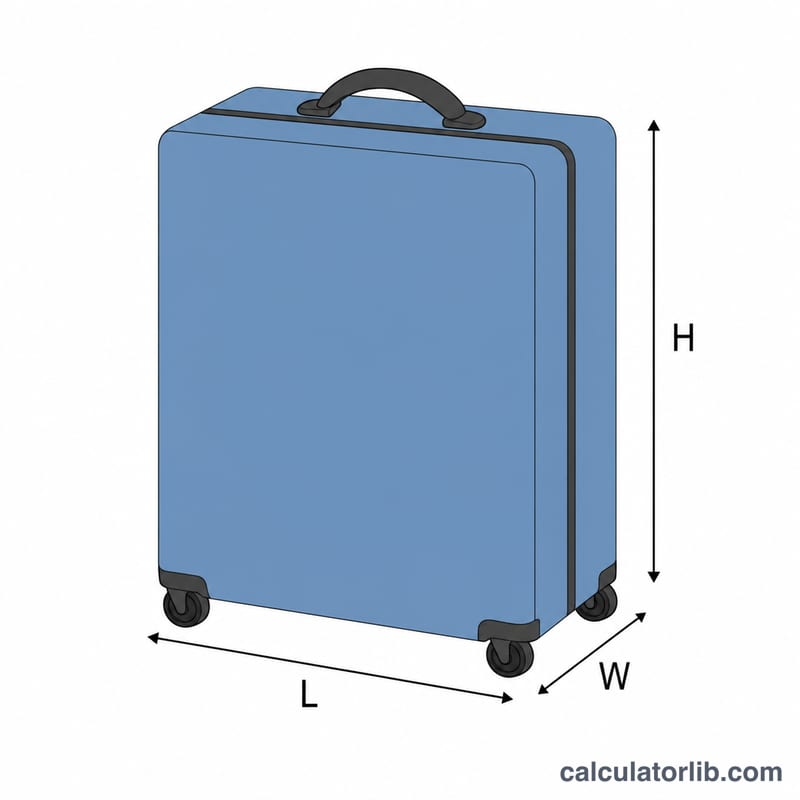
Measure the longest side as length, the next as width and the depth as height — all in centimetres, including any rigid handles, wheels or pockets that affect the airline measurement. Type the three values and read off the volume in litres, the volume in cubic centimetres, and the linear total. For soft bags, measure when packed since they expand.
The formula explained
Volume is simply length × width × height. Because there are 1,000 cubic centimetres in one litre, dividing the product by 1000 gives litres: $$V_{L} = \frac{L \times W \times H}{1000}$$ The linear dimension is the plain sum \(L + W + H\). Note this treats the bag as a perfect box, so real packing capacity is usually a little lower because of curved corners, padding and frames.
Worked example
A typical cabin bag measures 55 × 40 × 23 cm. Volume = $$55 \times 40 \times 23 = 50{,}600 \text{ cm}^3,$$ which divided by 1000 is 50.6 litres. The linear dimension is \(55 + 40 + 23 = 118\text{ cm}\) — 118 cm — right around many airlines' 115–118 cm carry-on limit.
Airline Cabin and Checked Baggage Size Limits
Airlines state baggage limits two ways: as three dimensions (length × width × height) and as a linear total, \(L + W + H\). The litre figures below are not published by the airlines — they are derived from the stated dimensions with the same formula this calculator uses, \(V = \frac{L \times W \times H}{1000}\), so they reconcile exactly with your own measurements.
| Allowance | Dimensions (cm) | Dimensions (in) | Linear total | Volume (L) |
|---|---|---|---|---|
| IATA recommended cabin bag (advisory guideline, not a rule) | 55 × 40 × 20 | 21.7 × 15.7 × 7.9 | 115 cm (45 in) | 44.0 L |
| Typical European / US carry-on | 55 × 40 × 23 | 21.7 × 15.7 × 9.1 | 118 cm (46 in) | 50.6 L |
| Common budget-carrier personal item (under-seat) | 40 × 20 × 25 | 15.7 × 7.9 × 9.8 | 85 cm (33 in) | 20.0 L |
| Checked bag at the standard linear limit | e.g. 78 × 50 × 30 | 30.7 × 19.7 × 11.8 | 158 cm (62 in) | 117.0 L |
| Oversize / excess-size band (fee applies, often still accepted) | e.g. 90 × 60 × 40 | 35.4 × 23.6 × 15.7 | 190 cm — inside the 158–203 cm band | 216.0 L |
| Upper cut-off for oversize acceptance | — | — | 203 cm (80 in) | — |
Two points matter when you compare your own bag. First, measurements must include handles, wheels and external pockets — most carriers state the limit for the bag at its largest point, and a sizer gauge at the gate does not care that the wheels are "extra". Second, a bag can pass the linear test and still fail the individual-dimension test: a 100 × 10 × 5 cm tube is only 115 cm linear but will not fit a cabin sizer.
These are the most widely published figures across major carriers, not a universal standard. Allowances vary by airline, route, cabin class, fare type and aircraft — several low-cost carriers in Europe and Asia use smaller cabin limits (for example 40 × 20 × 25 cm for the free item), and some carriers cut the checked-bag limit below 158 cm on regional jets. Always check the specific airline's baggage page for the flight you are booked on before you pack.
Volume and Dimension Conversions
Luggage volume is quoted in litres almost everywhere in the world, while bag dimensions are quoted in centimetres in most of the world and in inches in the United States. The inch is defined as exactly 2.54 cm, so every factor below is exact or exact-to-the-rounding shown.
| Quantity | Equals | Notes |
|---|---|---|
| 1 litre | 1,000 cm³ = 0.001 m³ | Exact (a 10 × 10 × 10 cm cube) |
| 1 inch | 2.54 cm | Exact by definition |
| 1 cubic inch | 16.387 cm³ ≈ 0.016387 L | \(2.54^3 = 16.387064\) cm³ |
| 1 litre | ≈ 61.024 in³ | Reciprocal of the row above |
| 1 cubic foot | ≈ 28.317 L | 1,728 in³ |
| 1 m³ | 1,000 L | Exact |
Linear limits in both units
| Linear total (cm) | Linear total (in) | Where it is used |
|---|---|---|
| 115 cm | ≈ 45.3 in (quoted as 45 in) | IATA-recommended cabin bag |
| 158 cm | 62.2 in (quoted as 62 in) | Standard checked-bag limit |
| 203 cm | 79.9 in (quoted as 80 in) | Upper oversize cut-off |
Note the small mismatch: 62 in is exactly 157.48 cm and 80 in is exactly 203.2 cm, so airlines round to the friendlier 158 cm and 203 cm. If your bag lands within a centimetre of a limit, treat it as being at the limit.
Worked micro-conversion: an inch-measured bag
A US-market carry-on is advertised as 22 × 14 × 9 in. Convert each edge before entering it:
$$22 \times 2.54 = 55.88\ \text{cm} \qquad 14 \times 2.54 = 35.56\ \text{cm} \qquad 9 \times 2.54 = 22.86\ \text{cm}$$
$$V = \frac{55.88 \times 35.56 \times 22.86}{1000} = \frac{45{,}424.9\ \text{cm}^3}{1000} = 45.42\ \text{L}$$
So the bag holds 45.42 litres, with a linear total of \(55.88 + 35.56 + 22.86 = 114.3\) cm (exactly 45 in) — inside the 115 cm cabin guideline, but with almost no margin for a bulging front pocket.
As a cross-check in imperial units: \(22 \times 14 \times 9 = 2{,}772\ \text{in}^3\), and \(2{,}772 \div 61.024 = 45.42\) L. The two routes agree, as they must.
Volume and Linear Size of Common Bag Sizes
The table below runs six typical bag sizes through the same two calculations: \(V = \frac{L \times W \times H}{1000}\) for litres and \(L + W + H\) for the linear total. Every figure is computed from the dimensions in the first column, so you can reproduce any row by entering those three numbers.
| Bag type | Dimensions (cm) | Volume (cm³) | Volume (L) | Linear (cm) | Limit band |
|---|---|---|---|---|---|
| Personal item / under-seat bag | 40 × 25 × 20 | 20,000 | 20.0 L | 85 | Well inside the 115 cm cabin band |
| Daypack (nominal 30 L) | 50 × 30 × 20 | 30,000 | 30.0 L | 100 | Inside the 115 cm cabin band |
| Cabin bag (IATA guideline size) | 55 × 40 × 20 | 44,000 | 44.0 L | 115 | Exactly at the 115 cm cabin limit |
| Larger cabin bag (common carrier allowance) | 55 × 40 × 23 | 50,600 | 50.6 L | 118 | Over 115 cm, but allowed by many carriers |
| Medium check-in | 67 × 45 × 27 | 81,405 | 81.4 L | 139 | Inside the 158 cm checked band |
| Large check-in | 77 × 50 × 30 | 115,500 | 115.5 L | 157 | Just inside the 158 cm checked limit |
Worth noticing: the large check-in bag holds 115.5 L in 157 linear cm, while the 55 × 40 × 23 cm cabin bag holds 50.6 L in 118 linear cm. Volume grows with the product of three edges but the linear limit only adds them, so cube-shaped bags convert a linear allowance into far more capacity than long, flat ones. A 158 cm allowance spent as a near-cube of roughly 53 × 53 × 52 cm would enclose about 146 L — some 30 L more than the conventional upright above, which is why many airlines add a separate per-dimension cap.
Two caveats on the litre figures. They describe the box the bag occupies from the outside, so the usable packing volume is lower — shell thickness, wheel housings, a telescopic handle and internal frames typically absorb 10–20% on a hard-shell roller, less on a soft duffel. And manufacturers' advertised litre ratings are measured inconsistently: some quote internal capacity, some quote external volume, some include expansion zips. Measuring your own bag and running the numbers is the only way to compare like with like, and it is the external dimensions that a gate sizer will judge.
FAQ
Why litres and not cubic metres? Litres are the standard size unit for bags and packs, making it easy to compare a 40 L backpack with a 50 L case.
Does the calculator account for wheels and handles? No — it uses the dimensions you enter, so include wheels and handles if your airline measures the bag with them.
Is the real capacity exactly this number? Usually slightly less. The maths assumes a rectangular box; rounded corners and internal padding reduce true packing space by roughly 5–15%.