
What this calculator does
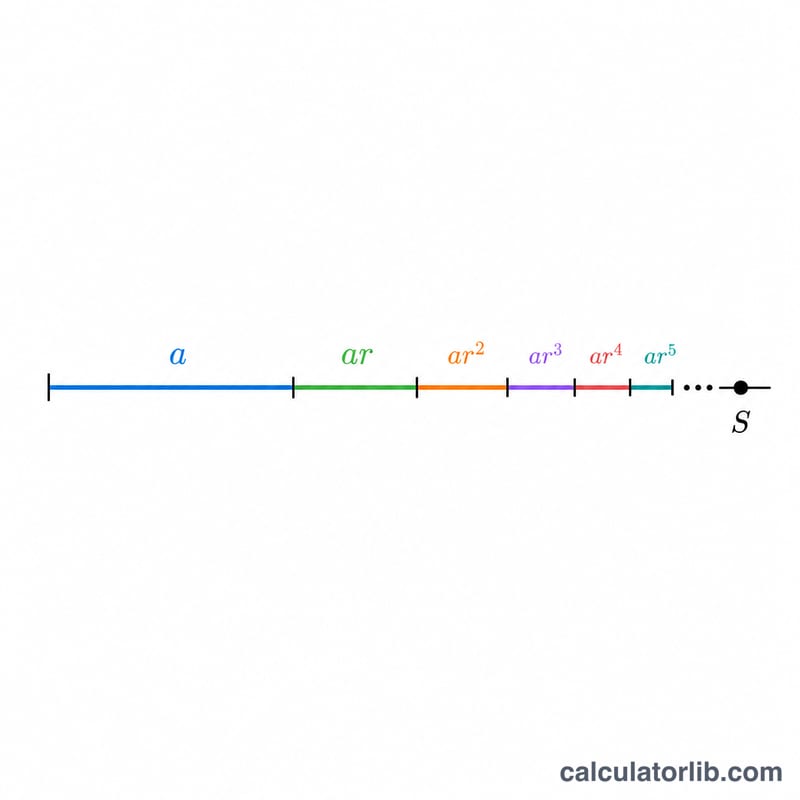
This tool evaluates the sum to infinity of a geometric series, written in sigma notation as the infinite sum of \(a r^{k}\) from \(k = 0\) onward. A geometric series adds terms that each multiply the previous one by a fixed common ratio \(r\). When the ratio is small enough, the partial sums settle on a single finite value even though there are infinitely many terms.
How to use it
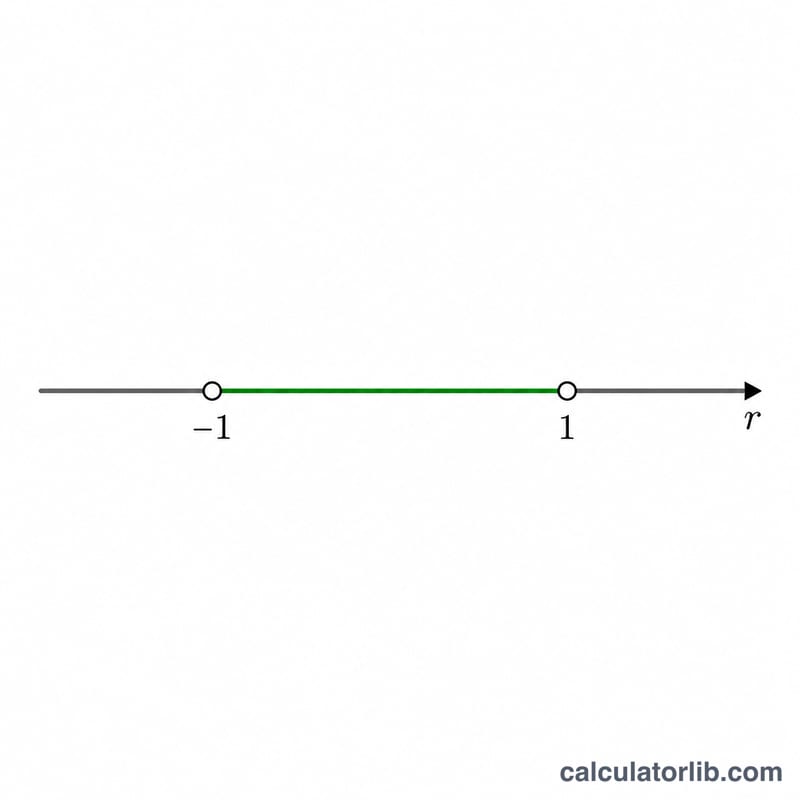
Enter the first term \(a\) (the value of the very first term in the series) and the common ratio \(r\) (the number each term is multiplied by to get the next). Press calculate. If the absolute value of \(r\) is below 1, the calculator returns the finite sum; otherwise it warns you that the series diverges.
The formula explained
The closed form is $$S = \frac{a}{1 - r}.$$ It comes from the partial-sum formula $$S_n = \frac{a(1 - r^{n})}{1 - r}.$$ As \(n\) grows without bound, \(r^{n}\) shrinks to 0 whenever \(|r| < 1\), leaving \(S = \frac{a}{1 - r}\). If \(|r|\) is 1 or larger, \(r^{n}\) does not vanish, so no finite limit exists and the series diverges.
Worked example
Take \(a = 1\) and \(r = \frac{1}{2}\). The terms are 1, 0.5, 0.25, 0.125, ... Since \(|r| = 0.5 < 1\), the series converges. Using the formula: $$S = \frac{1}{1 - 0.5} = \frac{1}{0.5} = 2.$$ The endless sum equals exactly 2.
FAQ
What if r is negative? A negative ratio still works as long as \(|r| < 1\); for example \(a = 3\), \(r = -0.5\) gives \(S = \frac{3}{1.5} = 2\). The terms alternate in sign.
Why must |r| be less than 1? Only then do later terms get small enough fast enough for the total to approach a fixed number. If \(|r| \ge 1\) the terms do not shrink and the sum grows without limit.
Does the first term need to be the k = 0 term? Enter whatever value is the first term of your series; the formula uses that value directly as \(a\).