What this calculator does
The Minutes Between Two Times Calculator tells you exactly how many minutes pass between a start time and an end time. Enter both times using a 24-hour clock and it returns the gap in minutes, the equivalent in decimal hours, and a tidy hours-and-minutes breakdown. It correctly handles spans that cross midnight, such as a night shift that begins at 22:00 and ends at 06:00.
How to use it
Enter the start hour and minute, then the end hour and minute. Hours run from 0 to 23 and minutes from 0 to 59. Press calculate to see the difference. If the end time is earlier in the day than the start time, the tool assumes the end falls on the following day and adds a full day (1,440 minutes) so you always get a positive duration.
The formula explained
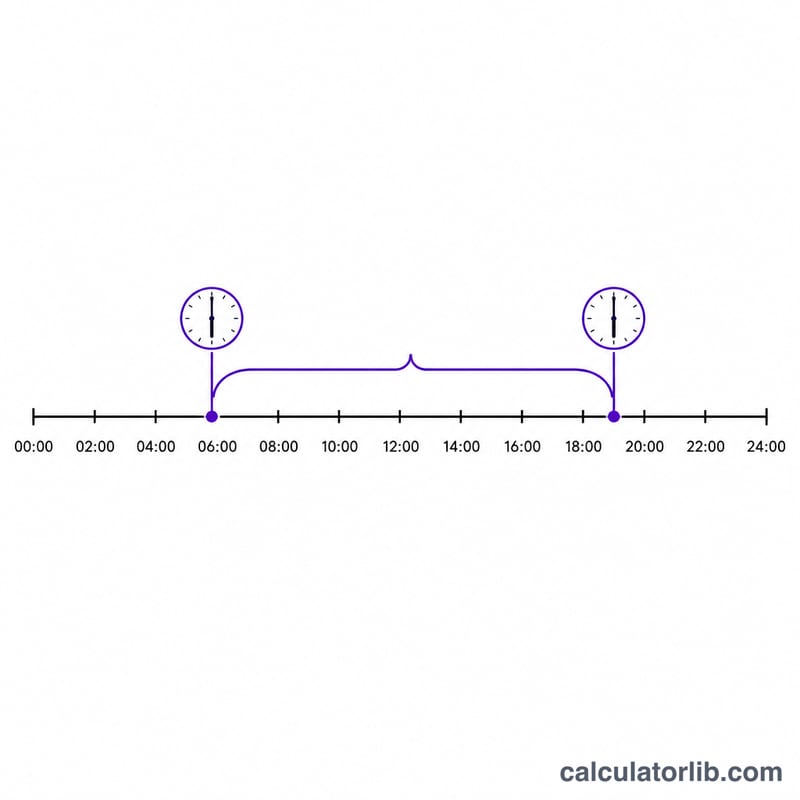
Each clock time is first converted to "minutes since midnight" using \(\text{hours} \times 60 + \text{minutes}\). The start value is subtracted from the end value. When that subtraction is negative, the span wrapped past midnight, so we add 1,440 — the number of minutes in 24 hours — to recover the real elapsed time.
$$\begin{gathered} \text{Minutes} = \left(D + 1440\right) \bmod 1440 \\[1.5em] \text{where}\quad D = \left(60 \cdot \text{End Hour} + \text{End Min}\right) - \left(60 \cdot \text{Start Hour} + \text{Start Min}\right) \end{gathered}$$Worked example
From 9:00 to 17:30: start = \(9 \times 60 + 0 = 540\) minutes; end = \(17 \times 60 + 30 = 1{,}050\) minutes. Difference = \(1{,}050 - 540 = \) 510 minutes, which is 8 hours and 30 minutes (8.5 hours).
$$1{,}050 - 540 = 510 \text{ minutes}$$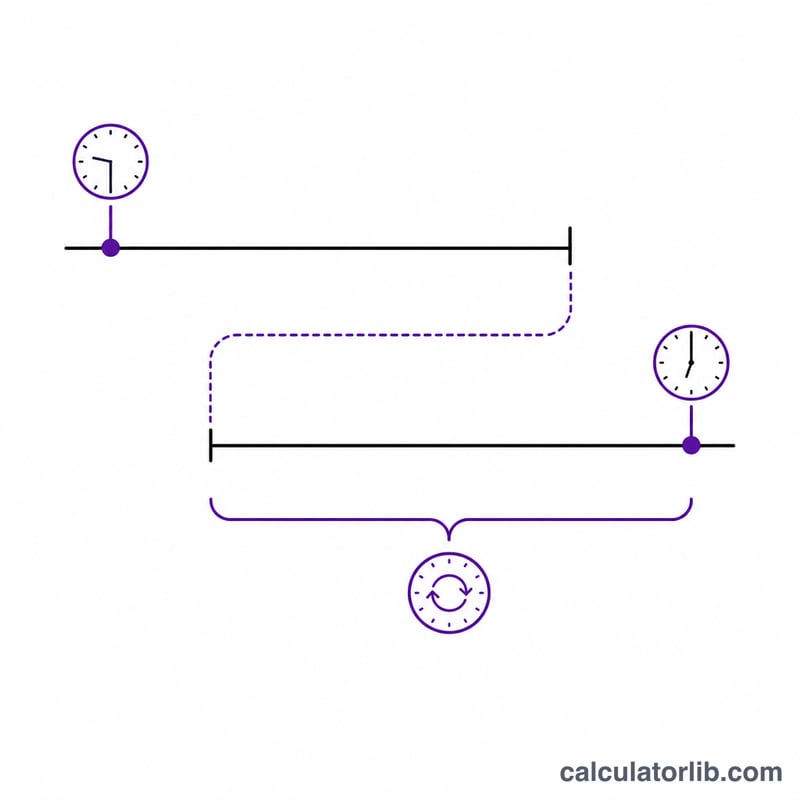
Example Time Spans and Their Results
The calculator converts each time to minutes since midnight, subtracts start from end, and adds 1,440 before taking the remainder so that overnight spans work. If the start and end are identical, the result is 0 minutes, not 24 hours.
| Start | End | Minutes | Hours and minutes |
|---|---|---|---|
| 09:00 | 17:30 | 510 | 8 h 30 min |
| 22:00 | 06:00 (next day) | 480 | 8 h |
| 23:45 | 00:15 (next day) | 30 | 0 h 30 min |
| 12:00 | 12:00 | 0 | 0 h 0 min |
| 00:00 | 23:59 | 1,439 | 23 h 59 min |
| 08:15 | 08:10 | 1,435 | 23 h 55 min (nearly a full day) |
Worked check for 22:00 to 06:00: \(D = (60\cdot 6 + 0) - (60\cdot 22 + 0) = 360 - 1320 = -960\), then \((-960 + 1440) \bmod 1440 = 480\) minutes, which is 8 hours.
Worked check for 08:15 to 08:10: \(D = 490 - 495 = -5\), so \((-5 + 1440) \bmod 1440 = 1435\) minutes. The end time is earlier than the start, so the span wraps around to the next day.
Minutes to Hours Conversion Table
To convert minutes to decimal hours, divide by 60: \(\text{Decimal hours} = \frac{\text{minutes}}{60}\). This is useful for timesheets and billing.
| Minutes | Hours and minutes | Decimal hours |
|---|---|---|
| 15 | 0 h 15 min | 0.25 |
| 30 | 0 h 30 min | 0.5 |
| 45 | 0 h 45 min | 0.75 |
| 60 | 1 h 0 min | 1 |
| 90 | 1 h 30 min | 1.5 |
| 120 | 2 h 0 min | 2 |
| 240 | 4 h 0 min | 4 |
| 480 | 8 h 0 min | 8 |
| 720 | 12 h 0 min | 12 |
| 1,440 | 24 h 0 min | 24 |
To go the other way, multiply decimal hours by 60. For example, 2.5 hours is \(2.5 \times 60 = 150\) minutes, or 2 h 30 min.
FAQ
What if the end time is past midnight? Enter it as it appears on a 24-hour clock (e.g. 1 a.m. = 1:00). If the result would be negative, the calculator adds 1,440 minutes automatically.
Can I get the answer in hours? Yes — the result also shows the total in decimal hours and as hours plus minutes.
Does it count both endpoints? No, it measures the elapsed duration between the two times, not an inclusive count.