What Is Net Operating Income (NOI)?
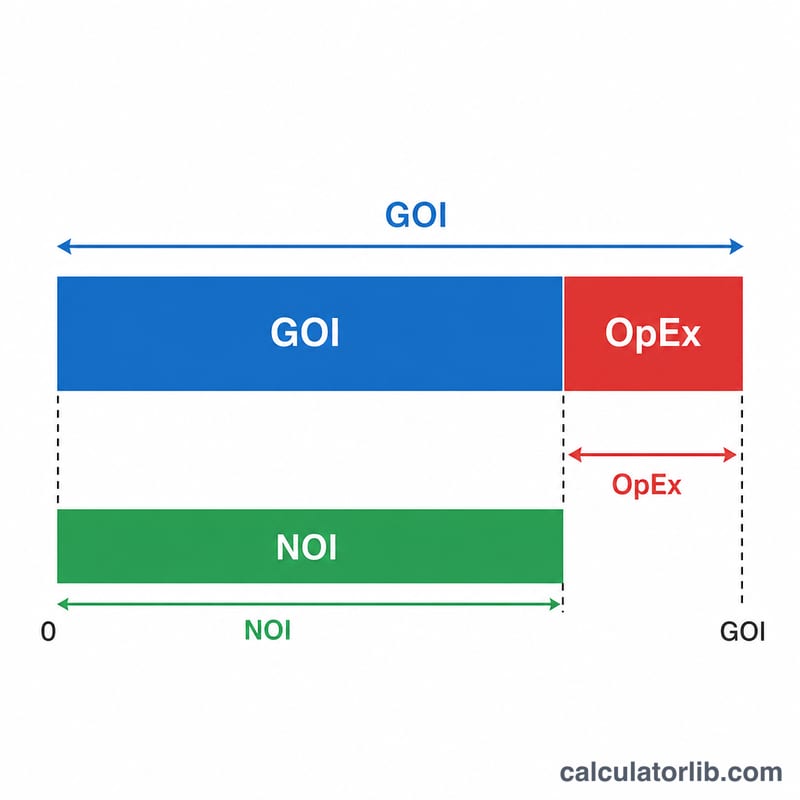
Net Operating Income (NOI) is a core metric in commercial and rental real estate that measures the profitability of an income-producing property before financing and taxes. It is calculated by subtracting all operating expenses from the gross operating income the property generates. NOI is used by investors and lenders to evaluate deals, calculate capitalization (cap) rates, and estimate property value.
How to Use This Calculator
Enter your gross operating income — the total rent and other income collected after accounting for vacancy and credit losses. Then enter your annual operating expenses, which include property management, insurance, property taxes, maintenance, utilities, and repairs. The calculator instantly returns your NOI and operating margin.
The Formula Explained
The formula is simple: $$\text{NOI} = \text{Gross Operating Income} - \text{Operating Expenses}$$ Importantly, NOI excludes mortgage principal and interest, depreciation, capital expenditures, and income taxes. These items relate to financing and accounting rather than the property's day-to-day operating performance, so leaving them out lets you compare properties on equal footing.
Worked Example
Suppose a small apartment building collects $120,000 in gross operating income per year and incurs $45,000 in operating expenses. The NOI is $$\$120{,}000 - \$45{,}000 = \$75{,}000$$ The operating margin is $$\$75{,}000 \div \$120{,}000 = 62.5\%$$ If the property's market value is $1,000,000, the cap rate would be $$\$75{,}000 \div \$1{,}000{,}000 = 7.5\%$$
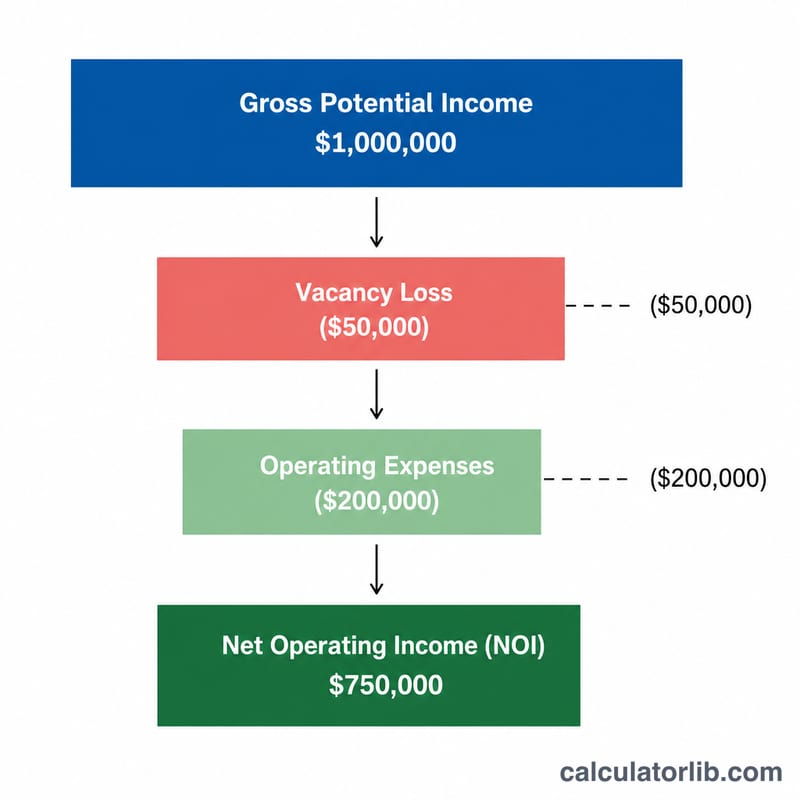
Key NOI Terms and Definitions
- Potential Gross Income (PGI)
- The total rent a property would collect if every unit were leased at market or contract rent for the full period, with no vacancy or non-payment. Other income (parking, laundry, fees) is often added.
- Vacancy and Credit Loss
- The income deducted from PGI for units that sit empty and for tenants who do not pay. It is usually expressed as a percentage of PGI.
- Effective / Gross Operating Income (EGI)
- PGI plus other income, minus vacancy and credit loss. This is the income figure entered in the calculator's gross field.
- Operating Expenses
- The recurring costs of running and maintaining the property: property taxes, insurance, utilities paid by the owner, repairs and maintenance, property management, landscaping, and similar items. This is the expenses field.
- Capital Expenditures (CapEx)
- Large, infrequent spending that extends a property's life or improves it, such as a new roof or HVAC replacement. CapEx is normally excluded from NOI, although some analysts separately set aside replacement reserves.
- Debt Service
- Mortgage principal and interest payments. Debt service is excluded from NOI, which is why NOI measures the property itself rather than how it is financed.
- Cap Rate
- The capitalization rate: NOI divided by property value (or price). It expresses the annual operating return on a property before financing.
- Operating Expense Ratio (OER)
- Operating expenses divided by effective gross income. It shows what share of income is consumed by running the property.
- Operating Margin
- NOI divided by effective gross income. It is the share of income left after operating expenses, so OER + operating margin = 100%.
Included in NOI: rental and other operating income, vacancy loss, and operating expenses. Excluded from NOI: debt service, capital expenditures, depreciation, amortization, and income taxes. Exact conventions (for example, treatment of reserves or management fees) vary between lenders and analysts, so confirm the definition used when comparing figures.
Interpreting Your NOI Result
NOI is an annual (or other period) measure of how much income a property generates from operations before financing, income taxes, and capital spending. It is calculated as \(\text{NOI} = \text{Gross Operating Income} - \text{Operating Expenses}\).
- Positive NOI: operating income exceeds operating costs, leaving money available to cover debt service, capital projects, and any owner return.
- Negative NOI: operating expenses exceed income. The property does not cover its own running costs, before any mortgage payment is considered.
Cap rate and value. NOI links income to price through the capitalization rate:
$$\text{Cap Rate} = \frac{\text{NOI}}{\text{Property Value}} \qquad \text{Value} = \frac{\text{NOI}}{\text{Cap Rate}}$$
For example, an NOI of $75,000 at a 7.5% cap rate implies a value of \(\$75{,}000 / 0.075 = \$1{,}000{,}000\). Because value is proportional to NOI, each $1 change in NOI changes the implied value by \(1 / \text{cap rate}\) dollars (about $13.33 at 7.5%).
Operating margin and expense ratio. Operating margin is \(\text{NOI} / \text{EGI}\) and the operating expense ratio is \(\text{Operating Expenses} / \text{EGI}\). A higher margin (lower expense ratio) means more of each income dollar remains after running the property. Typical ratios differ by property type, age, location, and which costs the tenant pays, so they are best compared against similar properties.
Why compare NOI before financing. Two identical properties can have very different cash flow after loan payments depending on their mortgages. Because NOI excludes debt service, it allows properties to be compared on operating performance alone, and lenders also use it for measures such as the debt service coverage ratio. NOI does not capture capital expenditure needs, so it is one input among several. This is general information, not investment advice.
NOI Scenario Comparison
The table uses one hypothetical property and a fixed 7.5% cap rate to show how changes in income and expenses flow through to NOI, margin, and implied value (Value = NOI / 0.075). Figures are illustrative, not market data.
| Scenario | Gross Operating Income | Operating Expenses | NOI | Operating Margin | Implied Value at 7.5% |
|---|---|---|---|---|---|
| Base case | $120,000 | $45,000 | $75,000 | 62.5% | $1,000,000 |
| Higher vacancy (income down 10%) | $108,000 | $45,000 | $63,000 | 58.3% | $840,000 |
| Expenses up 10% | $120,000 | $49,500 | $70,500 | 58.75% | $940,000 |
| Rent increase (income up 5%) | $126,000 | $45,000 | $81,000 | 64.3% | $1,080,000 |
Reading the table: a 10% drop in income cuts NOI by 16% (from $75,000 to $63,000) because expenses stay fixed, while a 10% rise in expenses cuts NOI by 6%. Operating margins are NOI divided by gross operating income, for example \(63{,}000 / 108{,}000 \approx 58.3\%\). Because implied value moves in proportion to NOI at a fixed cap rate, small operating changes can have a large effect on value.
FAQ
Does NOI include the mortgage payment? No. NOI is calculated before debt service, so mortgage principal and interest are not subtracted.
What counts as operating expenses? Recurring costs to run the property: management fees, insurance, property taxes, utilities, repairs, and maintenance. Capital improvements are not included.
Can NOI be negative? Yes. If operating expenses exceed gross operating income, NOI is negative, signaling the property is losing money on operations.