What this calculator does
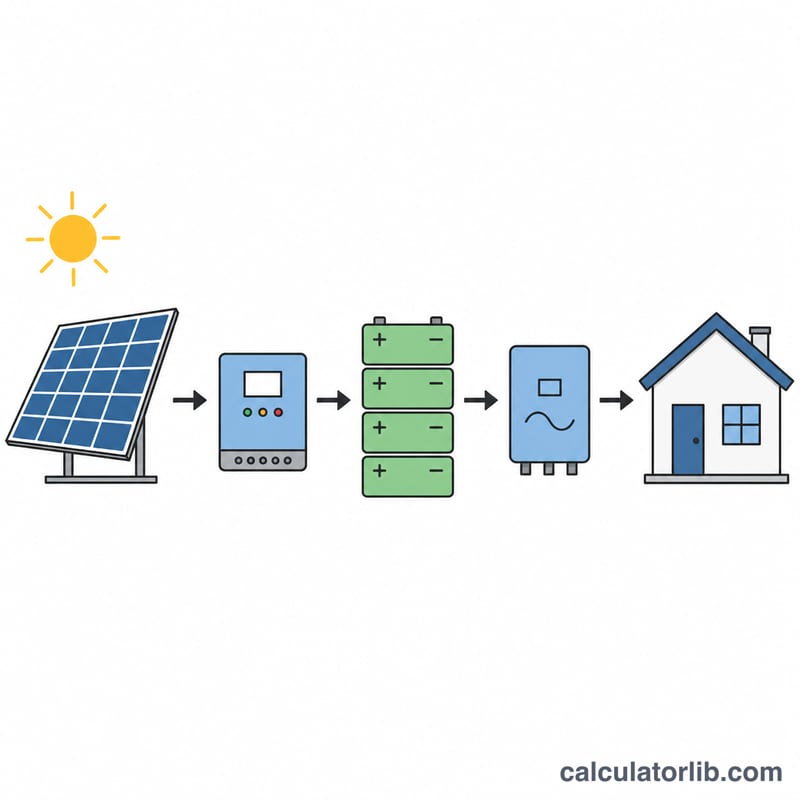
The Off-Grid Solar Power Calculator estimates the two core components of a standalone solar system: the size of the solar panel array (in watts) and the battery bank (in watt-hours and amp-hours). It starts from your daily energy consumption and accounts for local sunlight, days of backup you want, battery depth of discharge and overall system losses.
How to use it
Enter your average daily energy use in kilowatt-hours, the peak sun hours for your location, your battery bank voltage (commonly 12, 24 or 48 V), how many days of autonomy you want (backup with no sun), the usable depth of discharge of your batteries and an overall system efficiency to cover wiring, inverter and charge-controller losses.
The formula explained
The panel array is sized so it can replace a full day of energy within the available sun hours, after losses. With \(E_{day}\) = daily energy in kWh, \(H_{sun}\) = peak sun hours and \(\eta\) = efficiency fraction:
$$P_{array} = \frac{E_{day} \times 1000}{H_{sun} \times \eta}$$The battery bank must store enough usable energy for your autonomy days \(D\) at the chosen depth of discharge \(DoD\), then converted to amp-hours with the bank voltage \(V\):
$$C_{Ah} = \frac{E_{day} \times 1000 \times D}{DoD \times V}$$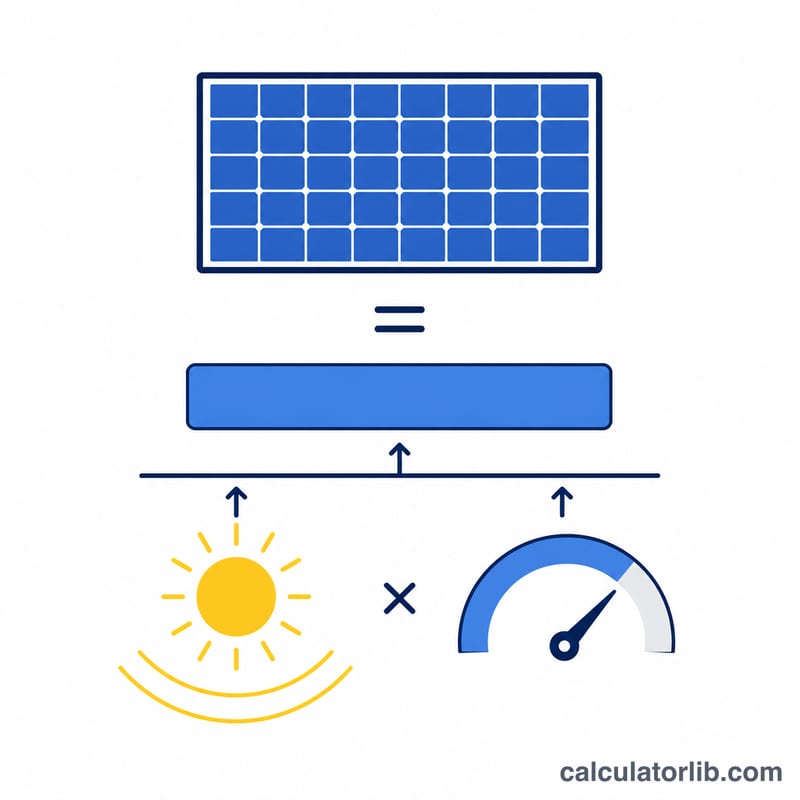
Worked example
Suppose you use 5 kWh/day, get 5 peak sun hours, run a 48 V bank, want 2 days of autonomy, use 50% depth of discharge and 75% system efficiency. The array size is:
$$P_{array} = \frac{5 \times 1000}{5 \times 0.75} = 1333\,\text{W}$$The battery storage and capacity are:
$$C_{Wh} = \frac{5 \times 1000 \times 2}{0.5} = 20000\,\text{Wh}, \quad C_{Ah} = \frac{20000}{48} = 417\,\text{Ah}$$Peak Sun Hours by Region
"Peak sun hours" (PSH) express a location's daily solar energy as the number of hours of full 1000 W/m² sun, so 5 PSH means about 5 kWh/m² received that day. For off-grid systems, size the array around the worst-case month (usually mid-winter) rather than the annual average, because that is when energy is scarcest and autonomy matters most.
The values below are approximate, widely-cited climate averages and are not tied to any single standard. Solar resource depends heavily on local climate, shading and orientation, so verify your exact site with an irradiance database such as NASA POWER, the EU's PVGIS, or the US NREL National Solar Radiation Database before committing to a design.
| Location (representative) | Winter ≈ (kWh/m²/day) | Summer ≈ (kWh/m²/day) | Annual avg ≈ |
|---|---|---|---|
| Equatorial (e.g. Nairobi, Kenya) | ≈ 5 | ≈ 6 | ≈ 5–6 |
| Phoenix, Arizona (USA) | ≈ 4–4.5 | ≈ 7–7.5 | ≈ 6–6.5 |
| Madrid, Spain | ≈ 2–2.5 | ≈ 7 | ≈ 4.5–5 |
| Sydney, Australia | ≈ 3 | ≈ 6 | ≈ 4.5–5 |
| London, UK | ≈ 0.8–1 | ≈ 4.5–5 | ≈ 2.5–3 |
| Berlin, Germany | ≈ 0.8–1 | ≈ 5 | ≈ 2.7–3 |
Note the pattern: seasonal spread widens sharply with latitude. Near the equator winter and summer are similar, while mid- and high-latitude sites (London, Berlin) can receive roughly five times more sun in summer than in winter — so a year-round off-grid system there must be sized on the low winter figure.
Typical Values for Key Inputs
These are general engineering rules of thumb for the calculator's inputs. Always confirm against the specific datasheets for the battery, inverter and charge controller you intend to buy.
Depth of discharge (dod)
- Flooded / sealed lead-acid: keep usable depth of discharge near \(50\%\) to preserve cycle life; deeper daily discharge shortens battery life considerably.
- LiFePO4 (lithium iron phosphate): commonly rated for \(80\%\) to \(90\%\) usable depth of discharge, giving far more usable energy per rated amp-hour.
Overall system efficiency (efficiency)
A whole-system efficiency of roughly \(70\%\) to \(80\%\) is typical once you account for inverter conversion, charge-controller losses (MPPT generally better than PWM), wiring and battery round-trip losses, temperature and panel soiling. Use a lower figure for long wire runs, hot climates or PWM controllers.
Common battery bank voltage (system_voltage)
- 12 V — small systems (RVs, cabins, loads up to a few hundred watts).
- 24 V — mid-size homes and larger loads.
- 48 V — whole-home and larger arrays; higher voltage means lower current, thinner cabling and less resistive loss.
Days of autonomy (autonomy_days)
- 2–3 days for mild, reliably sunny climates.
- 3–5+ days for cloudy or high-latitude regions with long overcast stretches, or for critical loads that must not be interrupted.
Practical Sizing Recommendations
Use these steps to turn the calculator's raw figures into a buildable, resilient system.
- Oversize the array by about 10–25%. Real output is reduced by module aging, dust, heat, wiring losses and below-average cloudy days, so add margin above the theoretical minimum — more margin for cloudy climates and critical loads.
- Round up to whole real panels. Panels come in fixed wattages (commonly 300–450 W each), so round the required array power up to a whole number of modules rather than down.
- Match the charge controller and inverter. Size the charge controller for the array's short-circuit current and voltage (with headroom), and size the inverter for your largest simultaneous load plus surge, not just the average draw.
- Verify the battery bank in amp-hours. Convert the required usable energy to amp-hours at your system voltage and depth of discharge, then check it maps cleanly onto available module capacities (e.g. 100 Ah or 200 Ah units) before purchasing.
Worked example
Suppose a cabin uses 3 kWh per day, the worst-case month gives 4 peak sun hours, and overall system efficiency is 75%. The array power is:
$$P_{\text{array}} = \frac{1000 \times E_{\text{daily}}}{H_{\text{sun}} \times \frac{\eta}{100}} = \frac{1000 \times 3}{4 \times \frac{75}{100}} = \frac{3000}{3} = 1000 \text{ W}$$So the minimum array is 1000 W. Applying a 20% oversize margin gives \(1000 \times 1.20 = 1200\) W, which rounds neatly to three 400 W panels (1200 W). For battery sizing at 2 days of autonomy on a 48 V LiFePO4 bank at 80% depth of discharge, the required usable energy is \(3 \times 2 = 6\) kWh, so the rated capacity is \(\frac{6000}{0.80} = 7500\) Wh, i.e. \(\frac{7500}{48} \approx 156\) Ah — round up to a standard bank such as 2 × 100 Ah (200 Ah) at 48 V.
This is general engineering information, not professional advice. Electrical system design and installation are safety-critical; have your final design and wiring reviewed by a qualified solar installer or electrician and follow your local codes.
FAQ
What are peak sun hours? They represent the number of hours per day the sun delivers 1000 W/m², a way to summarize daily solar energy. A location averaging 5 peak sun hours receives roughly the same total energy as 5 hours of full-strength sun.
Why include depth of discharge? Draining batteries fully shortens their life. Sizing the bank around a safe depth of discharge (for example 50% for lead-acid or 80%+ for lithium) keeps usable capacity healthy.
Should I add a safety margin? Yes. Real systems see cloudy days, aging panels and higher loads, so many designers oversize the array by 10-25% beyond the calculated value.