![pOH Calculator from [OH⁻]](https://cdn.calculatorlib.com/v5/calculators/thumb-flat-08a91d6b1d/pOH-to-poh-concentration-calculator.png)

What Is the pOH Calculator?
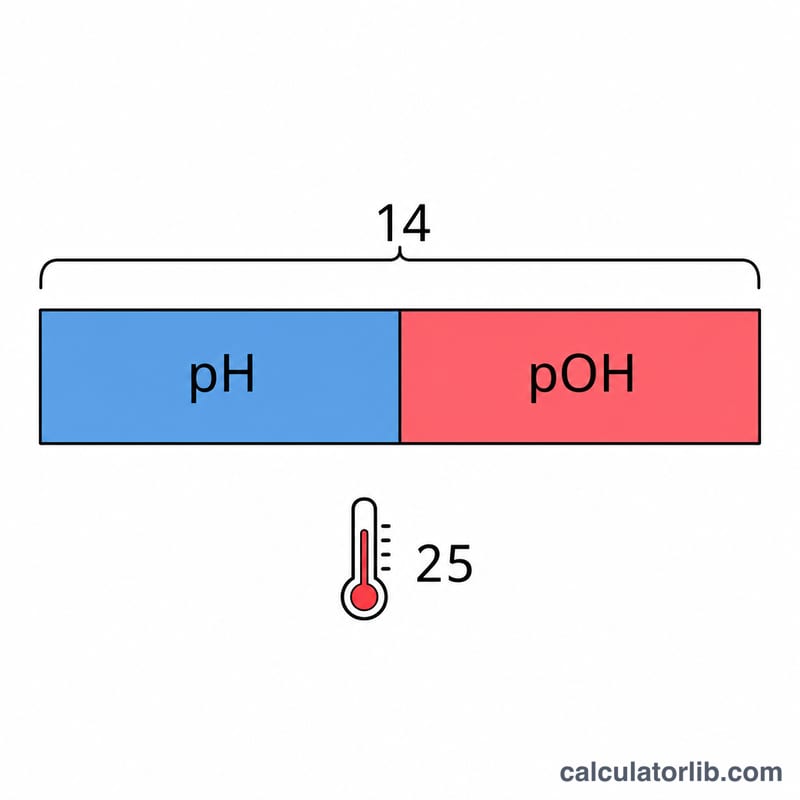
This tool calculates the pOH of an aqueous solution directly from its hydroxide ion concentration, written \([\text{OH}^-]\). pOH is a measure of how basic (alkaline) a solution is: the lower the pOH, the more basic the solution. It is the hydroxide counterpart to pH, and the two are linked at 25°C by the simple relation \(\text{pH} + \text{pOH} = 14\).
How to Use It
Enter the molar hydroxide ion concentration \([\text{OH}^-]\) in moles per liter (mol/L). For example, a 0.001 mol/L solution is typed as 0.001. The calculator returns the pOH instantly along with the corresponding pH at 25°C, so you can check both scales at once.
The Formula Explained
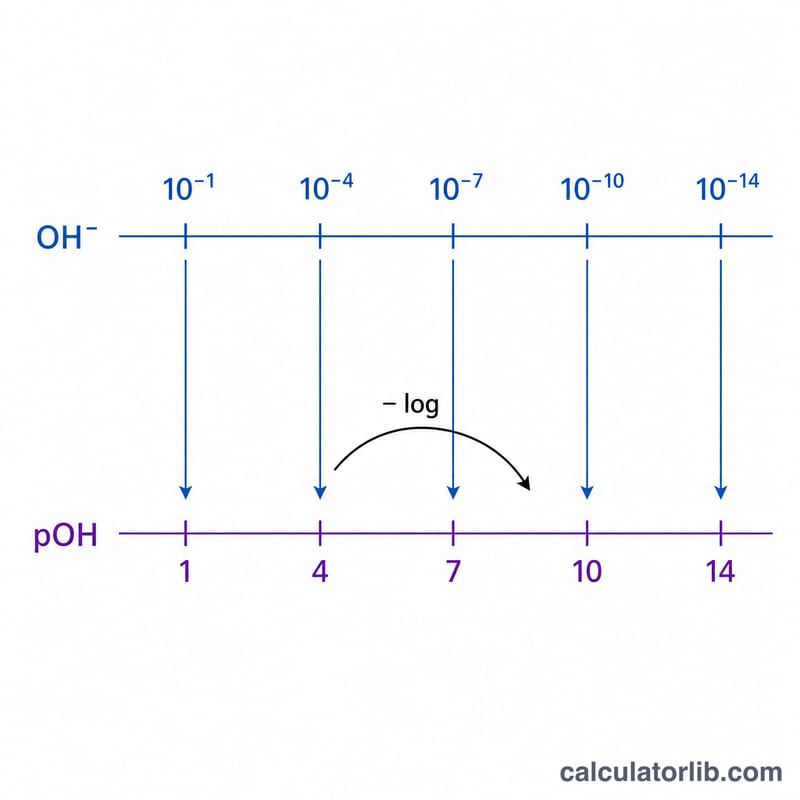
The defining equation is $$\text{pOH} = -\log_{10}\left(\text{[OH}^-\text{] (mol/L)}\right)$$ The base-10 logarithm compresses the wide range of possible concentrations (often spanning many orders of magnitude) into a convenient 0–14 scale. Because the logarithm of a number less than 1 is negative, the leading minus sign makes pOH a positive value for typical concentrations.
Worked Example
Suppose \([\text{OH}^-] = 1 \times 10^{-3}\) mol/L (0.001 mol/L). Then $$\text{pOH} = -\log_{10}(0.001) = -(-3) = 3$$ The corresponding pH \(= 14 - 3 = 11\), confirming a basic solution.
FAQ
Can the concentration be zero? No — the logarithm of zero is undefined, so the concentration must be greater than zero.
Does the pH = 14 − pOH relationship always hold? It holds at 25°C, where the ion product of water \(K_w = 1 \times 10^{-14}\). At other temperatures the constant 14 changes slightly.
What does a pOH of 7 mean? A pOH of 7 corresponds to a pH of 7, which is a neutral solution at 25°C.