What Is the Pallet Volume Calculator?
The Pallet Volume Calculator finds the total cubic space occupied by a loaded pallet. By entering the pallet footprint and the full stacked height, you get the volume in cubic meters, liters, and cubic centimeters. This helps with freight quoting, container loading, warehouse slotting, and dimensional-weight checks.
How to Use It
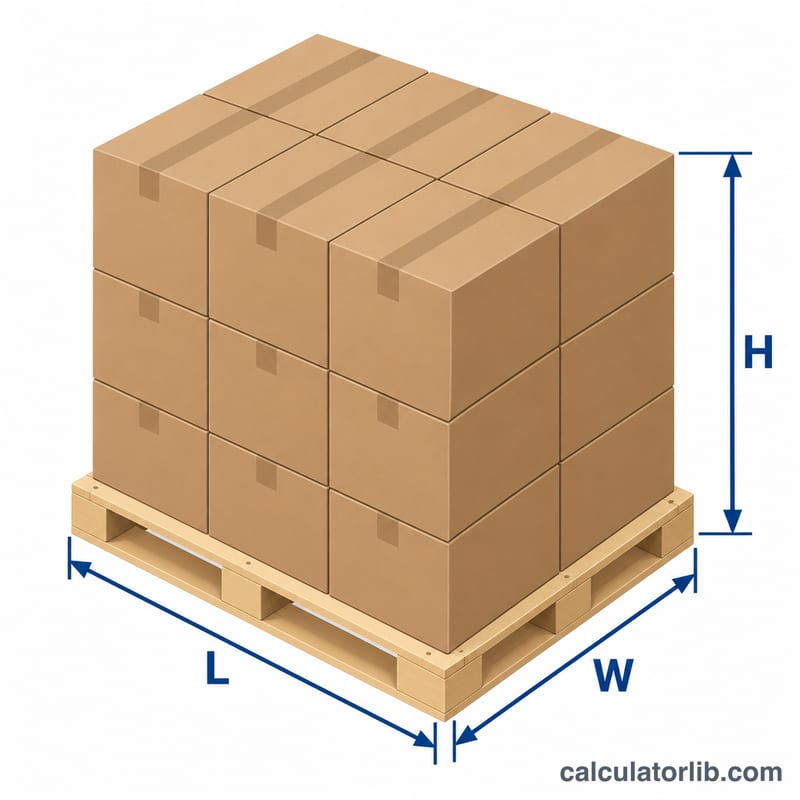
Measure the pallet's length and width (its footprint) and the total loaded height from the floor to the top of the cargo. Enter all three values in centimeters and read the volume instantly. Use the same unit for every field so the result stays consistent.
The Formula Explained
Volume is the product of three linear dimensions:
$$V = L \times W \times H$$where \(L\) = length in cm, \(W\) = width in cm, and \(H\) = total loaded height in cm. The raw result is in cubic centimeters, which converts to cubic meters by dividing by one million:
$$V_{m^3} = \frac{L \times W \times H}{1000000}$$Worked Example
Take a standard Euro pallet measuring \(120 \times 80\) cm loaded to \(150\) cm tall:
$$V = 120 \times 80 \times 150 = 1440000\ \text{cm}^3$$Converting to cubic meters:
$$V = \frac{1440000}{1000000} = 1.44\ \text{m}^3$$That equals \(1440\) liters of usable load space.
Standard Pallet Sizes and Footprints
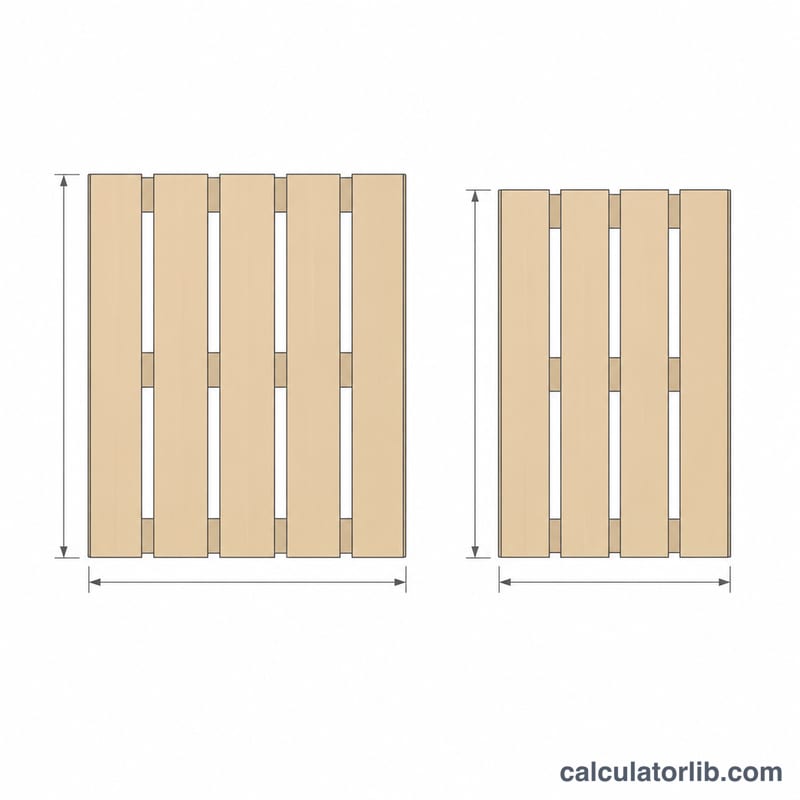
A pallet's footprint is its length × width. To get the volume of a loaded pallet, multiply the footprint by the loaded height. The table lists widely documented pallet footprints in centimetres, with the footprint area in square metres, worked out as \(A = L \times W / 10{,}000\). Several regions use their own standards. EUR/EPAL sizes are European, GMA is North American, and the 1165 × 1165 mm pallet is Australian. ISO 6780 recognises a set of international footprints that includes several of these.
| Pallet type | Region / standard | Footprint (cm) | Footprint area (m²) |
|---|---|---|---|
| EUR / EPAL 1 | Europe (EPAL) | 120 × 80 | 0.96 |
| EUR 2 | Europe | 120 × 100 | 1.20 |
| EUR 3 | Europe | 100 × 120 | 1.20 |
| EUR 6 (half pallet) | Europe | 80 × 60 | 0.48 |
| GMA (48 × 40 in) | North America | 121.9 × 101.6 | ≈ 1.239 |
| ISO 1100 × 1100 mm | Asia (common in Japan and Korea) | 110 × 110 | 1.21 |
| Australian standard | Australia | 116.5 × 116.5 | ≈ 1.357 |
| ISO 1200 × 1000 mm | ISO 6780 / Europe, Asia | 120 × 100 | 1.20 |
EUR 2 and EUR 3 have the same area, but their deck boards run in different directions. That matters for forklift entry and racking, but not for volume. The GMA footprint is exactly 48 × 40 inches, which is 121.92 × 101.6 cm, or 1.2387 m². The calculator examples round it to 121.9 cm.
Note on loaded height: no single maximum loaded height applies everywhere. Each freight carrier, warehouse, trailer or container type, and destination sets its own limit, and the limit usually counts the pallet base, which is often about 14–15 cm tall. Check the specific carrier's or consignee's requirements before you build a load. Measure loaded height from the floor to the highest point of the load so the calculated volume matches what the carrier will measure.
Volume at Common Loaded Heights
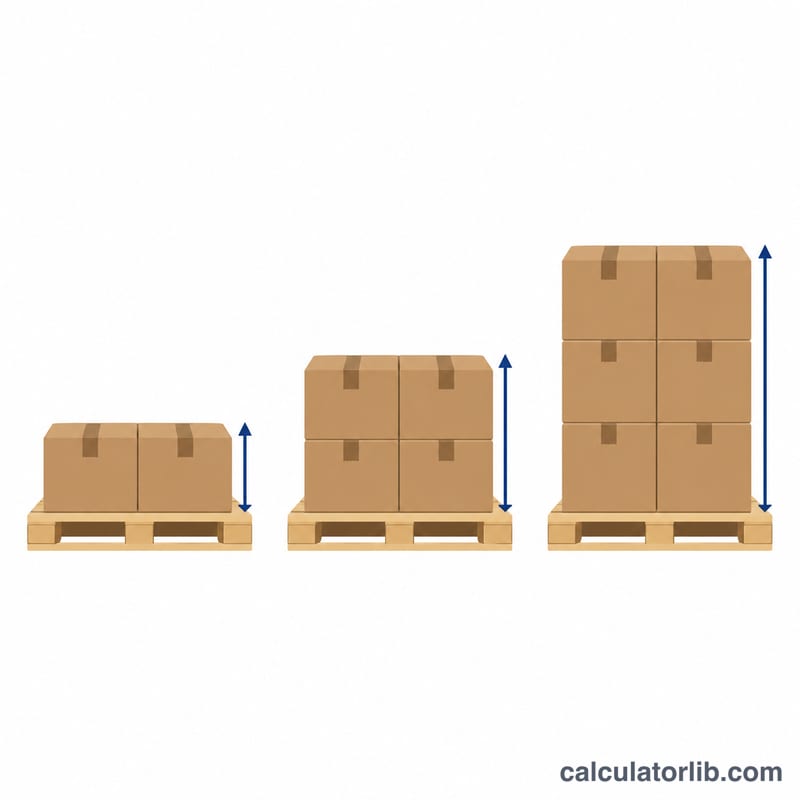
The table shows the gross cubic volume of a EUR 1 pallet (120 × 80 cm) and a North American GMA pallet (121.9 × 101.6 cm) at four loaded heights. Every value comes from the same formula:
$$V_{\text{m}^3} = \frac{L \times W \times H}{1{,}000{,}000} \qquad V_{\text{L}} = \frac{L \times W \times H}{1000}$$For example, a EUR pallet loaded to 180 cm: \(120 \times 80 \times 180 = 1{,}728{,}000\ \text{cm}^3\), and \(1{,}728{,}000 / 1{,}000{,}000 = 1.728\ \text{m}^3\), which is 1,728 litres. For the GMA pallet, the footprint is \(121.9 \times 101.6 = 12{,}385.04\ \text{cm}^2\), so at 180 cm the volume is \(12{,}385.04 \times 180 = 2{,}229{,}307.2\ \text{cm}^3 = 2.2293072\ \text{m}^3\).
| Loaded height (cm) | EUR 120 × 80: m³ | EUR 120 × 80: litres | GMA 121.9 × 101.6: m³ | GMA 121.9 × 101.6: litres |
|---|---|---|---|---|
| 100 | 0.96 | 960 | 1.238504 | 1,238.504 |
| 150 | 1.44 | 1,440 | 1.857756 | 1,857.756 |
| 180 | 1.728 | 1,728 | 2.2293072 | 2,229.3072 |
| 220 | 2.112 | 2,112 | 2.7247088 | 2,724.7088 |
At every height, the GMA pallet holds about 29% more volume than the EUR 1 pallet, because its footprint is 1.2385 m² against 0.96 m². Volume rises in direct proportion to height, so each extra 10 cm adds 0.096 m³ on a EUR 1 pallet and about 0.124 m³ on a GMA pallet. These are gross bounding-box volumes. They assume the load stays within the pallet footprint and include the pallet base if height is measured from the floor. Carriers that charge by volume or dimensional weight usually measure the same outer box, including any overhang.
FAQ
Should I include the pallet base in the height? Yes. Measure from the floor to the top of the stacked goods so the volume reflects the real shipping cube.
Can I use inches instead of cm? The calculator expects centimeters. Convert inches to cm first (1 in = 2.54 cm) for accurate results.
Why do shippers care about volume? Carriers often bill by dimensional weight, so an accurate cube can lower freight costs and improve container utilization.