
What is a 1RM Percentage Table?
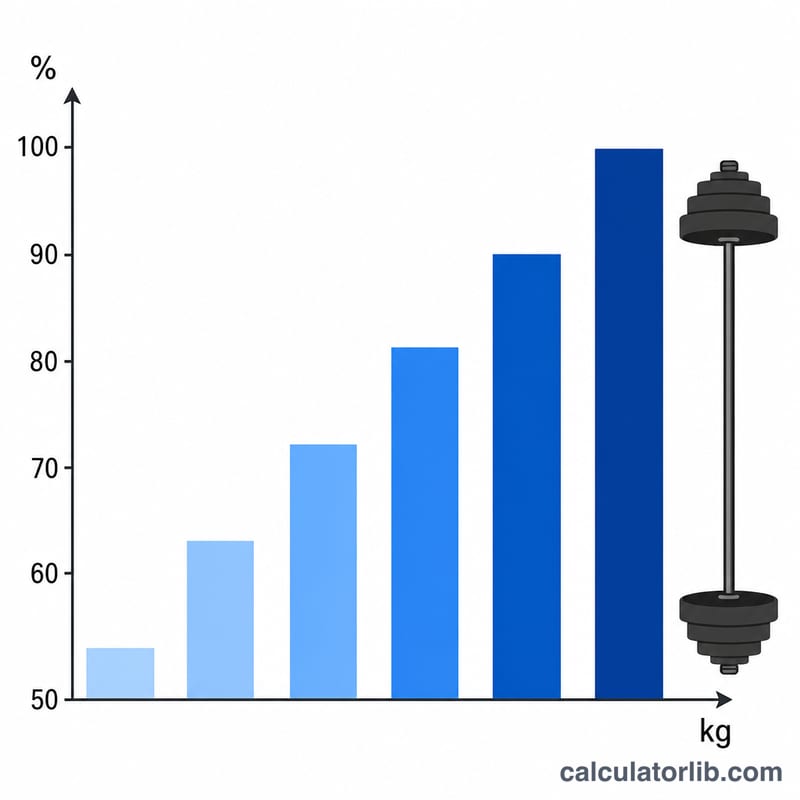
A one-rep max (1RM) percentage table converts your maximum single-rep lift into the working weights you should use across a training cycle. Most strength programs—from Wendler 5/3/1 to classic linear periodization—prescribe loads as a percentage of your 1RM rather than an absolute number. This calculator turns your squat, deadlift, bench, or press max into a clean chart from 50% all the way to 100%.
How to Use It
Enter your tested or estimated one-rep max, choose pounds or kilograms, and pick a percent you want to highlight (for example, the top set called for in today's workout). The hero box shows the exact load for that percentage, and the table below lists every 5% increment so you can plan warm-ups and back-off sets at a glance.
The Formula
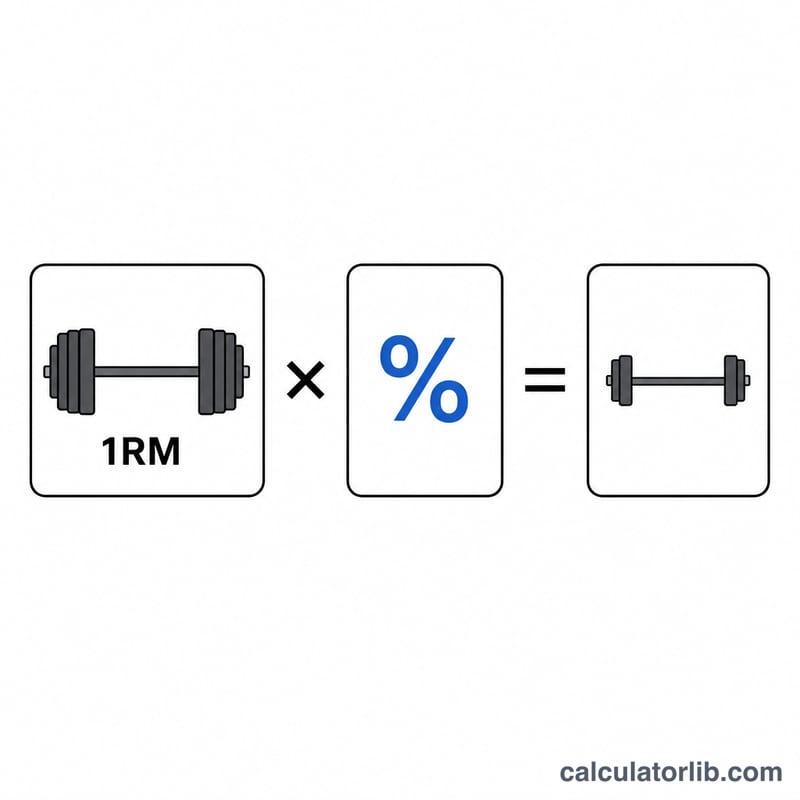
The math is simple and universal across all lifts:
$$\text{Weight} = \text{1RM} \times \frac{\text{Percent}}{100}$$
Because it is pure proportion, the same equation works for any exercise and either unit—no body weight or bar-speed assumptions are needed.
Worked Example
Suppose your deadlift 1RM is 200 kg and the program asks for a top set at 85%. The calculator computes $$200 \times 85 \div 100 = 170 \text{ kg}.$$ Your warm-up at 60% would be \(200 \times 0.60 = 120\) kg, and a back-off set at 70% would be 140 kg.
FAQ
Should I round the weights? Yes—round to the nearest plate increment available (commonly 2.5 kg or 5 lb) for practical loading.
What if I only know my estimated 1RM? An estimated max from a reps calculator works fine; just remember percentages will be approximate.
Does this only apply to squat and deadlift? No. The proportional formula applies to any barbell lift—bench press, overhead press, rows—wherever you train with percentages.