What this calculator does
The PPM to Grams Solution Calculator converts a parts-per-million (ppm) concentration and a volume of water into the actual mass of dissolved solute. It is useful for laboratory dilutions, water treatment, aquarium dosing, hydroponics, and any task where you know a target ppm but need the physical mass to weigh out.
The formula explained
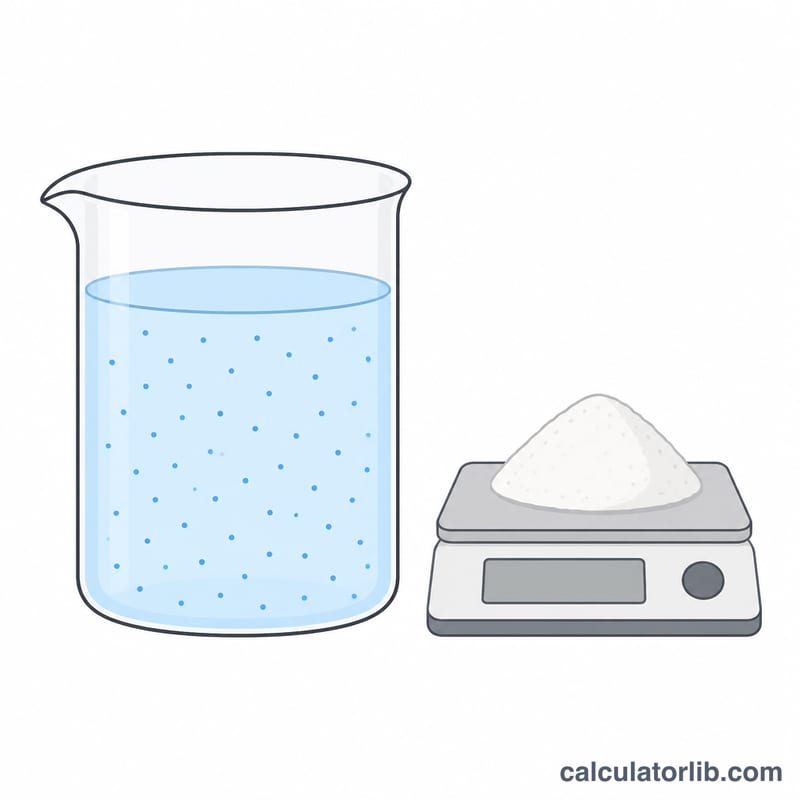
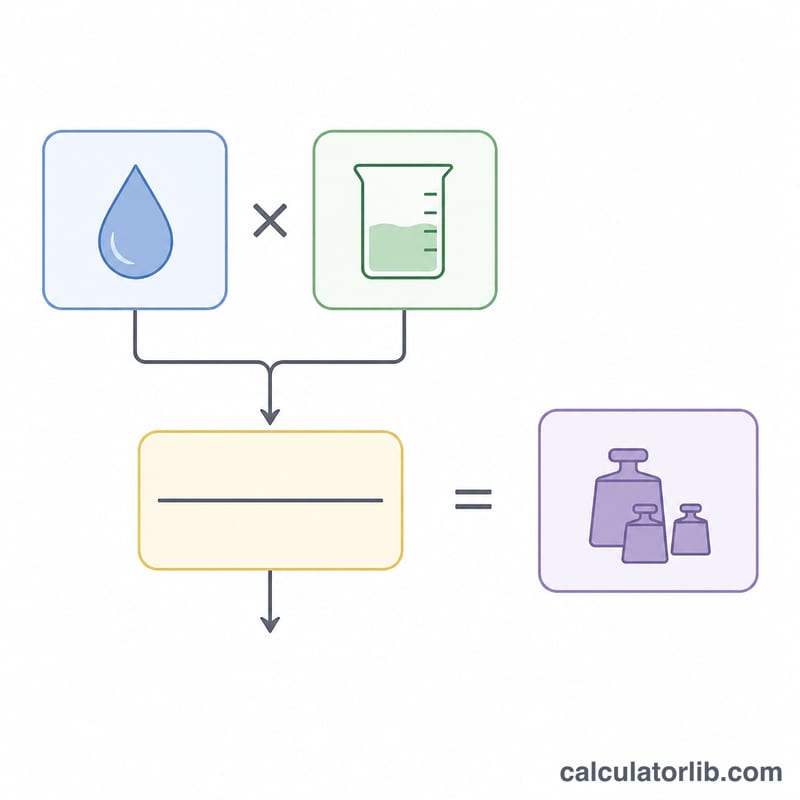
For dilute aqueous solutions the density of water is about 1 gram per milliliter, so one liter of water weighs one kilogram (one million milligrams). This makes the definition of ppm simple: \(1\,\text{ppm} = 1\,\text{mg/L}\). The mass of solute in grams is therefore:
$$m_{g} = \frac{\text{ppm} \times V_{L}}{1000}$$Here \(\text{ppm}\) is the concentration in parts per million, \(V_{L}\) is the water volume in liters, and \(m_{g}\) is the solute mass in grams. The mass in milligrams is simply \(m_{mg} = \text{ppm} \times V_{L}\).
How to use it
Enter the target concentration in ppm and the volume of water in liters, then read off the mass in grams to weigh out. Divide the grams result by any purity factor if your solute is not 100% pure.
Worked example
Suppose you want a \(500\,\text{ppm}\) solution in \(2\) liters of water:
$$m_{g} = \frac{500 \times 2}{1000} = 1\,\text{g}$$That is equal to \(1000\,\text{mg}\), so you would dissolve exactly 1 gram of solute in 2 liters of water.
Scenario Comparison
The mass of solute is found by multiplying the concentration in ppm by the volume in litres and dividing by 1000. This assumes the solvent is water with a density of about 1 g/mL, so that 1 ppm equals 1 mg/L:
$$\text{Grams} = \frac{ {\text{ppm}} \times \text{Volume (L)}}{1000}$$
The table below applies this formula to several realistic dosing cases. Milligrams are simply the grams value multiplied by 1000.
| Concentration (ppm) | Volume (L) | Mass (mg) | Mass (g) |
|---|---|---|---|
| 10 | 1 | 10 | 0.01 |
| 100 | 5 | 500 | 0.5 |
| 500 | 2 | 1000 | 1 |
| 1000 | 10 | 10000 | 10 |
Worked example for the 100 ppm case, showing the full substitution:
$$\text{Grams} = \frac{100 \times 5}{1000} = \frac{500}{1000} = 0.5\ \text{g}$$
Because 1 g = 1000 mg, that same result is 500 mg. Notice that mass scales linearly with both concentration and volume — doubling either input doubles the mass of solute required.
Unit Conversion Reference
The conversions below are the ones used most often when moving between ppm and mass or volume units. Several of them depend on the assumption that the solution is dilute and behaves like water, with a density of approximately 1 g/mL (1 kg/L). This is a good approximation for dilute aqueous solutions near room temperature; it does not hold for concentrated solutions or other solvents.
| Convert from → to | Multiply by | Note |
|---|---|---|
| ppm → mg/L | ×1 | Exactly equal only when density = 1 g/mL (dilute water assumption). |
| mg/L → ppm | ×1 | Same water-density assumption as above. |
| ppm → mg/kg | ×1 | ppm by mass; for water 1 L ≈ 1 kg, so mg/L and mg/kg coincide. |
| mg/kg → ppm | ×1 | Mass-based definition; independent of density. |
| mL → L | ÷1000 | 1000 mL = 1 L (exact, volume unit definition). |
| L → mL | ×1000 | Exact. |
| grams → milligrams | ×1000 | Exact (1 g = 1000 mg). |
| milligrams → grams | ÷1000 | Exact. |
| ppm → percent (%) | ÷10000 | 10000 ppm = 1% (both are mass ratios). |
| percent (%) → ppm | ×10000 | 1% = 10000 ppm. |
The ppm ↔ mg/L and ppm ↔ mg/kg equivalences rest on the density assumption stated above. In strict terms ppm is a dimensionless ratio (parts per million by mass); it equals mg/L only because 1 L of water weighs about 1 kg. For example, 250 ppm in water is 250 mg/L, which over a 4 L batch gives \(250 \times 4 / 1000 = 1\ \text{g}\) of solute, and 250 ppm expressed as a percentage is \(250 / 10000 = 0.025\%\).
FAQ
Does this work for any liquid? The 1 ppm = 1 mg/L shortcut assumes a density near that of water. For solvents with very different density, multiply the volume by the actual density first.
What if I have milliliters instead of liters? Divide milliliters by 1000 to get liters before entering the volume.
Is ppm the same as mg/kg? Yes, ppm can be expressed as mg per kg of solution; for water, mg/kg and mg/L are effectively equal.