What Is the Rectangle Fence Cost Calculator?
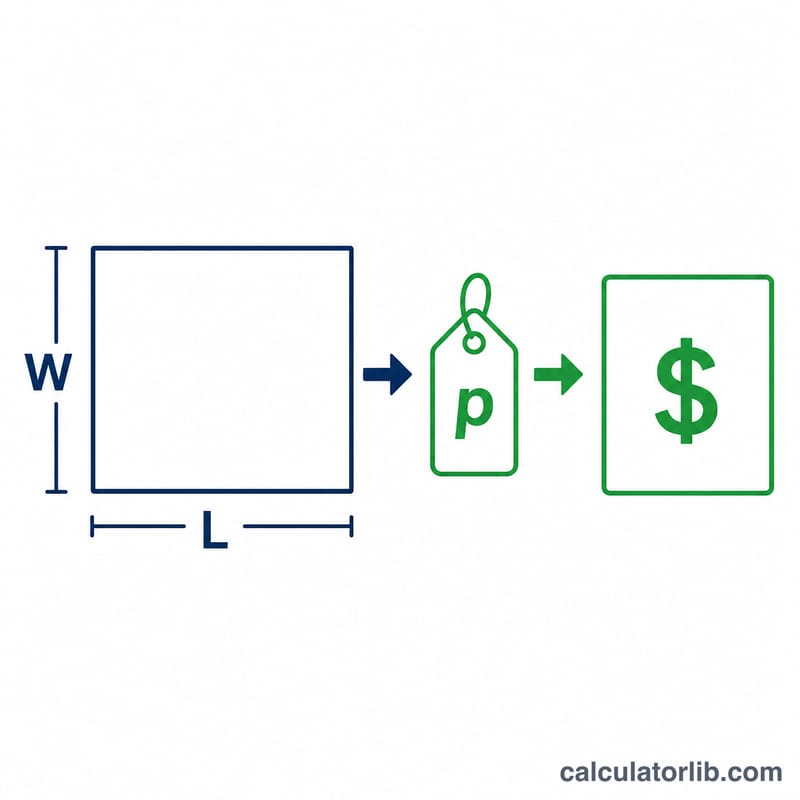
This tool estimates how much it will cost to fence a rectangular area such as a yard, garden, paddock, or lot. By measuring the perimeter of the rectangle and multiplying by your price per foot (or any unit of length), you get a quick material-cost estimate before you call a contractor or buy supplies.
How to Use It
Enter the length and width of the area you want to enclose, then enter the price per foot of fencing (the installed or material price you have been quoted). The calculator returns the total perimeter and the estimated cost. Use consistent units — if your dimensions are in feet, your price should be per foot.
The Formula Explained
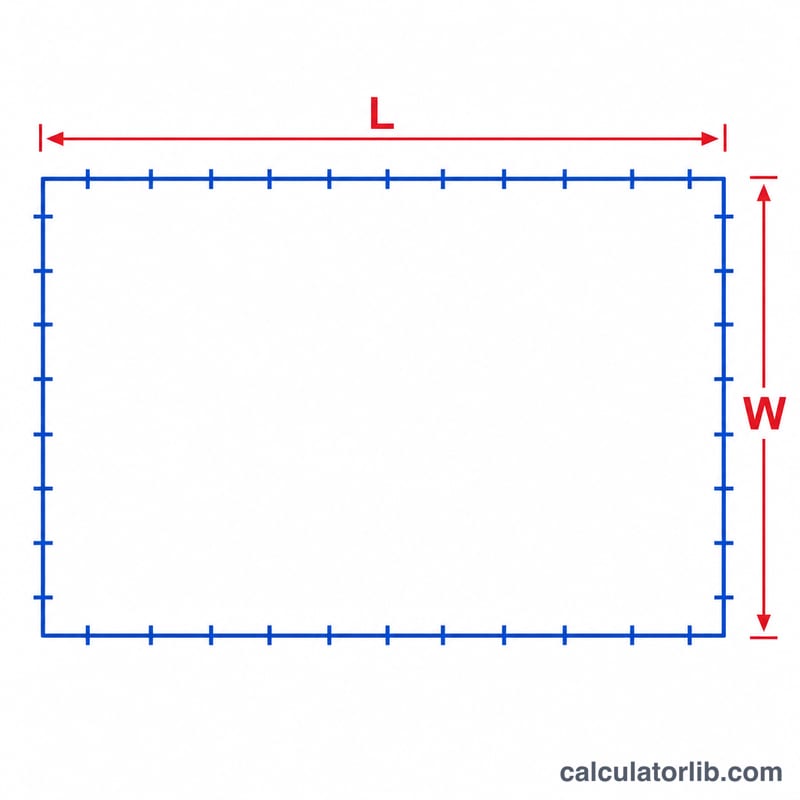
A rectangle has two sides of length \(L\) and two of width \(W\), so the perimeter is \(P = 2 \times (L + W)\). Multiplying the perimeter by the price per unit length \(p\) gives the total cost:
$$\text{Cost} = 2 \times (L + W) \times p$$
This covers the linear amount of fencing needed. It does not automatically add gates, posts beyond the standard run, corner hardware, or labor surcharges, so treat it as a baseline estimate.
Worked Example
Suppose you want to fence a backyard that is 50 ft long and 30 ft wide, with fencing priced at $15 per foot. The perimeter is \(2 \times (50 + 30) = 160\) ft. The cost is $$160 \times \$15 = \$2{,}400$$
Practical Tips for Estimating Fence Materials
The calculator gives the perimeter and the base material cost. A real project usually needs a few adjustments on top of that number. This is general information, not professional advice.
- Add 5-10% for waste. Cuts, damaged pieces, and layout mistakes use up material. Multiply the perimeter or the material cost by 1.05 to 1.10.
- Subtract gate openings, then add gates separately. Reduce the fence run by the width of each gate opening (for example, 4 ft for a walk gate or 12 ft for a drive gate). Then add the gate, hinges, and latch as separate line items, since gates cost much more per foot than standard fence.
- Round up to full panel lengths. Panels are commonly sold in 6 ft or 8 ft sections. Divide the run by the panel length and round up. A 140 ft run needs 140 ÷ 8 = 17.5, so 18 panels at 8 ft.
- Count your posts. You need a post at each corner, at each end, and at each gate, plus one per panel joint. A closed rectangle has 4 corner posts and, in general, about as many posts as it has panels.
- Check property lines and permits. Confirm the boundary with a survey or plat. Many local authorities set limits on fence height, setbacks, and materials, and some require a permit. Rules vary by location, so contact your local building or zoning office.
- Get contractor quotes for labor. The calculator covers materials only. Labor, post-hole digging, concrete, removal of an old fence, and site access can add substantially to the cost.
Example: A 40 ft × 30 ft yard at $15 per foot has a perimeter of 2 × (40 + 30) = 140 ft. The material cost is 140 × $15 = $2,100. With a 10% waste allowance, order about 154 ft of material, or roughly $2,310, before gates, posts, and labor.
Length and Price Unit Conversions
Use these factors if your measurements or quotes are in meters or yards instead of feet.
| Conversion | Value |
|---|---|
| 1 ft in meters | 0.3048 m |
| 1 m in feet | 3.2808 ft |
| 1 yd in feet | 3 ft |
| 1 yd in meters | 0.9144 m |
Price conversions
| From | To | Rule |
|---|---|---|
| Price per foot | Price per meter | price per foot × 3.2808 |
| Price per meter | Price per foot | price per meter × 0.3048 |
| Price per foot | Price per yard | price per foot × 3 |
Example: $15 per foot × 3.2808 = $49.212, which is about $49.21 per meter. Converting back, $49.21 × 0.3048 ≈ $15.00 per foot.
The calculator expects length and width in feet and price in dollars per foot. Convert any metric measurements or quotes first.
FAQ
Does this include gates? No. Subtract the gate width from the run if you buy gates separately, or add the gate price afterward.
Can I use meters? Yes. Enter dimensions in meters and price per meter — the result will be in the same currency you used.
Should I add a waste allowance? For panel or picket fencing, adding 5–10% for cuts and uneven terrain is a smart buffer.