What this calculator does
Jurisdiction: Japan. This tool simulates a Japanese-style recurring savings or time-deposit plan where you pay in a fixed amount every month, add a larger top-up twice a year (the summer and winter bonus custom), and interest is credited and taxed at the end of each compounding period. Amounts are entered in units of 10,000 (man-en); the default tax rate of 20.315% is Japan's interest withholding tax since January 2013 (15.315% income tax including the Reconstruction Special Income Tax plus 5% inhabitant tax). Non-Japanese users can simply change the tax rate and read the amounts as their own currency.
How to use it
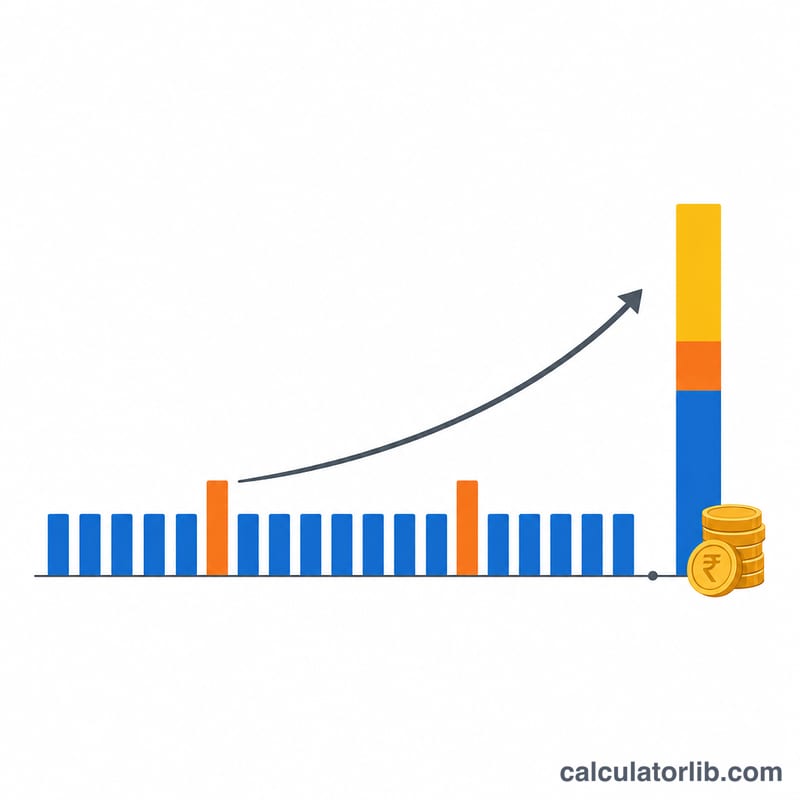
Enter the annual interest rate, the savings period in years, your monthly contribution, the bonus-month top-up, the existing principal, and choose how often interest compounds (monthly, semiannual, or annual). Pick whether contributions earn interest in the same period they are paid (beginning) or not (end), and whether interest is taxed each period or tax-exempt. The calculator runs a month-by-month simulation and shows the maturity total, total principal, after-tax interest, total tax, and a period-by-period table.
The formula explained
The model tracks a yen balance B starting from your existing principal. Each month it adds your monthly contribution, plus the bonus whenever the month aligns with the bonus start month and every 6 months after. At the close of each k-month period it computes interest as \( B \times \dfrac{r \times k}{12} \), rounds it to whole yen (truncate, round, or ceiling), withholds tax of \( \lfloor interest \times taxRate \rfloor \), and adds the net interest back to the balance. Because rounding happens every period, results can differ slightly from a single closed-form future-value formula — the simulation is authoritative.
$$ i_{period} = B \times \frac{r \times k}{12}, \quad net = i_{period} - \lfloor i_{period} \times t \rfloor $$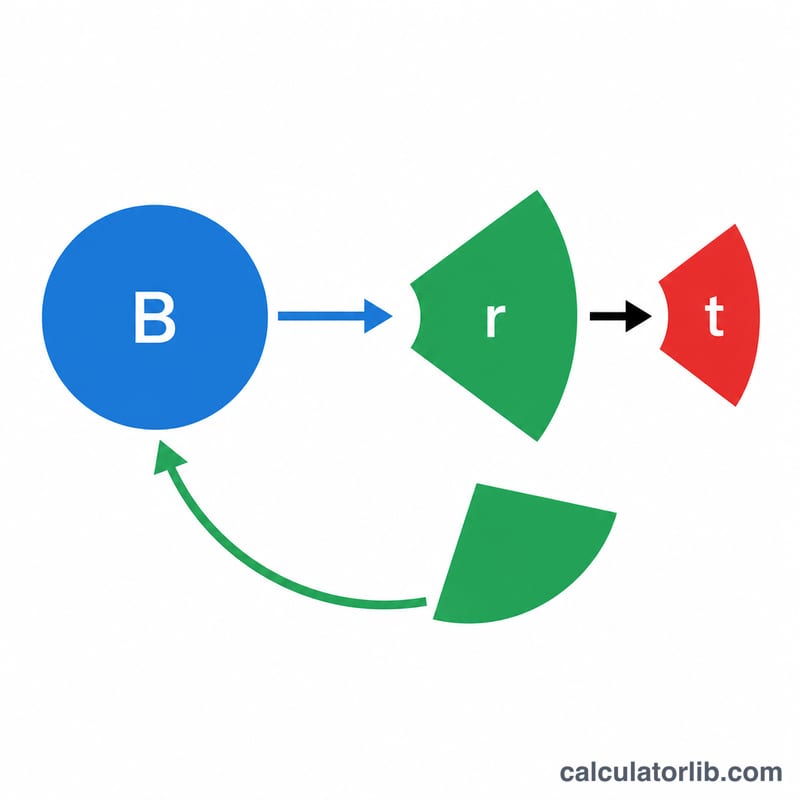
Worked example
Rate 3%, 1 year, 10 man-en monthly (100,000 yen), 40 man-en bonus, bonus start month 6, annual compounding, beginning timing, taxed at 20.315%. Contributions = \( 12 \times 100{,}000 + 2 \times 400{,}000 = 2{,}000{,}000 \) yen. One period closes at month 12 with base 2,000,000. Gross interest:
$$ 2{,}000{,}000 \times 0.03 = 60{,}000 \text{ yen} $$tax = \( \lfloor 60{,}000 \times 0.20315 \rfloor = 12{,}189 \); net = 47,811. Maturity = 2,047,811 yen.
Scenario Comparison: Compounding Frequency, Timing and Tax Treatment
All scenarios use the same base inputs: 3% annual rate, 5 years, 100,000 yen monthly (10 man-en), a 400,000 yen bonus top-up (40 man-en) twice a year, no initial principal, truncation (floor) rounding of interest, and per-period tax of ⌊interest × 20.315%⌋ unless tax-exempt. Each figure was worked out period by period with the recurrence \(B_j = B_{j-1} + C_j + g_j - T_j\). Total principal is 5 × (1,200,000 + 800,000) = 10,000,000 yen in every case.
| Scenario | Total principal (yen) | Gross interest (yen) | Tax (yen) | Maturity balance (yen) |
|---|---|---|---|---|
| A. Annual compounding, interest on prior balance (end timing), taxed 20.315% | 10,000,000 | 614,514 | 124,838 | 10,489,676 |
| B. Annual compounding, interest including the period's deposits (beginning timing), taxed 20.315% | 10,000,000 | 929,204 | 188,767 | 10,740,437 |
| C. Annual compounding, end timing, tax-exempt (0%) | 10,000,000 | 618,271 | 0 | 10,618,271 |
| D. Semiannual compounding (1.5% per period), end timing, taxed 20.315% | 10,000,000 | 696,969 | 141,585 | 10,555,384 |
Working assumptions: "End timing" means interest in a period is computed on the previous balance only, with that period's deposits added afterwards. "Beginning timing" means interest is computed on the previous balance plus that period's deposits. Each period's deposit is the months' worth of monthly contributions plus the bonuses falling in it, so the annual case adds 2,000,000 yen per period and the semiannual case 1,000,000 yen. A scenario with monthly compounding (60 periods) is not tabulated here; enter the same inputs into the calculator to see it.
Reading the table:
- A vs B: counting each period's deposits as earning interest for that period raises gross interest by 314,690 yen over 5 years.
- A vs C: removing the tax adds 128,595 yen to the maturity balance. Tax is about 20.3% of gross interest in A (124,838 / 614,514), slightly below the full rate because the tax is truncated to whole yen each period.
- A vs D: halving the period length credits interest, and takes in deposits, twice as often. Part of the extra 65,708 yen comes from deposits being counted half a year sooner, not only from more frequent compounding.
Definitions & Glossary
- Man-en (万円)
- A Japanese unit equal to 10,000 yen. The calculator takes initial principal, monthly deposit and bonus amount in man-en and multiplies by 10,000 internally. For example, 10 man-en is 100,000 yen.
- Bonus top-up and bonus start month
- An extra deposit made twice a year, typically when Japanese employees receive seasonal bonuses. The first bonus is paid in the chosen start month, and further bonuses follow every 6 months after it, which is the rule \((m - \text{start}) \bmod 6 = 0\).
- Compounding period
- The number of months between interest credits, such as 1, 6 or 12. Interest earned in one period becomes part of the balance that earns interest in the next. Number of periods: \(N = 12 \times \text{years} / k\).
- Beginning vs end timing
- Whether a period's deposits already earn interest in that period (beginning timing, interest base \(B_{j-1} + C_j\)) or only from the next period (end timing, base \(B_{j-1}\)). Check which convention your bank product uses.
- Rounding modes
- Interest per period is converted to whole yen by truncation (round down, ⌊x⌋), standard rounding (round half up, ⌊x + 0.5⌋), or ceiling (round up, ⌈x⌉).
- Withholding tax 20.315%
- The standard Japanese tax on deposit interest for residents. It is made up of 15% national income tax, 0.315% Reconstruction Special Income Tax, and 5% inhabitant (local) tax. The national and local parts are generally summed as 20.315%. This is a Japan-specific rule, and the calculator lets you change the rate.
- Maturity balance
- The balance after the last period: all deposits plus all interest, minus all tax.
- Total principal
- The initial principal plus every monthly deposit and bonus top-up. It excludes interest.
- After-tax interest
- Gross interest minus the tax deducted each period. It equals the maturity balance minus the total principal.
Interpreting Your Result
Reading the three headline numbers. The total principal is what you paid in. The maturity balance is what the account holds at the end. Their difference is the after-tax interest. Using Scenario A above, 10,489,676 − 10,000,000 = 489,676 yen, which equals gross interest 614,514 minus tax 124,838. Because deposits are spread over time, the average money is invested for only part of the term, so total interest is much smaller than a lump sum of the same size would earn.
Effective net rate. Tax is deducted from each period's interest, so the after-tax return is roughly the nominal rate × (1 − 0.20315). At 3% this is \(3\% \times (1 - 0.20315) \approx 2.39\%\) per year. Because the tax is taken every period, the interest left to compound is the after-tax amount. The result is therefore close to compounding at that net rate, not taxing a gross total at the end.
Why it differs from the closed-form formula. The textbook future-value formula for regular deposits assumes exact, unrounded interest. This simulation converts interest and tax to whole yen every period. Truncation lowers interest slightly and truncating the tax slightly raises the net amount. Ceiling or round-half-up changes the result in the other direction. The differences are normally a few yen per period, and they add up over many periods.
Effect of shorter compounding periods. More frequent crediting at the same nominal rate gives a modestly higher balance, since interest starts earning interest sooner. The effect is small at low rates. The timing of deposits within each period and the beginning or end convention can matter as much as the compounding frequency, as the scenario table shows.
This is a simulation for general information, not financial or tax advice. Actual bank products may differ in rounding, crediting dates, bonus handling and tax treatment, so confirm the terms with your provider.
Central bank policy rates today
The latest official policy rates of major central banks, updated automatically — the benchmark that bank deposit and loan rates follow.
- Federal Reserve · United States
- 3.75–4.00%
- As of
- 2026-11-13
- Change in 1 year
- 0 pp
Latest change Up +25 bp Federal Reserve changed its rate on 2026-09-17: from 3.50–3.75% to 3.75–4.00%.
| Central bank | Policy rate | As of | Change in 1 year |
|---|---|---|---|
| Banco Central do Brasil (Selic) · Brazil | 13.75% | 2026-11-16 | −1.25 pp |
| Banco de México · Mexico | 6.25% | 2026-11-10 | −1.00 pp |
| Federal Reserve · United States | 3.75–4.00% | 2026-11-13 | 0 pp |
| ECB | 2.50% | 2026-11-16 | +0.50 pp |
| Sveriges Riksbank · Sweden | 2.00% | 2026-11-16 | +0.25 pp |
| Saudi Central Bank (SAMA) · Saudi Arabia | 4.50% | 2026-10-29 | 0 pp |
| Reserve Bank of Australia · Australia | 4.60% | 2026-10-31 | +1.00 pp |
| Central Bank of the Republic of Türkiye · Türkiye | 36.00% | 2026-11-06 | −3.50 pp |
| Bank of Russia · Russia | 14.00% | 2026-11-10 | −2.50 pp |
| People’s Bank of China · China | 3.00% | 2026-11-10 | 0 pp |
| Bank of Canada · Canada | 2.50% | 2026-11-13 | +0.25 pp |
| Reserve Bank of India · India | 5.50% | 2026-10-19 | 0 pp |
| Bank of England · United Kingdom | 4.00% | 2026-11-16 | 0 pp |
| Bank of Japan · Japan | 1.25% | 2026-11-10 | +0.75 pp |
| Bank of Korea · South Korea | 3.00% | 2026-11-02 | +0.50 pp |
Federal Reserve: key rates and overnight market rates
The rates that frame monetary policy and the overnight market rate they steer, each with the date of its latest published value.
| Rate | Level | As of | Change in 1 year |
|---|---|---|---|
| Federal funds target range | 3.75–4.00% | 2026-11-13 | 0 pp |
| Effective federal funds rate (EFFR) | 3.88% | 2026-11-13 | 0 pp |
| Secured Overnight Financing Rate (SOFR) | 3.90% | 2026-11-13 | −0.10 pp |
Each rate keeps the date of its own latest published value; overnight market rates are published on the next business day.
Latest figure: 2026-11-13 Data last updated 2026-11-16 · current
Source: Banco Central do Brasil ODbL; Bank for International Settlements (BIS) Terms of permitted use of BIS statistics; Federal Reserve Bank of New York New York Fed Terms of Use; Board of Governors of the Federal Reserve System Public domain (U.S. government work); European Central Bank ECB reuse policy; Sveriges Riksbank Riksbank open data terms; The World Bank Group CC BY 4.0; Reserve Bank of Australia 2026 RBA copyright terms (Cash Rate); Bank of Canada Bank of Canada terms of use; Bank of England Open Government Licence v3.0
The one-year change is computed by CalculatorLib from these data. The EFFR and SOFR are subject to the Terms of Use posted at newyorkfed.org. The New York Fed is not responsible for publication of the EFFR and SOFR by CalculatorLib, does not sanction or endorse any particular republication, and has no liability for your use.
Source details and methodology
- Banco Central do Brasil
- Bank for International Settlements (BIS) — Central bank policy rates
- Federal Reserve Bank of New York — Reference rates (EFFR, SOFR)
- Board of Governors of the Federal Reserve System
- European Central Bank
- Sveriges Riksbank
- The World Bank Group — World Development Indicators (FR.INR.LEND, FR.INR.RINR)
- Reserve Bank of Australia 2026
- Bank of Canada
- Bank of England
FAQ
Why 20.315%? It is the standard Japanese withholding on interest income since 2013. Edit the field for other countries or tax-advantaged accounts.
What does beginning vs end timing change? Only whether the current period's contributions earn interest in that same period — "beginning" treats them as deposited at period start, "end" as deposited at period end.
Are real bank results identical? Rounding conventions vary by institution, so treat this as an estimate; your bank's figure may differ slightly.