What is rounding to the nearest hundred?
Rounding to the nearest hundred replaces a number with the closest multiple of 100 — such as 0, 100, 200, 300, and so on. It is a common way to simplify numbers for estimation, mental math, budgeting, and reporting where exact figures are unnecessary.
How to use this calculator
Type any number into the field — it can be positive, negative, or a decimal — and the calculator instantly returns the nearest multiple of 100. There is nothing else to configure.
The formula explained
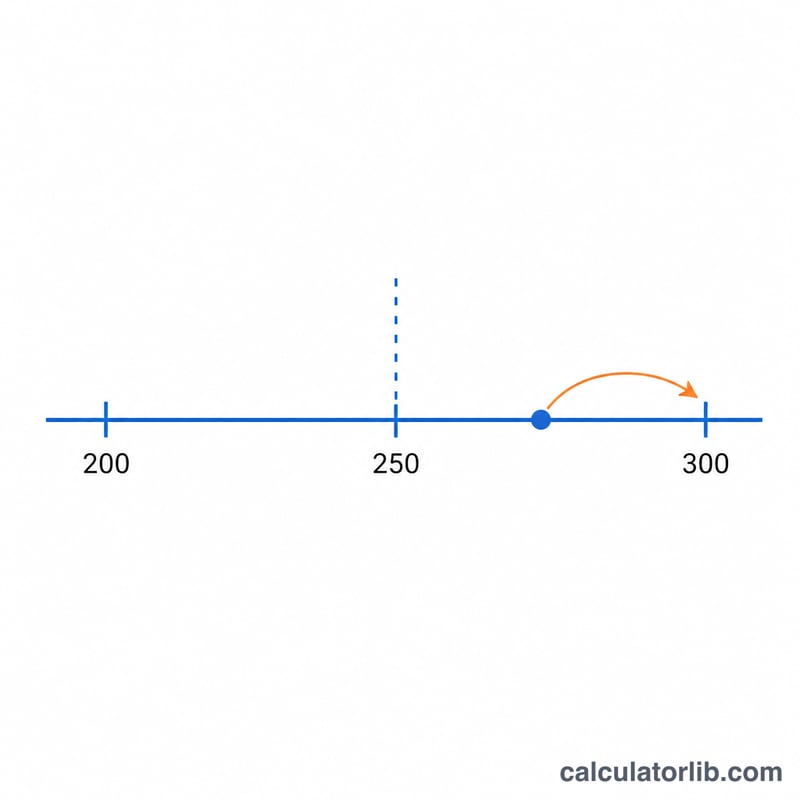
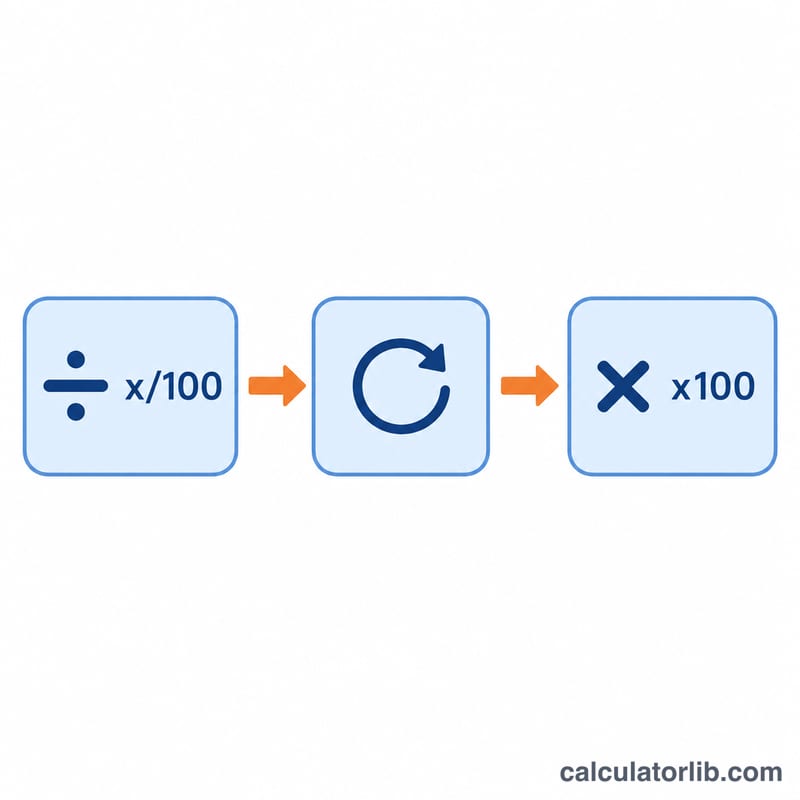
The rule is $$\text{Rounded} = \left\lfloor \frac{\text{Number}}{100} \right\rceil \times 100$$ First divide the value by 100 to scale it down, then round that result to the nearest whole number, and finally multiply by 100 to scale it back. Standard rounding sends a digit of 5 (in the tens place) upward, so \(150\) rounds up to \(200\).
Worked example
Take 1,234. Divide by 100 to get \(12.34\). Rounding \(12.34\) to the nearest whole number gives \(12\). Multiply by 100 to get 1,200. Because the tens digit (3) is below 5, the number rounds down.
Rounding Results Across Different Inputs
To round to the nearest hundred, divide the number by 100, round that quotient to the nearest whole number, then multiply by 100. The table shows each step. The convention used is that a value exactly halfway rounds up (toward positive infinity) for positive numbers.
| Input | Divided by 100 | Rounded result | Note |
|---|---|---|---|
| 49 | 0.49 | 0 | Tens digit is 4, so round down. |
| 50 | 0.5 | 100 | Exactly halfway, so round up. |
| 149.99 | 1.4999 | 100 | Just below 150, so it stays at 100. |
| 150 | 1.5 | 200 | Exactly halfway, so round up. |
| 250 | 2.5 | 300 | Exactly halfway, so round up (not to the nearest even hundred). |
| 1,234 | 12.34 | 1,200 | Tens digit is 3, so round down. |
| 1,049.9 | 10.499 | 1,000 | Tens digit is 4, so the decimals do not change the result. |
| 0 | 0 | 0 | Already a multiple of 100. |
| -1,260 | -12.6 | -1,300 | -12.6 is closer to -13 than -12, so the result moves away from zero. |
| -250 | -2.5 | -200 or -300 | Negative halfway case: round-half-up gives -200; round-half-away-from-zero gives -300. Conventions differ, so check which one your context uses. |
Rounding Cut-offs by Hundred Range
Each multiple of 100 "owns" the values within 50 of it. The halfway rule is: if the tens digit is 5 or more (that is, the last two digits are 50 or higher), round up to the next hundred; if it is 4 or less, round down. The table below covers non-negative numbers.
| Rounds to | Range of values (from, up to but not including the upper limit unless noted) |
|---|---|
| 0 | 0 to 49.99… (below 50) |
| 100 | 50 to 149.99… (below 150) |
| 200 | 150 to 249.99… (below 250) |
| 300 | 250 to 349.99… (below 350) |
| 400 | 350 to 449.99… (below 450) |
| 500 | 450 to 549.99… (below 550) |
| 600 | 550 to 649.99… (below 650) |
| 700 | 650 to 749.99… (below 750) |
| 800 | 750 to 849.99… (below 850) |
| 900 | 850 to 949.99… (below 950) |
| 1,000 | 950 to 1,049.99… (below 1,050) |
The same pattern repeats for every higher hundred. For negative numbers the ranges mirror this table around zero, except for exact halfway values such as -50 or -150, where the result depends on whether round-half-up or round-half-away-from-zero is applied.
Conventions and edge cases
Each case below was run through this calculator; the result column is what it actually returns.
| Case | Input | Result | Note |
|---|---|---|---|
| Exactly half-way: 250 | 250 | 300 | |
| Exactly half-way: −250 | -250 | -200 | Halves round up, toward +∞. |
Checked on 2026-11-08
FAQ
What happens at the halfway point, like 250? \(250 \div 100 = 2.5\), which rounds up to \(3\), giving \(300\). This calculator uses standard "round half up" behavior.
Can I round negative numbers? Yes. For example, \(-1{,}260\) becomes \(-1{,}300\), since \(-12.6\) rounds to \(-13\).
Does it handle decimals? Yes. The tens and ones digits (and any decimals) are absorbed into the rounding, so \(1{,}049.9\) rounds to \(1{,}000\).