What Is Rounding to the Nearest Thousandth?
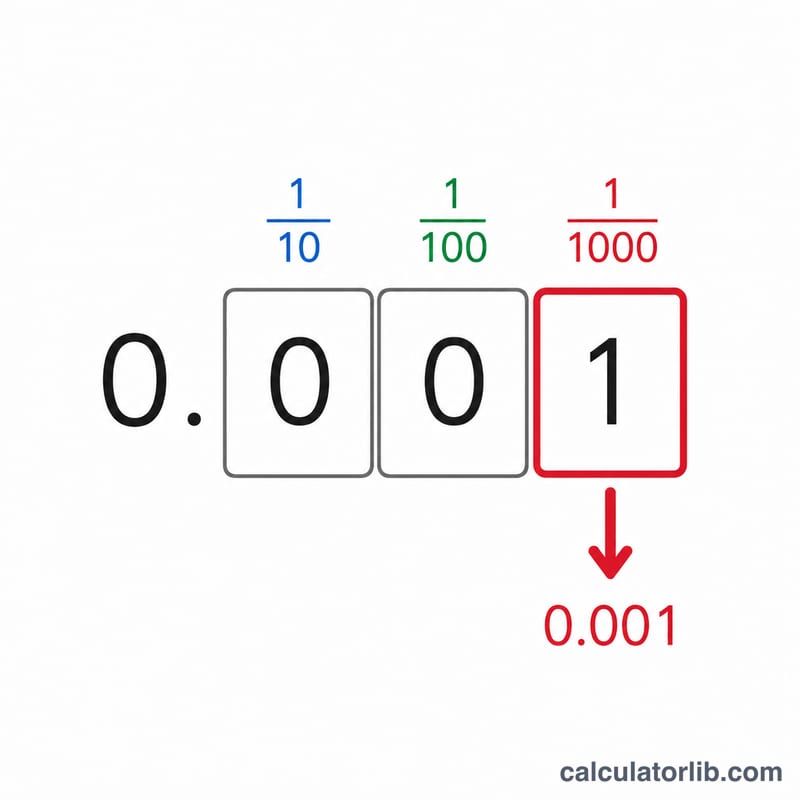
The thousandth is the third digit to the right of the decimal point (the 0.001 place). Rounding to the nearest thousandth means keeping three decimal places and adjusting the last kept digit based on the digit immediately after it. This calculator does it instantly for any number you enter, positive or negative.
How to Use This Calculator
Type the number you want to round into the input box and submit. The tool returns the value rounded to three decimal places along with your original number for reference. It works with long decimals, whole numbers, and negative values.
The Formula Explained
The standard rounding formula is $$\text{Result} = \frac{\left\lfloor \text{Number} \times 1000 + 0.5 \right\rfloor}{1000}$$ Multiplying by 1000 shifts the thousandths place into the ones place, the round function snaps to the nearest whole number, and dividing by 1000 shifts the decimal point back. The "round half up" rule means a trailing digit of 5 or more rounds the third decimal up.
Worked Example
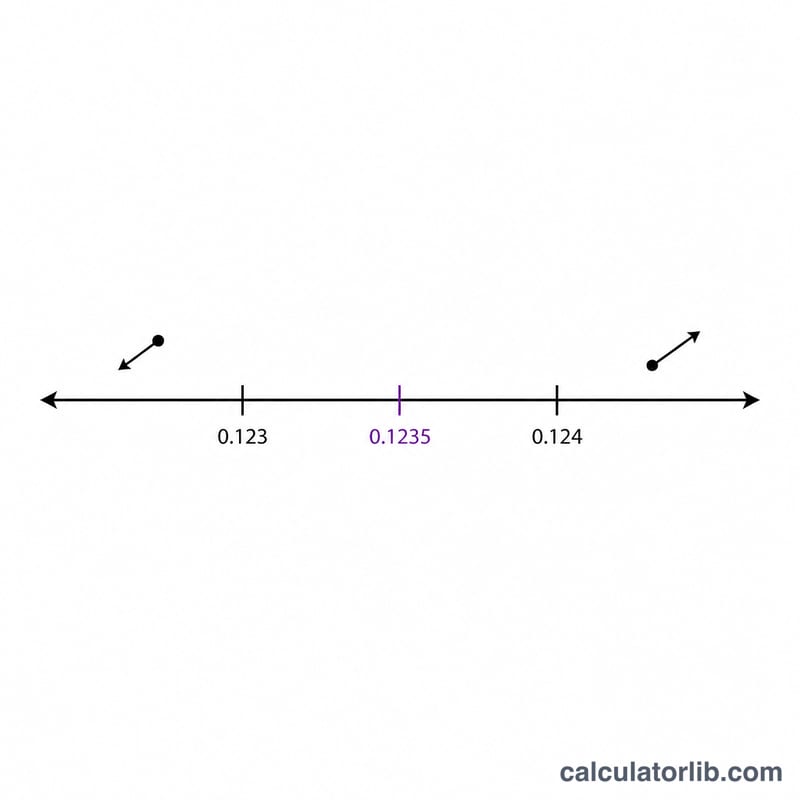
Round 3.14159 to the nearest thousandth. Multiply: \(3.14159 \times 1000 = 3141.59\). Round to the nearest whole number: \(3142\). Divide by 1000: \(3.142\). Because the fourth decimal (5) is 5 or more, the third decimal rounds up from 1 to 2, giving 3.142.
Rounding Examples: Edge Cases Compared
Rounding to the nearest thousandth means keeping 3 decimal places. The fourth decimal digit decides the outcome: 0–4 keeps the third digit, and 5–9 raises it by one. The calculator uses \(\text{Result} = \lfloor x \times 1000 + 0.5 \rfloor / 1000\). This is a half-up rule.
| Input | Fourth decimal digit | Rounded to thousandth |
|---|---|---|
| 2.71828 | 2 | 2.718 |
| 1.2345 | 5 | 1.235 |
| 0.9996 | 6 | 1.000 (the carry changes the units digit) |
| 5 | 0 (5 = 5.0000) | 5.000 |
| 0.0004 | 4 | 0.000 |
| -4.5678 | 8 | -4.568 |
| -1.2345 | 5 (exact tie) | -1.234 or -1.235, depending on convention |
Negative ties: with the half-up formula \(\lfloor x \times 1000 + 0.5 \rfloor / 1000\), the calculation for -1.2345 is \(\lfloor -1234.5 + 0.5 \rfloor = \lfloor -1234 \rfloor = -1234\). The result is -1.234, because half-up moves ties toward positive infinity. Round-half-away-from-zero gives -1.235 instead, because it moves ties away from zero in both directions. The two conventions differ only on exact ties of negative numbers. For positive numbers they agree.
Other notes: 0.9996 becomes 1.000 because the carry runs through the whole number. The trailing zeros in 5.000 and 0.000 are kept to show that the value is given to three decimal places. Computers store many decimals in binary, so a tie such as 1.2345 may sit a tiny bit above or below the exact value. This can affect which way a tie rounds in software.
Place Value Terms and Rounding Vocabulary
Decimal places
- Tenths (0.1): the first digit after the decimal point. In 0.7 there are 7 tenths.
- Hundredths (0.01): the second digit after the decimal point. In 0.07 there are 7 hundredths.
- Thousandths (0.001): the third digit after the decimal point. This is the place you round to here. In 0.007 there are 7 thousandths.
- Ten-thousandths (0.0001): the fourth digit after the decimal point. This is the digit that decides whether the thousandths digit rounds up or stays.
Decimal place vs significant figure
A decimal place is counted from the decimal point, regardless of how large or small the number is. Rounding 0.004567 to 3 decimal places gives 0.005. A significant figure is counted from the first nonzero digit. Rounding 0.004567 to 3 significant figures gives 0.00457. This calculator works in decimal places, not significant figures.
Tie-breaking rules (when the dropped part is exactly half)
- Round half up: ties go toward positive infinity. 1.2345 becomes 1.235 and -1.2345 becomes -1.234. This is the rule used by \(\lfloor x \times 1000 + 0.5 \rfloor / 1000\).
- Round half away from zero: ties go to the larger absolute value. 1.2345 becomes 1.235 and -1.2345 becomes -1.235. It is the usual "school" rule.
- Banker's rounding (round half to even): ties go to the nearest even last digit. 1.2345 becomes 1.234 and 1.2355 becomes 1.236. This reduces bias when many values are rounded and added, and it is common in some software and accounting systems.
Truncation vs rounding
Truncation just cuts off the digits after the chosen place without looking at them. Truncating 2.7189 to three places gives 2.718, while rounding gives 2.719. For negative numbers, truncation moves toward zero (-4.5678 truncates to -4.567, but rounds to -4.568).
FAQ
What is the nearest thousandth of 2.71828? Multiply by 1000 to get \(2718.28\), round to \(2718\), divide to get \(2.718\).
How does it handle a digit of exactly 5? It uses round-half-up, so the fourth decimal digit of 5 rounds the third decimal place upward (e.g. \(1.2345 \to 1.235\)).
Does it work for negative numbers? Yes. For example, \(-4.5678\) rounds to \(-4.568\).