What the calculator does
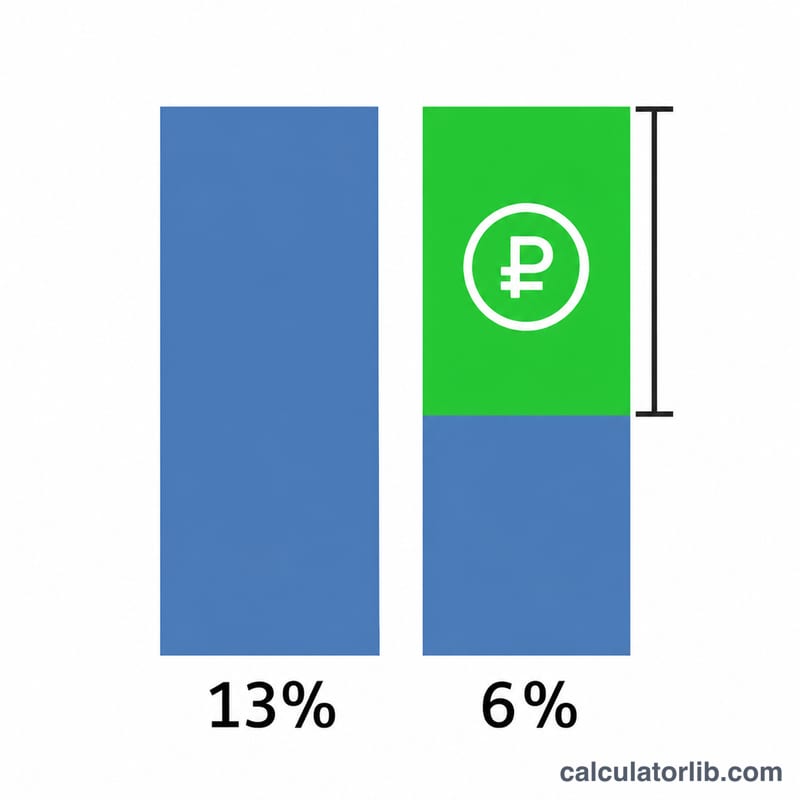
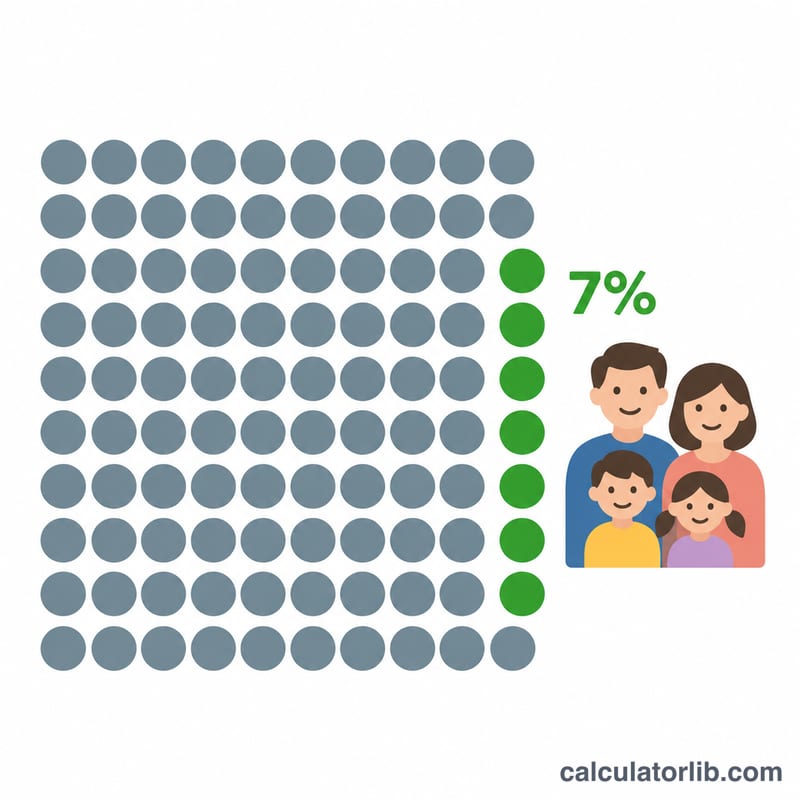
This calculator estimates the Russian annual family payment (ежегодная семейная выплата) set out in Federal Law 179-FZ for one working parent. The payment equals the difference between personal income tax (NDFL) at 13% and at 6% on the same labour income, with no deductions. The tool also tests the main eligibility criteria published by the Social Fund of Russia (SFR) and the Federal Tax Service (FNS). Defaults reflect the payment for 2025, claimed from 1 June to 1 October 2026.
How to use it
Enter the inputs in this order: the applicant parent's gross annual taxable labour income; total family income for the year (it must include the applicant's income); the number of family members; the number of qualifying children; the monthly regional subsistence minimum for the working-age population; whether the parent and children are Russian citizens residing in Russia; and whether the applicant has alimony arrears. Each working parent should run the calculation separately with their own income.
Formula
The payment and the income test use these expressions:
$$P = 0.13\,I - 0.06\,I = 0.07\,I$$$$D = \frac{F}{12 \cdot N}, \qquad D \le 1.5\,PM$$Here \(P\) = payment in RUB, \(I\) = the parent's annual taxable labour income, \(F\) = total family income for the year, \(N\) = number of family members, \(D\) = average monthly income per family member, and \(PM\) = regional monthly subsistence minimum for the working-age population.
Conventions and assumptions
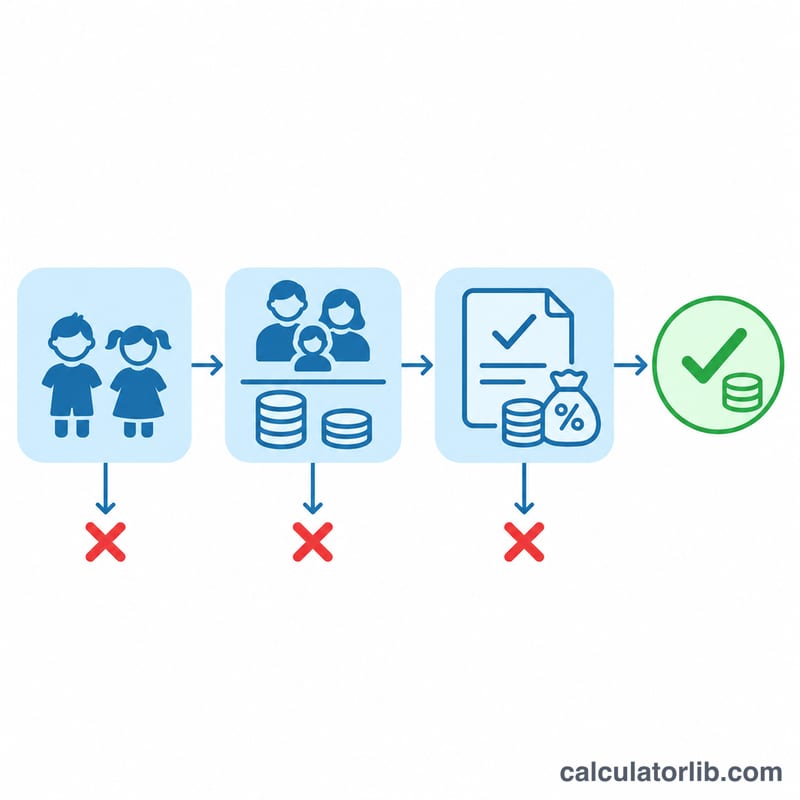
The result is for one applicant parent only. NDFL at 13% is applied flat to the whole income, as in the FNS formula, even though real NDFL above 2.4 million RUB is taxed at progressive rates; the sources do not explain how such income is treated. Family income counts wages, business income, pensions, benefits, stipends and alimony received, entered as one figure. Eligibility needs at least 2 children under 18, or under 23 if in full-time study. The income limit is inclusive, so a per-capita income equal to 1.5 × PM passes. The subsistence minimum is the value for the year being recalculated (2025 for 2026 claims); the default is 15,073 RUB (Tatarstan 2025). Property criteria are not computed. Checks run in this order: citizenship and residence, alimony debt, children, taxable income above zero, per-capita income. Money is shown to 2 decimal places without intermediate rounding.
Worked example
A parent earned 540,000 RUB in 2025. The family has 4 members, 2 qualifying children, total income of 540,000 RUB and a subsistence minimum of 15,073 RUB, with no alimony debt.
$$\text{NDFL}_{13} = 0.13 \times 540000 = 70200$$$$\text{NDFL}_{6} = 0.06 \times 540000 = 32400$$$$P = 70200 - 32400 = 37800\ \text{RUB}$$$$D = \frac{540000}{12 \cdot 4} = 11250\ \text{RUB/month}$$$$1.5 \times 15073 = 22609.5\ \text{RUB/month}$$Since 11,250 is below 22,609.5, the family is eligible. The maximum family annual income to qualify is \(22609.5 \times 12 \times 4 = 1085256\) RUB. The estimated payment is 37,800 RUB.
How to read the result
The main output is the estimated payment, which is 0 when a check fails. The eligibility code shows the first failing check. The payment ignoring eligibility is shown separately. The result is an estimate: actual awards depend on the SFR review, on income data held by the tax authority, on property rules not modelled here, and on how income taxed above 13% is treated. A parent with no NDFL-taxed labour income, such as a self-employed person, should enter 0 and will be shown as ineligible.
FAQ
Do both parents receive the payment?
Each working parent may apply separately, and the amount depends on that parent's own taxable income.
Is the payment always 7% of income?
Yes in this model: 13% minus 6% of the same income, with no deductions.
Which subsistence minimum should I enter?
Enter your region's monthly figure for the working-age population for the year being recalculated, which is 2025 for claims made in 2026.
Does a child studying full-time count?
Yes, a child under 23 in full-time study counts as a qualifying child and as a family member.
What if per-capita income equals the limit?
The sources say income must not exceed 1.5 times the minimum, so equality qualifies.
Are property limits checked?
No. Property assessment is mentioned by the SFR but no thresholds are given in the sources, so it is not computed.
Sources
- Соцфонд России с 1 июня начнет принимать заявления на получение семейной выплаты, Социальный фонд России, 2026
- Управление разъясняет порядок получения семейной выплаты, ФНС России (УФНС по Курской области), 2026
- В 2026 году работающие родители двух и более детей могут оформить ежегодную выплату, Отделение СФР по Калужской области, 2026