
What Is a Salary Increment Percentage?
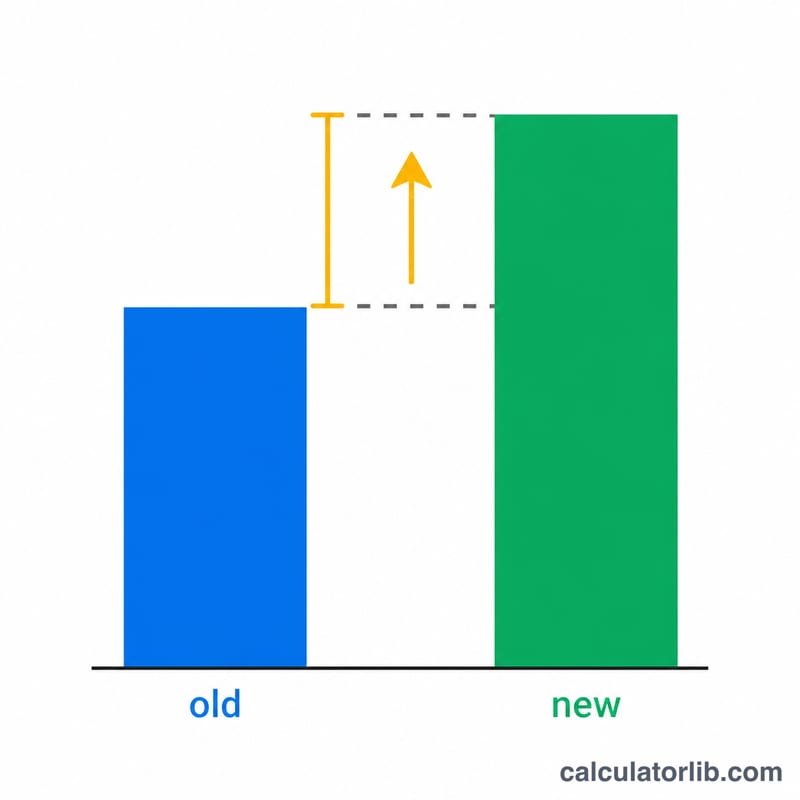
A salary increment percentage tells you how much your pay rose relative to what you earned before. Instead of looking at the raw dollar (or any currency) increase, it expresses the raise as a proportion of your old salary, which makes it easy to compare offers, benchmark against inflation, or evaluate whether a promotion is competitive.
How to Use This Calculator
Enter your old salary (your pay before the raise) and your new salary (your pay after the raise). The calculator instantly returns the increment percentage along with the exact amount of increase. Both figures use the same currency, so the result is currency-independent.
The Formula Explained
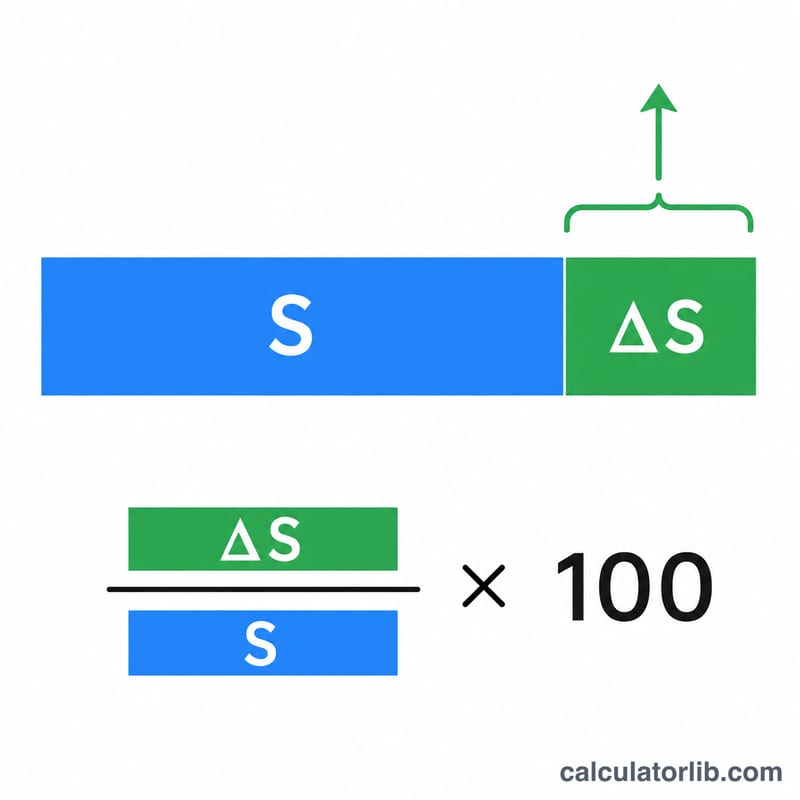
The calculation is: $$\text{Increment \%} = \frac{\text{New Salary} - \text{Old Salary}}{\text{Old Salary}} \times 100$$ First we subtract the old salary from the new salary to find the increase. We then divide that increase by the old salary to express it as a fraction, and multiply by 100 to convert it into a percentage.
Worked Example
Suppose your old salary was 50,000 and your new salary is 55,000. The increase is $$55{,}000 - 50{,}000 = 5{,}000.$$ Dividing by the old salary gives $$5{,}000 \div 50{,}000 = 0.1,$$ and multiplying by 100 yields a 10% salary increment.
FAQ
Can the result be negative? Yes. If your new salary is lower than your old salary, the percentage will be negative, indicating a pay cut.
Does the currency matter? No. As long as you enter both salaries in the same currency, the percentage is the same.
Is this gross or net salary? Use whichever you want to compare, but be consistent — compare gross to gross or net to net for a meaningful result.