
What Is Point-Slope Form?
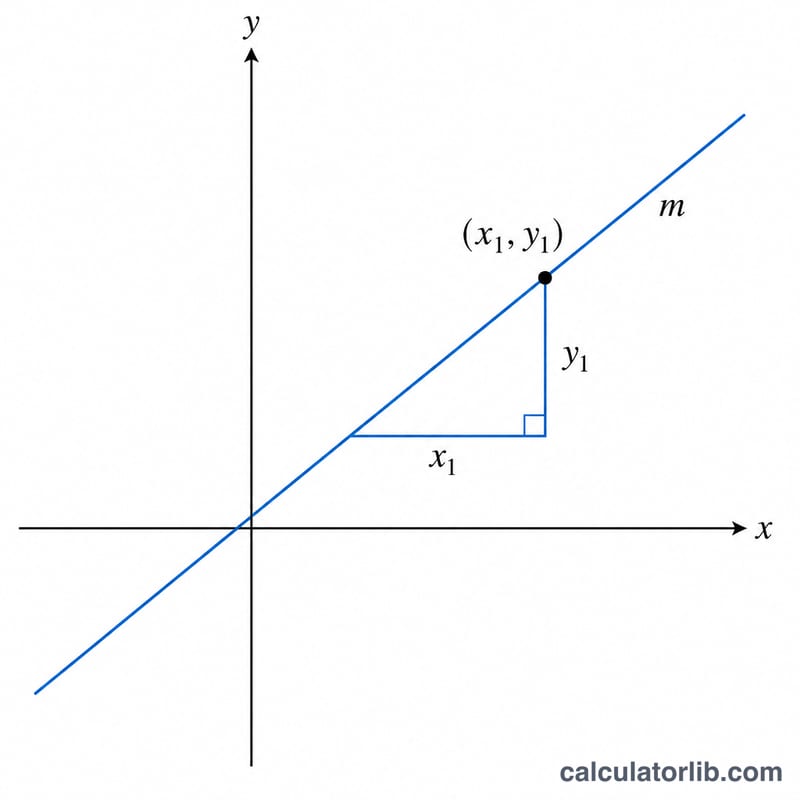
Point-slope form is one of the most useful ways to write the equation of a straight line. If you know the slope m of a line and a single point (x₁, y₁) that the line passes through, you can write its equation immediately as \(y - \text{y}_1 = \text{m}\left(x - \text{x}_1\right)\). This calculator builds that equation for you and also converts it into the more familiar slope-intercept form \(y = \text{m}x + b\).
How to Use This Calculator
Enter the slope m, then enter the coordinates of any point on the line, \(\text{x}_1\) and \(\text{y}_1\). The calculator returns the point-slope equation, the slope, and the y-intercept b. It works with positive, negative, and decimal values.
The Formula Explained
Starting from the definition of slope, \(\text{m} = \dfrac{y - \text{y}_1}{x - \text{x}_1}\), multiply both sides by \(\left(x - \text{x}_1\right)\) to get the point-slope form
$$y - \text{y}_1 = \text{m}\left(x - \text{x}_1\right)$$Expanding gives \(y = \text{m}x - \text{m}\cdot\text{x}_1 + \text{y}_1\), so the y-intercept is
$$b = \text{y}_1 - \text{m}\cdot\text{x}_1$$
Worked Example
Suppose a line has slope \(\text{m} = 2\) and passes through \((3, 5)\). The point-slope form is
$$y - 5 = 2\left(x - 3\right)$$Expanding:
$$y = 2x - 6 + 5 = 2x - 1$$so the y-intercept is \(b = -1\).
FAQ
When should I use point-slope form? It is ideal when you know a point and the slope, such as writing a tangent line or a line through a given data point.
Can the slope be negative or a fraction? Yes. Enter any real number, including decimals like 0.5 or −1.25.
What if my line is vertical? Vertical lines have an undefined slope and cannot be written in point-slope or slope-intercept form; they take the form x = constant.