
What is a repeating decimal to fraction calculator?
A repeating (recurring) decimal is a decimal whose digits eventually repeat forever, such as 0.333... or 2.4545.... This calculator converts any such decimal into its exact, fully simplified fraction. Instead of rounding, it gives you the precise rational value the decimal represents.
How to use it
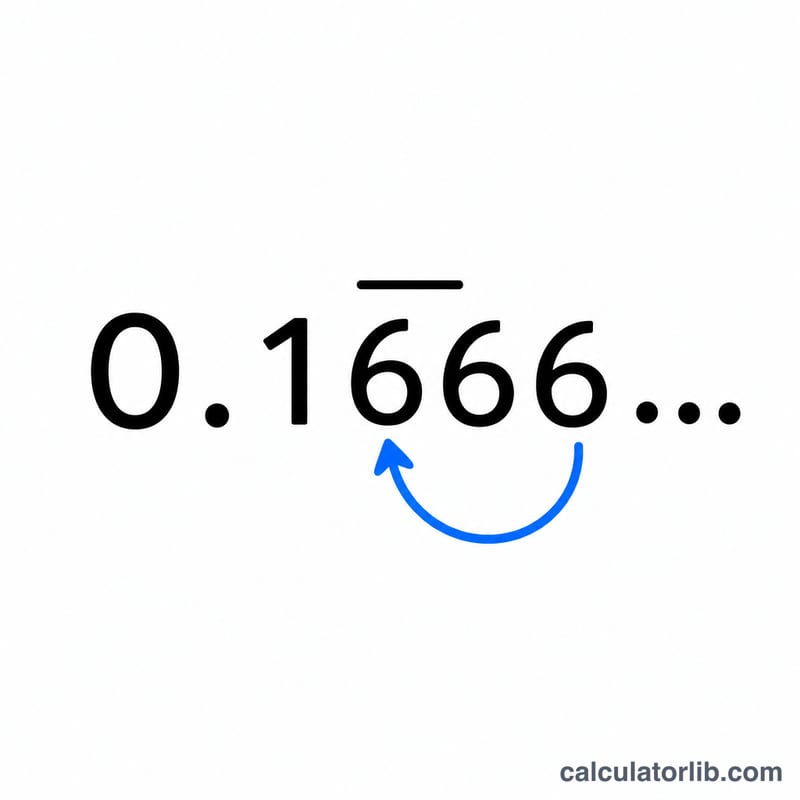
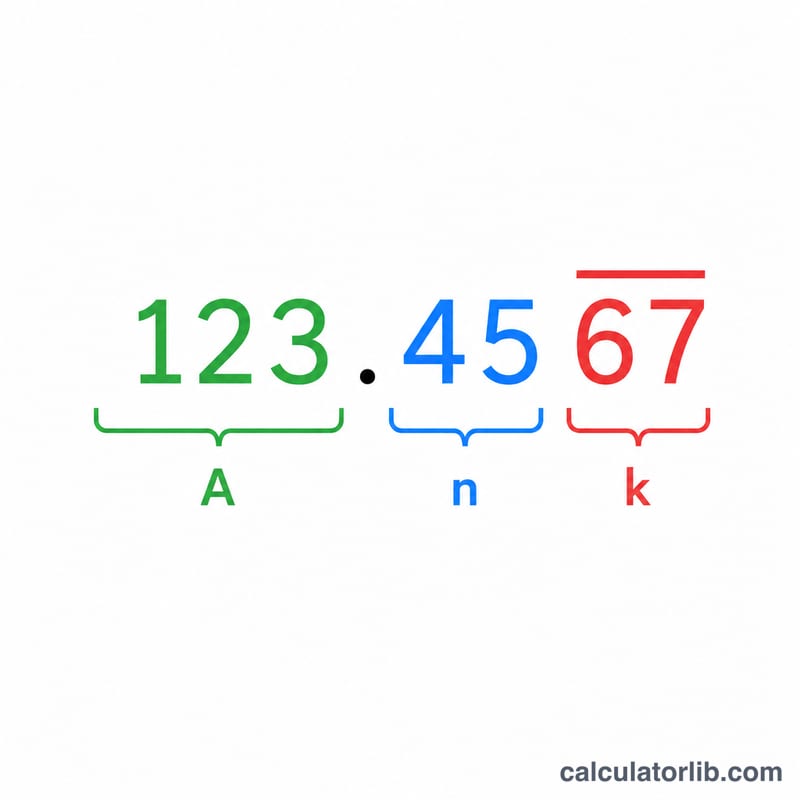
Enter three pieces: the integer part (digits before the decimal point), the non-repeating digits that appear right after the decimal point (leave blank if there are none), and the repeating digits (the block that repeats forever). For 2.4545... the integer part is 2, there are no non-repeating digits, and the repeating block is 45.
The formula explained
Let A be the non-repeating block of length \(n\) and B be the repeating block of length \(k\). The fractional part equals $$F = I + \dfrac{(AB) - A}{(10^{k}-1)\cdot 10^{n}}$$ where \(AB\) is the two blocks read together as one integer. Multiplying \((10^{k} - 1)\) by \(10^{n}\) shifts the decimal past the non-repeating digits. The integer part \(I\) is then added over the common denominator \(d\), giving \((I\cdot d + p)/d\), and the result is reduced by its greatest common divisor.
Worked example
Convert 0.1666.... Here \(A = 1\) (\(n = 1\)) and \(B = 6\) (\(k = 1\)). \(AB = 16\), so $$\text{numerator} = 16 - 1 = 15 \quad\text{and}\quad \text{denominator} = (10 - 1) \times 10 = 90.$$ That gives \(15/90\), which reduces to \(1/6\). Check: \(1 \div 6 = 0.1666...\), correct.
FAQ
What if my decimal does not repeat? Leave the repeating field blank or enter the terminating digits as the non-repeating part; the tool then returns the simple terminating-decimal fraction.
How is the fraction simplified? Numerator and denominator are divided by their greatest common divisor so the result is in lowest terms.
Why is 0.999... equal to 1? With A empty and \(B = 9\), you get \(9/9 = 1\), which is mathematically exact.