
What This Calculator Does
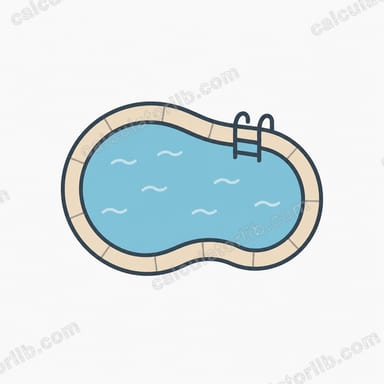
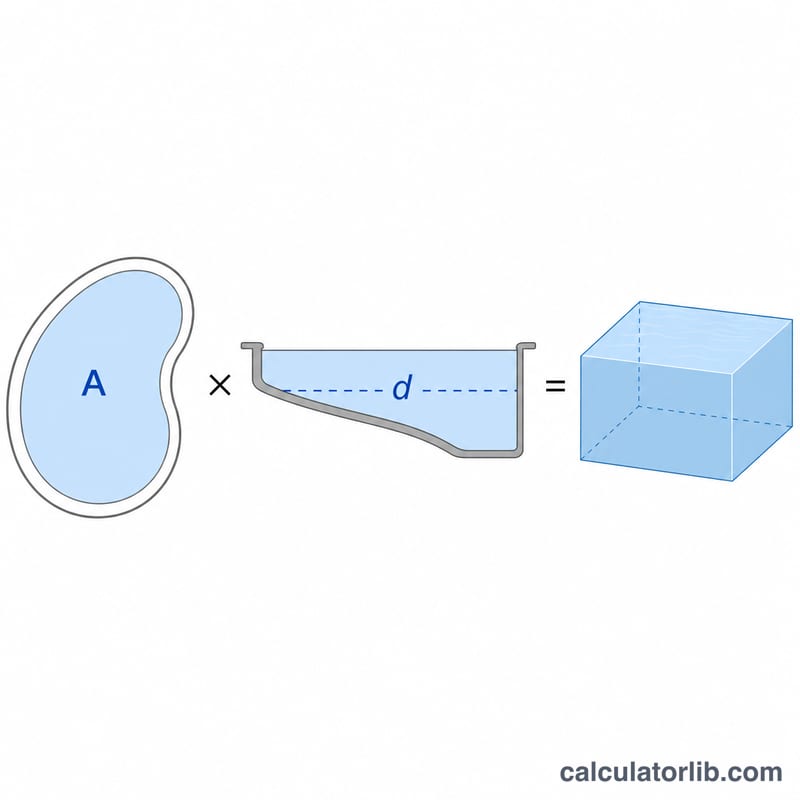
Kidney-shaped and free-form swimming pools don't fit neat rectangular or circular formulas, so the simplest reliable way to estimate their water volume is to use the pool's measured surface area and its average depth. This calculator multiplies those two figures to get the volume in cubic feet, then converts to US gallons using the constant 7.48052 gallons per cubic foot.
How to Use It
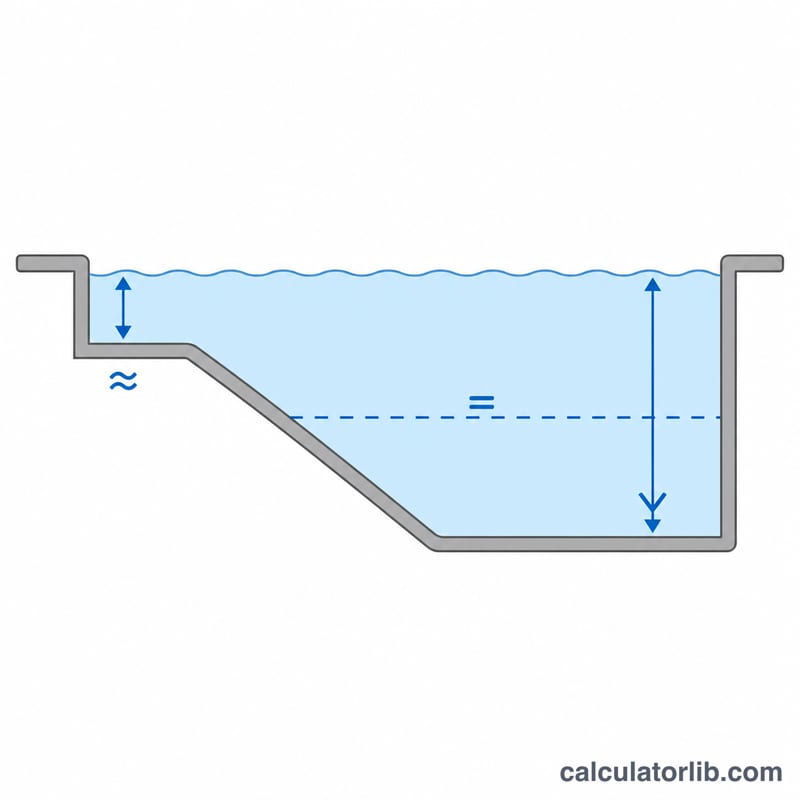
Enter the surface area of the water in square feet. You can measure this by overlaying a grid on a scaled drawing, using a pool-surface app, or splitting the shape into simple sections and adding them up. Then enter the average depth in feet. If your pool slopes from a shallow end to a deep end, average depth is simply \((\text{shallow depth} + \text{deep depth}) \div 2\). Click calculate to see the total in gallons.
The Formula Explained
Volume in cubic feet equals surface area × average depth. One cubic foot holds 7.48052 US gallons, so multiplying cubic feet by that factor gives gallons. This area-based method works for any pool outline — kidney, lagoon, oval, or custom — because it relies on the actual footprint rather than an idealized shape.
$$\text{Gallons} = \text{Surface Area (sq ft)} \times \text{Avg Depth (ft)} \times 7.48052$$
Worked Example
Suppose a kidney pool has a surface area of 400 sq ft and an average depth of 5 ft. Cubic feet = \(400 \times 5 = 2{,}000\). Gallons:
$$2{,}000 \times 7.48052 = 14{,}961 \text{ gallons}$$
That figure tells you how much water you need to fill it and helps size chemicals and pumps.
FAQ
How do I find the surface area of an irregular pool? Break the shape into rectangles and half-circles, measure each, and add the areas — or trace it on graph paper.
What if my pool depth varies? Use the average of the shallowest and deepest points for a good estimate; for complex bottoms, average several depth readings.
Are these US or Imperial gallons? US gallons. Multiply the result by 0.8327 to get Imperial gallons.