What Is the Time Conversion Calculator?
The Time Conversion Calculator converts a quantity of time from one unit to another among seconds, minutes, hours, and days. It works by first normalizing every value into seconds, then dividing by the factor of the target unit. This makes conversions consistent and accurate no matter which direction you go.
How to Use It
Enter the numeric value you want to convert, choose the source unit under "From," and choose the unit you want under "To." The calculator instantly shows the converted result along with the equivalent number of seconds so you can double-check the math.
The Formula Explained
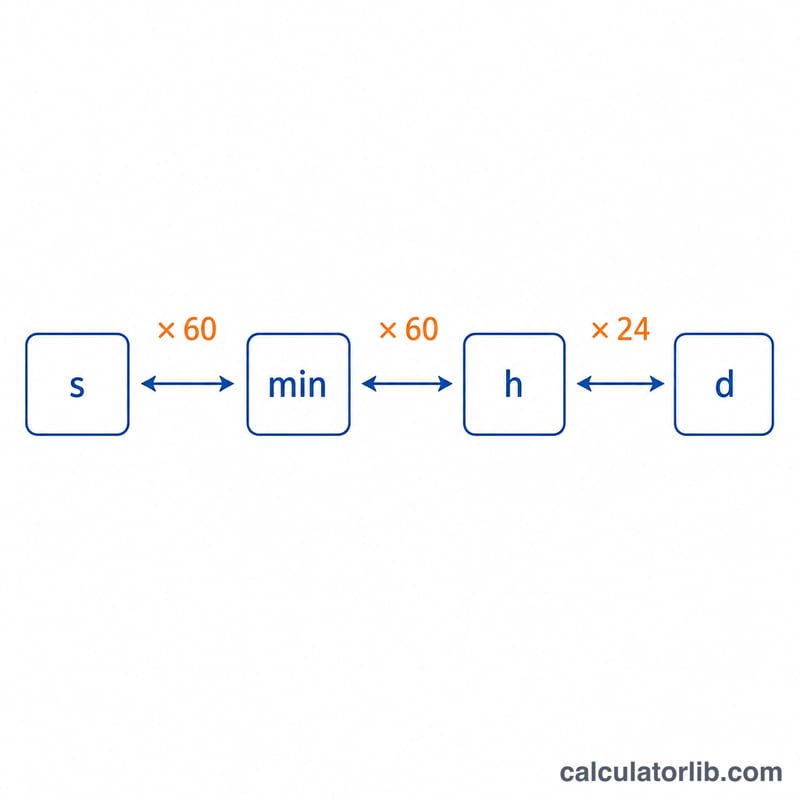
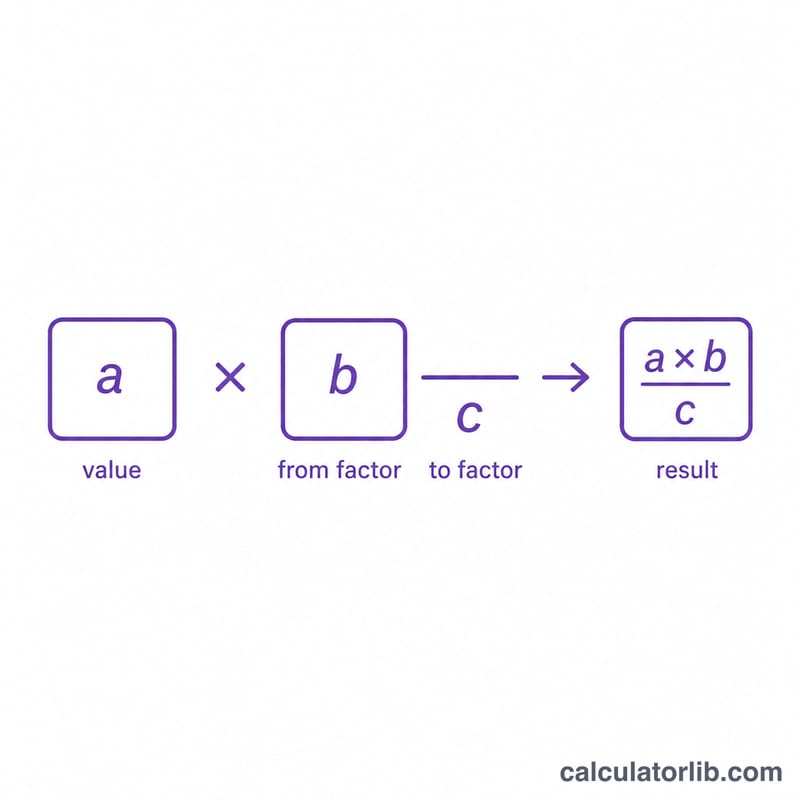
Each unit has a fixed factor in seconds: 1 second = 1, 1 minute = 60, 1 hour = 3,600, and 1 day = 86,400. To convert, multiply your value by the source factor to get seconds, then divide by the target factor:
$$\text{result} = \dfrac{\text{value} \times \text{fromFactor}}{\text{toFactor}}$$
Worked Example
Suppose you want to convert 90 minutes to hours. First convert to seconds: \(90 \times 60 = 5{,}400\) seconds. Then divide by the hour factor: \(5{,}400 \div 3{,}600 = 1.5\) hours. So 90 minutes equals 1.5 hours.
Time Unit Conversion Table
All factors below assume a fixed 24-hour day (86,400 seconds), which is the convention this calculator uses. Every value in the matrix is exact — read a row as the from unit and a column as the to unit, then apply the operation shown.
| From \ To | Seconds (s) | Minutes (min) | Hours (h) | Days (d) |
|---|---|---|---|---|
| Seconds (s) | × 1 | ÷ 60 | ÷ 3,600 | ÷ 86,400 |
| Minutes (min) | × 60 | × 1 | ÷ 60 | ÷ 1,440 |
| Hours (h) | × 3,600 | × 60 | × 1 | ÷ 24 |
| Days (d) | × 86,400 | × 1,440 | × 24 | × 1 |
The same relationships written as a single chain: \(1\ \text{d} = 24\ \text{h} = 1{,}440\ \text{min} = 86{,}400\ \text{s}\). Dividing by a factor converts to a larger unit; multiplying converts to a smaller one.
| Input | Equivalent |
|---|---|
| 30 s | 0.5 min |
| 90 min | 1.5 h |
| 12 h | 0.5 d |
| 2 d | 48 h = 2,880 min = 172,800 s |
Note that these are calendar-free conversions. Civil days that contain a daylight-saving transition run 23 or 25 hours, and a UTC day with a leap second inserted runs 86,401 seconds, so clock-time arithmetic across such a boundary needs a calendar-aware tool rather than a fixed factor.
More Worked Examples
Each conversion follows the same two moves: first normalize the input to seconds by multiplying by the from factor, then divide by the to factor. Writing it this way means you only ever need the four factors \(1,\ 60,\ 3{,}600,\ 86{,}400\).
-
4,500 seconds → hours. Normalize: \(4{,}500 \times 1 = 4{,}500\ \text{s}\). Divide by the hour factor:
$$\frac{4{,}500}{3{,}600} = 1.25\ \text{h}$$So 4,500 seconds is exactly 1.25 hours — one hour and fifteen minutes. The result terminates, so no rounding is needed.
-
3 days → minutes. Normalize: \(3 \times 86{,}400 = 259{,}200\ \text{s}\). Divide by the minute factor:
$$\frac{259{,}200}{60} = 4{,}320\ \text{min}$$Three days contain 4,320 minutes. You can check it directly against the matrix: \(3 \times 1{,}440 = 4{,}320\).
-
150 minutes → days. Normalize: \(150 \times 60 = 9{,}000\ \text{s}\). Divide by the day factor:
$$\frac{9{,}000}{86{,}400} = 0.10416\overline{6}\ \text{d} \approx 0.1042\ \text{d}$$Here the quotient does not terminate — it is the repeating decimal 0.104166…, equal to the exact fraction \(\tfrac{5}{48}\). Rounded to four decimal places it becomes 0.1042 days. Converting back confirms the magnitude: \(0.10416\overline{6} \times 24 = 2.5\ \text{h}\), i.e. 2 hours 30 minutes, which is indeed 150 minutes.
A practical habit with small unit fractions: keep more decimal places than you think you need while the value is still an intermediate step, and round only at the very end. Rounding 0.104166… to 0.10 days first and then multiplying by 24 would give 2.4 hours — an error of six minutes introduced purely by premature rounding.
FAQ
How many seconds are in a day? There are 86,400 seconds in a day (\(24 \times 60 \times 60\)).
Can I convert days to minutes? Yes. For example, 2 days = \(2 \times 86{,}400 = 172{,}800\) seconds, divided by 60 = 2,880 minutes.
Does this account for leap seconds or daylight saving? No. It uses standard fixed unit factors and assumes a 24-hour day, which is suitable for general calculations.