What is time rounding?
Time rounding adjusts a recorded clock time so it lands on a clean interval, such as every 15 minutes. Payroll and timesheet systems commonly round punches to reduce noise and to comply with rounding policies. This calculator takes a time and an interval and returns the rounded clock time, the number of minutes since midnight, and how many minutes were added or removed.
The formula
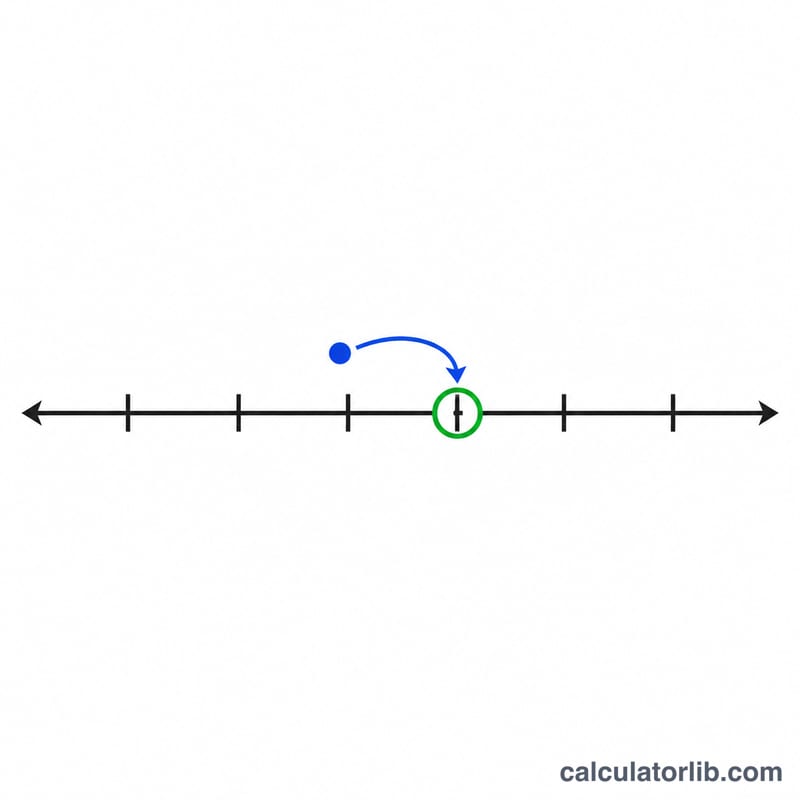
First the time is converted to minutes since midnight, \(T\). With an interval \(I\) (in minutes), the nearest-interval result is:
$$T_r = \text{round}\!\left(\frac{T}{I}\right)\times I$$
Here \(T\) = hours \(\times 60\) + minutes, and \(T_r\) is converted back to \(HH{:}MM\). For strict policies you can round up with the ceiling \(\lceil T/I \rceil\) or down with the floor \(\lfloor T/I \rfloor\).
How to use it
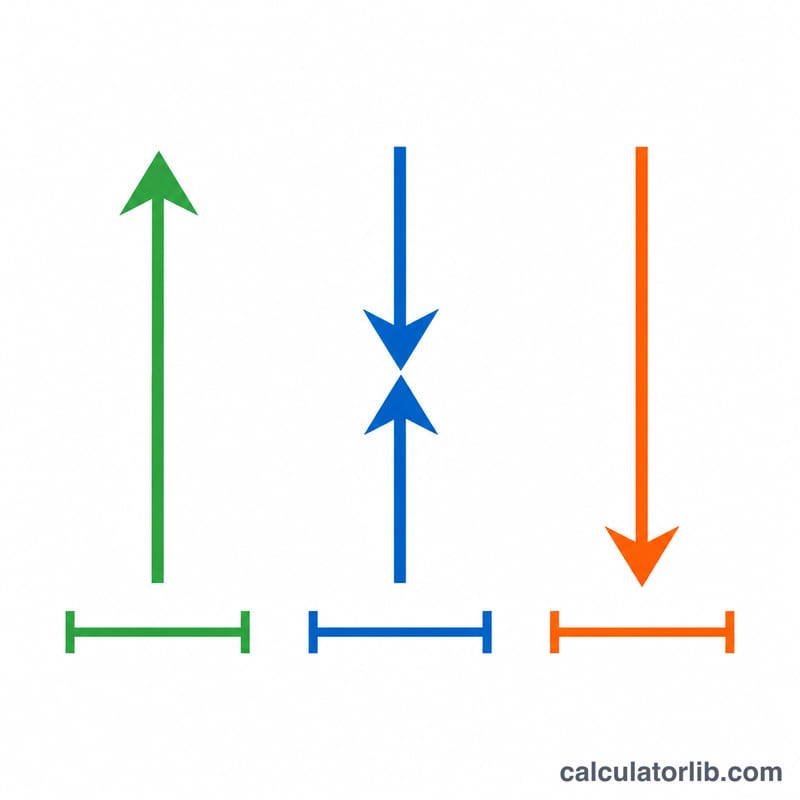
Enter the clock time, choose an interval (for example 15 minutes), and pick a rounding method: nearest, up, or down. The result shows the adjusted time and the exact adjustment so you can audit the change.
Worked example
Round \(09{:}07\) to the nearest 15 minutes. Convert to minutes: \(T = 9\times 60 + 7 = 547\), with \(I = 15\).
$$T_r = \text{round}\!\left(\frac{547}{15}\right)\times 15 = 36\times 15 = 540$$
So \(540\) minutes equals \(09{:}00\), an adjustment of \(540 - 547 = -7\) minutes.
Rounding Breakpoints Reference (the 7-Minute Rule)
When you round to the nearest interval, the deciding point is the midpoint of that interval: minutes below it round down, minutes at or above it round up. For a 15-minute interval the midpoint falls at 7.5 minutes, which is why timesheets in the United States describe it as the "7-minute rule" — anything from 0 to 7 minutes past the quarter-hour rounds back, and 8 to 14 rounds forward. This rounding practice is explicitly permitted for payroll under the U.S. Fair Labor Standards Act (FLSA, 29 CFR §785.48); other countries and employment agreements may not allow rounding, so confirm your local rules.
Formally, the midpoint is half the interval: \(\text{midpoint} = \dfrac{\text{Interval}}{2}\). The table uses the common round-half-up convention, so a value sitting exactly on the midpoint rounds up.
| Interval (min) | Round DOWN (minutes past the mark) | Round UP (minutes past the mark) | Midpoint (min) |
|---|---|---|---|
| 5 | 0–2 | 3–4 | 2.5 |
| 6 | 0–2 | 3–5 | 3 |
| 10 | 0–4 | 5–9 | 5 |
| 15 | 0–7 | 8–14 | 7.5 |
| 30 | 0–14 | 15–29 | 15 |
Rounding Results Compared Across Intervals and Methods
The punch time below is 09:07, which is \(T = 60 \times 9 + 7 = 547\) minutes since midnight. Each cell applies \(\text{Rounded} = \operatorname{round}\!\left(\tfrac{T}{\text{Interval}}\right)\times\text{Interval}\) for the nearest column, and the floor/ceiling of the same quotient for down/up. The signed value is the adjustment applied to the original 09:07.
| Interval (min) | Nearest | Up | Down |
|---|---|---|---|
| 5 | 09:05 (−2) | 09:10 (+3) | 09:05 (−2) |
| 6 | 09:06 (−1) | 09:12 (+5) | 09:06 (−1) |
| 10 | 09:10 (+3) | 09:10 (+3) | 09:00 (−7) |
| 15 | 09:00 (−7) | 09:15 (+8) | 09:00 (−7) |
| 30 | 09:00 (−7) | 09:30 (+23) | 09:00 (−7) |
Notice how the same punch drifts further from the real clock time as the interval grows: rounding 09:07 to the nearest 5 minutes moves it only 2 minutes, but rounding up to the next 30-minute block adds 23 minutes. This is why the choice of interval and method has a direct effect on paid time.
FAQ
Which interval should I use? Timesheets often use 15 minutes (quarter hour), but 5, 6, and 10 minutes are also common.
What does a negative adjustment mean? The rounded time is earlier than the original, so minutes were removed.
Does it handle midnight? Yes. If rounding pushes past 24 hours the displayed clock time wraps to the next day, while the minute total keeps the raw computed value.