
What this calculator does
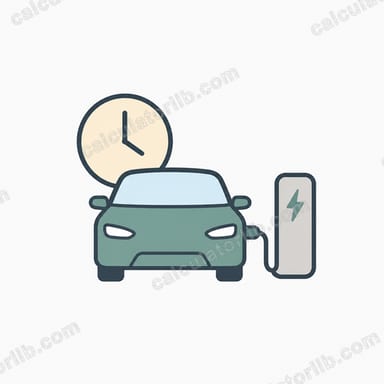
This tool estimates how many miles of driving range a VinFast electric vehicle (such as the VF 8 or VF 9) gains for each hour of charging. Instead of just showing kilowatts, it translates raw charger power into a number most drivers care about: miles added per hour. This works for any EV, but the defaults are based on VinFast figures.
How to use it
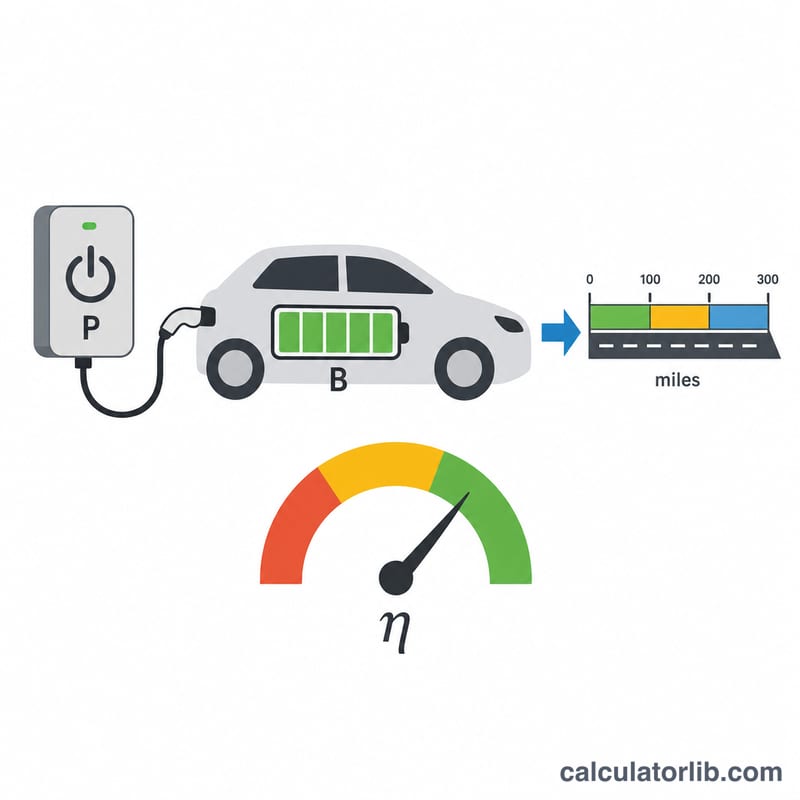
Enter four values: the charger power in kW (e.g. 11 kW for a Level 2 home charger, 7.2 kW for a slower wallbox, or 150+ kW for DC fast charging), the charging efficiency (typically 85–95% due to heat and conversion losses), your battery capacity in kWh, and the EPA range in miles. The result updates to show miles per hour plus your car's efficiency.
The formula explained
First we find the vehicle's energy use per mile: \(\text{kWh/mile} = \text{battery} \div \text{range}\). Then effective charging power is \(\text{charger power} \times \text{efficiency}\). Dividing usable power by energy-per-mile gives miles of range per hour: $$\text{mph} = \frac{\text{charger\_power} \times \text{efficiency}}{\text{battery} \div \text{range}}$$
Worked example
An 82 kWh VinFast with 215 miles of EPA range uses \(82 \div 215 \approx 0.3814\) kWh per mile. On an 11 kW charger at 90% efficiency, usable power is 9.9 kW. Range added per hour $$= 9.9 \div 0.3814 \approx \textbf{25.96 miles per hour}$$
FAQ
Why use efficiency below 100%? Charging loses energy as heat in the cables, onboard charger and battery. AC home charging is often 85–90% efficient; DC fast charging is higher.
Does fast charging slow down as the battery fills? Yes. DC fast charging tapers above roughly 80% state of charge, so real-world miles per hour drop near a full battery.
Is this VinFast-specific? The math applies to any EV, but the default battery and range reflect VinFast models. Update the values for your exact trim.