What is the Watts to BTU/hr Calculator?
This tool converts electrical or thermal power expressed in watts (W) into heat output measured in British Thermal Units per hour (BTU/hr). Both units describe a rate of energy transfer, so the conversion is a simple constant multiplication. It is widely used in HVAC, heating, and cooling work to compare equipment ratings, size air conditioners, and estimate heat dissipation from electronics.
How to use it
Enter the power value in watts and the calculator instantly returns the equivalent in BTU per hour. For example, a 1,500 W space heater, server, or appliance can be quickly translated into its BTU/hr heat-load equivalent — handy when sizing ventilation or cooling capacity.
The formula explained
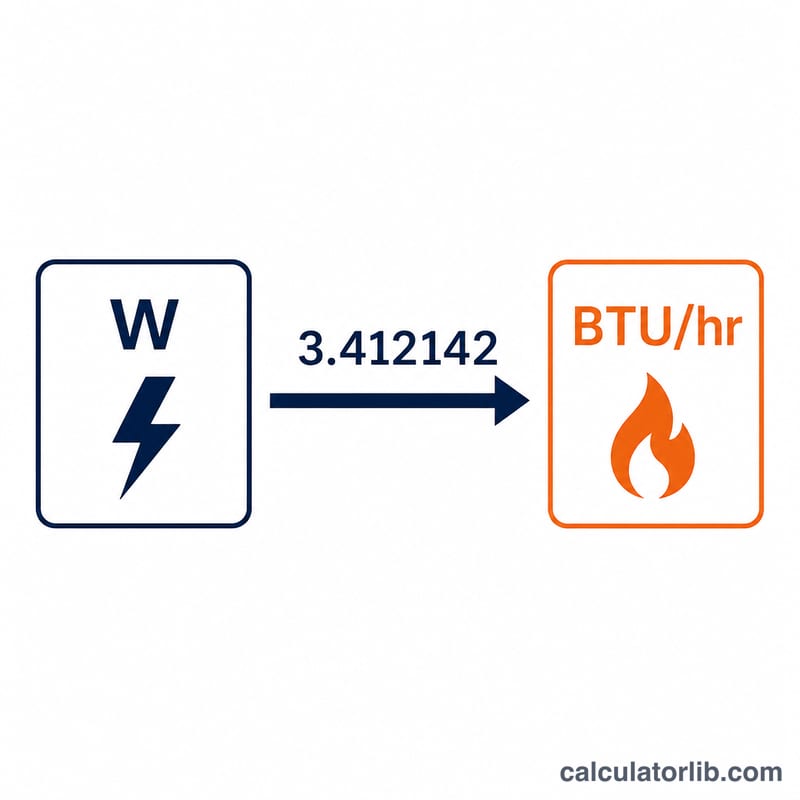
One watt equals 3.412142 BTU per hour, since 1 BTU ≈ 1055.06 joules and there are 3600 seconds per hour: \((3600 / 1055.06) \approx 3.412142\). The conversion is therefore:
$$\text{BTU/hr} = \text{Watts} \times 3.412142$$
Worked example
Suppose a device consumes 1,000 W. Multiply:
$$1{,}000 \times 3.412142 = 3{,}412.14 \text{ BTU/hr}$$A 2,000 W heater outputs about 6,824.28 BTU/hr.
Typical Appliance Heat Output Comparison
The table converts common nominal power ratings to BTU/hr using \(\text{BTU/hr} = \text{W} \times 3.412142\). The wattages are typical nameplate or rated values, not measured draw. Real devices vary with load, settings and model. For resistive loads such as heaters and incandescent bulbs, the electrical input becomes heat at close to 100%. Most other electronics also end up releasing nearly all of their consumed power as heat into the room.
| Device | Nominal power (W) | Heat output (BTU/hr) |
|---|---|---|
| Incandescent bulb | 100 | ≈ 341 |
| Desktop PC (under load) | 300 | ≈ 1,024 |
| Small server | 500 | ≈ 1,706 |
| Electric heater (low setting) | 750 | ≈ 2,559 |
| Microwave oven (input power) | 1,000 | ≈ 3,412 |
| Portable space heater (high setting) | 1,500 | ≈ 5,118.21 |
Example substitution: \(1500 \times 3.412142 = 5118.213\) BTU/hr, which rounds to about 5,118 BTU/hr. A microwave's rated cooking output is usually lower than its electrical input, so the 1,000 W figure here is the input power only.
Interpreting Your BTU/hr Result
- Rate of heat transfer: BTU/hr is a rate (energy per hour), like watts. It is not an amount of heat. One BTU/hr is about 0.293 W, and one watt is about 3.412 BTU/hr.
- Electronics become heat: Almost all electrical power drawn by computers, servers, lighting and similar equipment ends up as heat in the surrounding space. A small amount leaves as light, sound or signals, or is carried away through cables. The BTU/hr result is therefore a good estimate of the heat load the device adds to a room.
- Air conditioner ratings are cooling capacity: A rating such as 12,000 BTU/hr describes how much heat the unit can remove, not how much electricity it uses. The electrical input depends on efficiency (EER, the ratio of BTU/hr to watts). For instance, a 12,000 BTU/hr unit with an EER of 12 draws about \(12000 \div 12 = 1000\) W. Do not convert a cooling rating straight to watts of electrical input.
- Heat pumps deliver more heat than they consume: A heat pump moves heat rather than only generating it. Its coefficient of performance (COP) is heat delivered divided by electrical energy used. At a COP of 3, 1,000 W of electrical input delivers about 3,000 W of heat, which is \(3000 \times 3.412142 =\) 10,236.43 BTU/hr. COP varies with outdoor conditions.
- Tons of refrigeration: One ton of refrigeration equals 12,000 BTU/hr, which is about 3,517 W of heat. To convert, use \(\text{tons} = \dfrac{\text{BTU/hr}}{12000}\). A 5,118 BTU/hr load is roughly \(5118 \div 12000 \approx 0.43\) tons.
This is general reference information. Actual heating or cooling needs depend on room size, insulation, climate and equipment, so consult the manufacturer's data or a qualified HVAC professional for specific systems.
FAQ
Is 3.412 accurate enough? The rounded factor 3.412 is fine for everyday estimates; this calculator uses 3.412142 for better precision.
Does this apply to kilowatts? Yes — multiply kilowatts by 1000 first, or use the factor 3412.142 per kW.
What about cooling vs heating? The conversion is identical; BTU/hr simply measures the rate of energy, whether added or removed.