What is the Years to Days Calculator?
This tool converts a duration expressed in years into its equivalent number of days. It uses the average year length of 365.25 days, which accounts for the extra day added every four years during leap years. This makes it more accurate for long spans than simply using 365 days.
How to use it
Enter the number of years you want to convert. You can use whole numbers like 5 or decimals like 2.5. Press calculate and the tool returns the equivalent number of days. The result table also shows the conversion factor used so you can verify the math.
The formula explained
The calculation is straightforward:
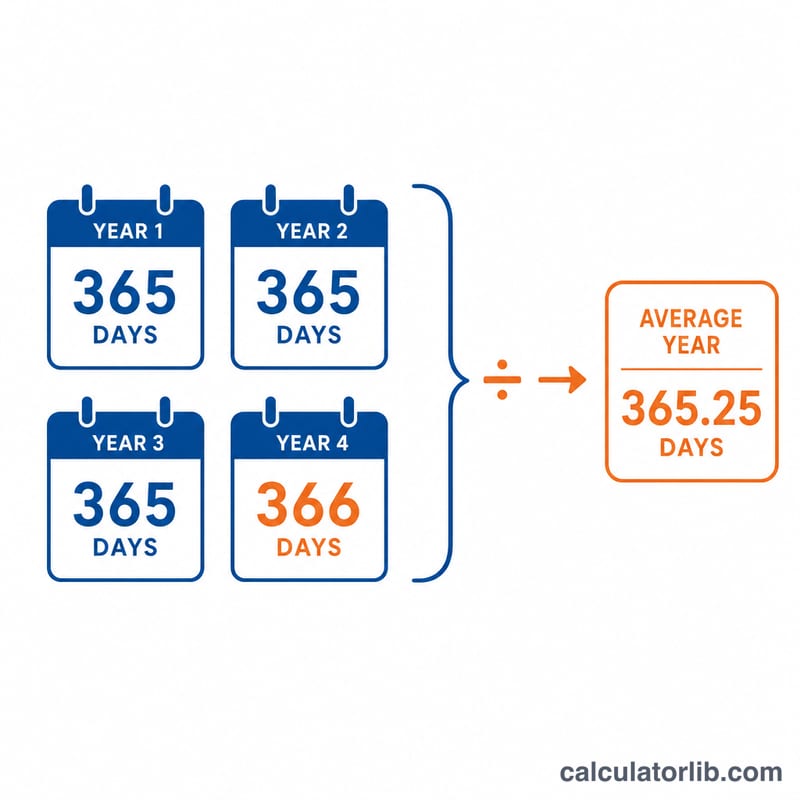
$$\text{days} = \text{years} \times 365.25$$The value 365.25 comes from averaging year lengths over a typical four-year cycle — three years of 365 days plus one leap year of 366 days, giving \((365 + 365 + 365 + 366) \div 4 = 365.25\) days per year.
Worked example
Suppose you want to know how many days are in 10 years. Multiply
$$10 \times 365.25 = 3{,}652.5 \text{ days}$$For 2.5 years, the calculation is
$$2.5 \times 365.25 = 913.125 \text{ days}$$Year Lengths and Constants Used
"One year" is not a single number of days — it depends on which definition of a year you use. The table below lists the standard year lengths, all expressed in days of exactly 86,400 SI seconds (the SI day, the unit used throughout this calculator).
| Constant | Length in days | What it is |
|---|---|---|
| Common year | 365 days | A non-leap year in the Julian and Gregorian calendars (8,760 hours). |
| Leap year | 366 days | A calendar year with an extra day (29 February); 8,784 hours. |
| Julian year | 365.25 days | The exact average of the Julian calendar (one leap year in every four). Equal to 31,557,600 SI seconds. This is the constant this calculator applies. |
| Gregorian mean calendar year | 365.2425 days | The average length of a year in the Gregorian calendar, which drops three leap days per 400 years (years divisible by 100 are not leap years unless also divisible by 400). |
| Tropical (solar) year | ≈ 365.24219 days | The time from one March equinox to the next — the year the seasons follow. The Gregorian rule was designed to approximate it. |
| Sidereal year | ≈ 365.25636 days | The time for Earth to complete one orbit relative to the fixed stars. Slightly longer than the tropical year because of the precession of the equinoxes. |
The unit conversion underlying every row is fixed: \(1\ \text{day} = 24\ \text{h} = 1{,}440\ \text{min} = 86{,}400\ \text{SI seconds}\). So the Julian year used here is
$$365.25 \times 86{,}400 = 31{,}557{,}600\ \text{s}$$This calculator multiplies your input by the Julian year of 365.25 days:
$$\text{Days} = \text{Years} \times 365.25$$That factor is the conventional choice for generic year-to-day conversions because it builds in the ordinary four-year leap cycle, and it is also the definition behind the light-year in astronomy. It is a mean value, not a calendar span: any individual year you pick is either 365 or 366 whole days.
How the Year Definition Changes Your Result
Because the three common year lengths differ only in their decimals, short conversions barely disagree — but the gap grows linearly with the number of years. The table shows the same inputs converted with a flat 365-day year, the Julian 365.25-day year used by this tool, and the Gregorian mean year of 365.2425 days.
| Years | × 365 (common year) | × 365.25 (Julian — this tool) | × 365.2425 (Gregorian mean) | Julian − common | Julian − Gregorian |
|---|---|---|---|---|---|
| 1 | 365 days | 365.25 days | 365.2425 days | +0.25 day (6 hours) | +0.0075 day (about 11 minutes) |
| 10 | 3,650 days | 3,652.5 days | 3,652.425 days | +2.5 days | +0.075 day (about 1.8 hours) |
| 50 | 18,250 days | 18,262.5 days | 18,262.125 days | +12.5 days | +0.375 day (9 hours) |
| 100 | 36,500 days | 36,525 days | 36,524.25 days | +25 days | +0.75 day (18 hours) |
Reading the 100-year row directly: the flat 365-day year falls about 25 days short over a century because it ignores leap days entirely, while the Julian and Gregorian averages differ by only 0.75 day — the three leap days the Gregorian rule removes per 400 years, scaled to 100 years:
$$100 \times (365.25 - 365.2425) = 100 \times 0.0075 = 0.75\ \text{day}$$Practical rule of thumb: the Julian-versus-Gregorian discrepancy stays under one day for spans shorter than about 133 years, so for everyday conversions the 365.25 factor is entirely adequate. The 365-day shortcut, by contrast, drifts by roughly one day every four years.
Averages are not calendar spans. These figures answer "how many days is N years on average?" — they do not tell you how many days lie between two specific dates. The exact span from 1 March 2020 to 1 March 2021 is 365 days (2020's leap day falls before the start), while 1 January 2020 to 1 January 2021 is 366 days. Whenever the start and end dates matter — contract terms, age in days, project deadlines, interest accrual periods — use a date-difference (days-between-dates) tool that counts real calendar days rather than multiplying by an average, and expect a whole-number answer instead of a decimal.
FAQ
Why 365.25 and not 365? Because most calendar years have 365 days but every fourth year (a leap year) has 366. Averaging gives 365.25, which is more accurate over multiple years.
Can I enter decimals? Yes. Decimal years such as 1.75 are fully supported.
Is this exact? It is an average. The Gregorian calendar's true average is \(365.2425\) days, but 365.25 is the common, simple convention used for most conversions.