What this calculator does
The Yu-Gi-Oh! Life Points Calculator is a running scorekeeper for a two-player duel. It tracks each player's Life Points (LP) across as many rounds as you need, applying the damage or healing you enter each round and declaring a winner when a player drops to 0 LP or below. The math is pure arithmetic, so it works for any format or house rule.
How to use it
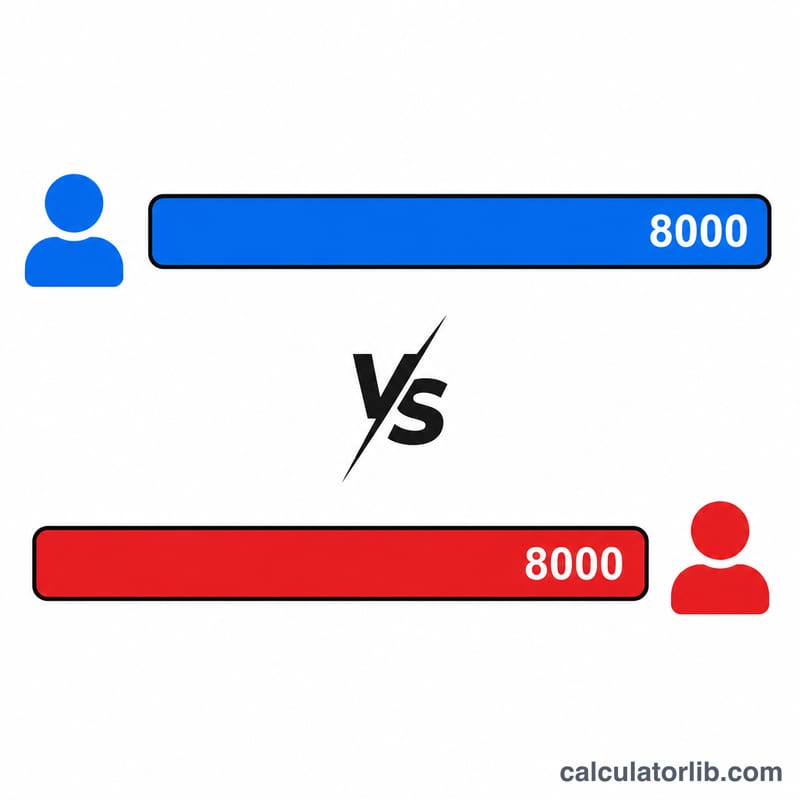
Set each player's starting Life Points (8000 is the modern Master Rule default; older Speed Duel formats use 4000). For every round, type the Life Points each player lost. A positive number is damage taken and is subtracted from that player's total; a negative number represents LP gained (healing) and is added back. Leave a cell blank for no change. After you recalculate, a fresh blank round row appears so the duel can continue indefinitely.
The formula explained
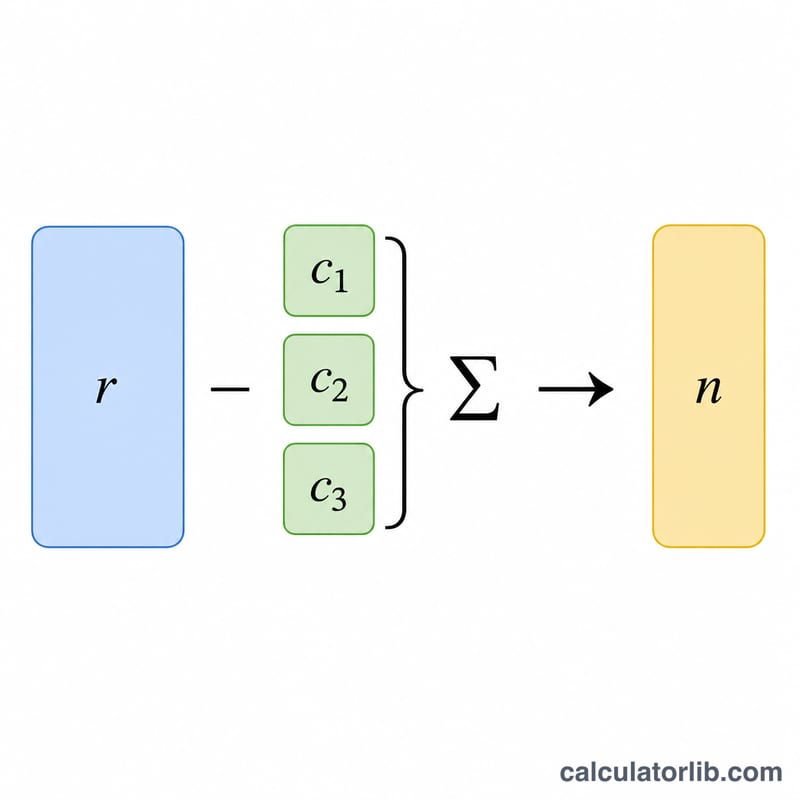
For each player, the remaining total is the starting Life Points minus the sum of all the changes entered for that player: $$\text{LP}_{\text{total}} = \text{LP}_{\text{initial}} - \sum_{r=1}^{n} \text{change}_r$$ The running history table shows the Life Points after every round so you can audit the whole duel. A player loses the moment their total reaches 0 or below, that is when \(\text{LP}_{\text{total}} \le 0 \Rightarrow \text{defeat}\).
Worked example
Both players start at 8000. Round 1: Player 1 takes 1200 damage → \(\text{P1} = 6800\), \(\text{P2} = 8000\). Round 2: Player 2 takes 3000 → \(\text{P2} = 5000\). Round 3: Player 1 enters −800 (heals 800) → \(\text{P1} = 7600\), and Player 2 takes 5200 → \(\text{P2} = -200\). Player 2 has reached 0 or below, so the result is "Player 1 wins!"
Starting Life Points by Format
Yu-Gi-Oh! is played in several officially supported formats, and not all of them begin at the same Life Point (LP) total. The table below lists the documented starting LP for each format along with the usual match structure. All values refer to Konami's official rules for the Trading Card Game (TCG), Official Card Game (OCG) and Konami's digital titles.
| Format | Starting LP | Typical match structure |
|---|---|---|
| Advanced Format (TCG/OCG, paper) | 8000 | Match: best-of-three duels, side deck between duels |
| Traditional Format (TCG, paper) | 8000 | Match: best-of-three duels (Forbidden cards treated as Limited) |
| Yu-Gi-Oh! Master Duel (digital) | 8000 | Single duel in ranked play; best-of-three in some events |
| Speed Duel (paper) | 4000 | Single duel is standard; Skill cards used, no Main Phase 2 |
| Yu-Gi-Oh! Duel Links (digital) | 4000 | Single duel; Speed Duel rules with Skills |
| Rush Duel (OCG, paper) | 8000 | Single duel is standard; draw until 5 cards in hand |
| Duel Monsters, original 1999 release | 8000 | Single duel; the 8000 LP total has been standard since the game's launch |
A 2000 LP starting total appears in some early Yu-Gi-Oh! video games and in parts of the anime and manga, where the story's rules were not identical to the card game. Those totals are not an official tournament format — treat them as flavour or as a house rule.
This tracker is not locked to any single value. Both player1InitialLP and player2InitialLP can be set independently, so you can run a standard 8000 LP Advanced duel, a 4000 LP Speed Duel, a handicap game where one player starts lower, or any custom house-rule total your playgroup agrees on.
Key Terms and Variables
The calculator is deliberately simple: every entry is added to or subtracted from a running total. The vocabulary below comes from the official Yu-Gi-Oh! rulebook and explains why a number changes, even though the arithmetic is identical in every case.
| Term | Meaning | How to enter it |
|---|---|---|
| Life Points (LP) | The score each duelist starts with and must protect; reaching 0 means losing the duel. | Starting total in player1InitialLP / player2InitialLP |
| Battle damage | Damage dealt by combat between monsters, or by a direct attack, based on the difference in ATK/DEF. | Positive number in that player's round field |
| Effect damage (burn) | Damage inflicted by a card effect rather than by battle — for example a burn spell or a trap that inflicts a fixed amount. | Positive number |
| Piercing damage | Battle damage that passes through a monster attacked while in Defense Position, when the attacker's ATK exceeds that monster's DEF and an effect grants piercing. | Positive number (the excess only) |
| LP payment | An LP cost paid voluntarily to activate or maintain a card — e.g. Solemn Judgment, which asks you to pay half your current LP. It is a cost, not damage, but it reduces LP the same way. | Positive number equal to the amount paid |
| LP gain / healing | An effect that increases LP, such as a recovery spell or a monster that restores LP on a successful attack. | Negative number, because the formula subtracts each entry |
| Round | One entry row in this tracker. It is a convenience label, not an official game term — a round here may be one turn, one battle step, or a whole exchange. | One row per change you want on the record |
| Duel | A single game, played until one duelist's LP hits 0 or another loss condition triggers. | One tracker session |
| Match | A best-of-three series of duels, standard in Advanced Format tournament play. LP does not carry across duels. | Reset the tracker between duels |
| Deck-out | Losing because you must draw a card and your Main Deck is empty. An official loss condition with no LP change attached. | Not tracked — decide it at the table |
The key point: the calculator treats every LP change as plain arithmetic. Battle damage, burn, piercing and a self-inflicted cost are all just numbers subtracted from a total, and healing is the same subtraction with a negative sign:
$$\text{LP} = \text{Initial LP} - \sum_{r=1}^{n} (\text{Round } r \text{ Change})$$So a Solemn Judgment payment on 8000 LP is entered as 4000, a 700-point burn effect is entered as 700, and a 1200 LP recovery is entered as −1200. The tracker never asks which card caused the change, and never needs to.
Reading Your Running Totals
Each player's line shows the starting total minus everything entered so far. A duelist whose total reaches exactly 0 — or goes below it — loses the duel under the official Yu-Gi-Oh! rules. In actual play LP never falls below 0; the game simply ends at 0. This tracker still displays the negative figure on purpose, because the overshoot is useful information: if a player finishes at −1800, you know the final attack carried 1800 points more than were needed, which is worth knowing when you are testing a deck's consistency or judging whether a defensive card would have mattered.
For example, a player starting at 8000 who takes 2400 battle damage, then a 1000-point burn effect, then a 4600-point direct attack ends at
$$8000 - (2400 + 1000 + 4600) = 8000 - 8000 = 0$$— exactly 0 LP, which is a loss for that player even though the total never dipped below zero.
Two limits are worth stating plainly.
- The winner line reflects LP only. It reports which duelist ran out of Life Points first, and nothing else.
- Official alternate win and loss conditions are invisible to the arithmetic. A duel can end with both players still well above 0 LP. Deck-out (being required to draw from an empty Main Deck), assembling all five pieces of Exodia the Forbidden One in hand, the completion of Destiny Board, a surrender, a disqualification or a time-limit ruling all decide the duel without touching Life Points. The tracker will not flag any of them — record the result yourself.
In match play, remember that Life Points do not carry over. Each duel in a best-of-three match begins fresh at the format's starting total, so reset both players before duel two and again before duel three. The match itself is won 2–0 or 2–1, and that score is something you tally outside the tracker. If you want a record of a whole match, the cleanest approach is one tracker session per duel, noted down as you go, rather than one long list of rounds.
FAQ
Do I enter remaining LP or the change? Enter the change for that round (how much was lost), not the new total. The calculator keeps the running total for you.
How do I record healing or LP gain? Enter a negative number, e.g. \(-800\), which is added back to that player's Life Points.
Can I edit a past round? Yes. Change any round and recalculate; all running totals are recomputed from the starting Life Points.