

What This Calculator Does
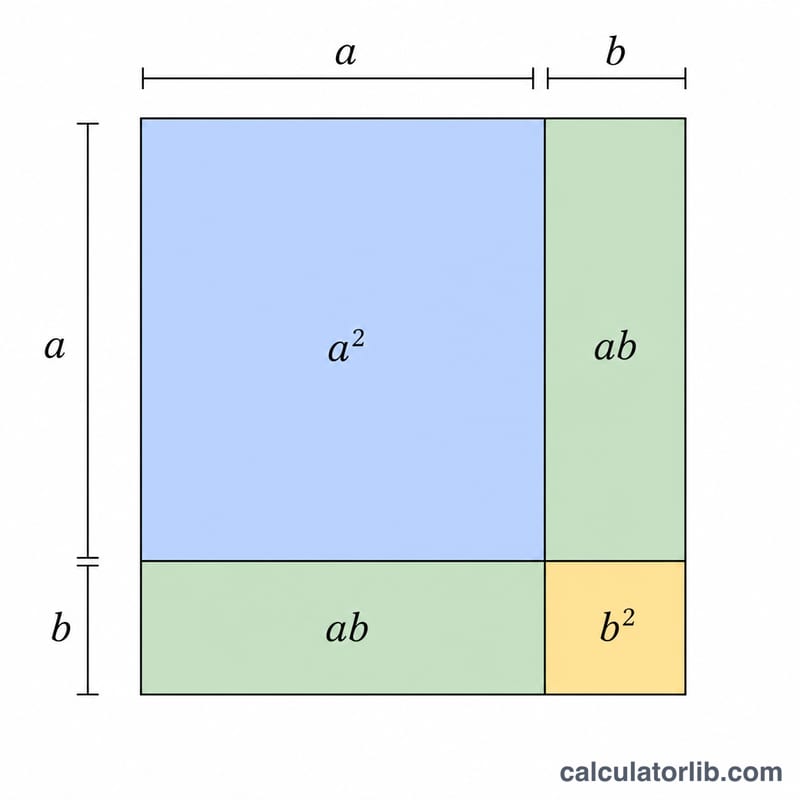
This tool analyzes any quadratic function written in standard form, \(f(x) = ax^2 + bx + c\). By completing the square, every quadratic can be rewritten as \(f(x) = a(x - h)^2 + k\), where \((h, k)\) is the vertex of the parabola. The calculator finds that vertex and tells you whether it is a minimum or a maximum.
How to Use It
Enter the three coefficients \(a\), \(b\), and \(c\). Coefficient \(a\) must not be zero (otherwise the expression is linear, not quadratic). Press calculate to see the vertex x-coordinate, the extreme value, and whether the parabola opens up (minimum) or down (maximum).
The Formula Explained
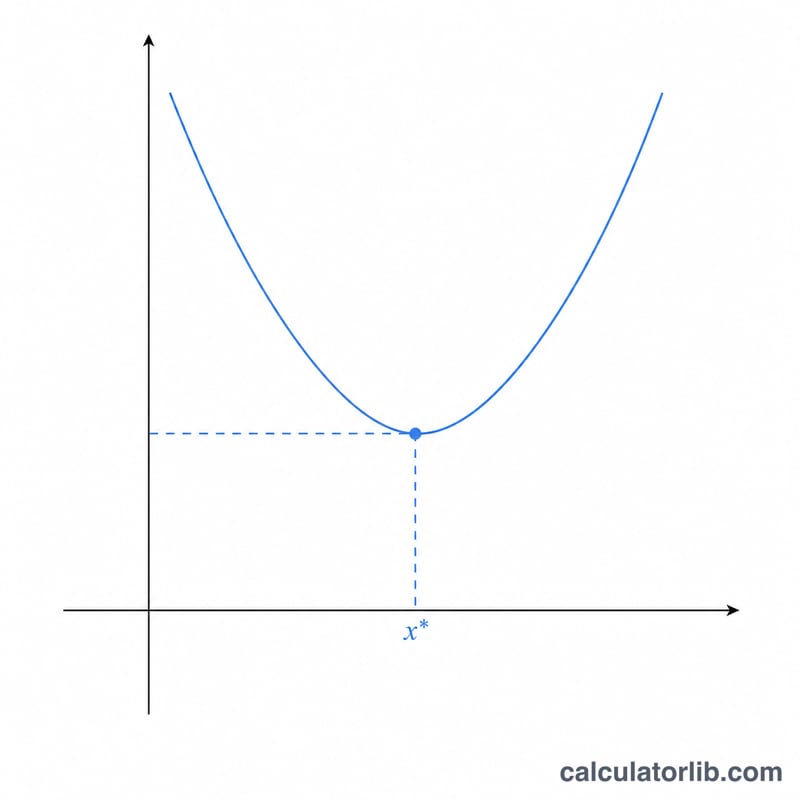
The vertex x-coordinate is $$x^* = -\frac{b}{2a}.$$ Substituting this back into the function gives the extreme value $$k = c - \frac{b^2}{4a}.$$ When \(a > 0\) the parabola opens upward, so this point is a minimum. When \(a < 0\) it opens downward, making it a maximum.
Worked Example
Take \(f(x) = x^2 - 4x + 3\), so \(a = 1\), \(b = -4\), \(c = 3\). The vertex x is $$\frac{-(-4)}{2 \times 1} = \frac{4}{2} = 2.$$ The extreme value is $$3 - \frac{(-4)^2}{4 \times 1} = 3 - \frac{16}{4} = 3 - 4 = -1.$$ Since \(a > 0\), this is a minimum at the point \((2, -1)\).
FAQ
What if \(a = 0\)? Then the function is linear and has no vertex; the calculator flags this case.
Is the extreme value the y-coordinate of the vertex? Yes. The vertex is \((x^*, \text{extreme value})\).
How does this relate to completing the square? Completing the square rewrites \(ax^2 + bx + c\) as \(a(x - h)^2 + k\) with \(h = x^*\) and \(k =\) the extreme value.