What the Capsule Volume Calculator Does
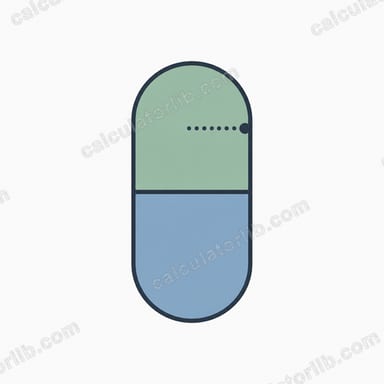
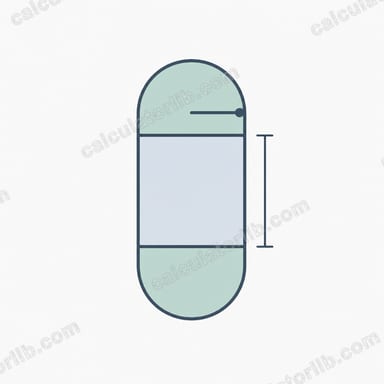
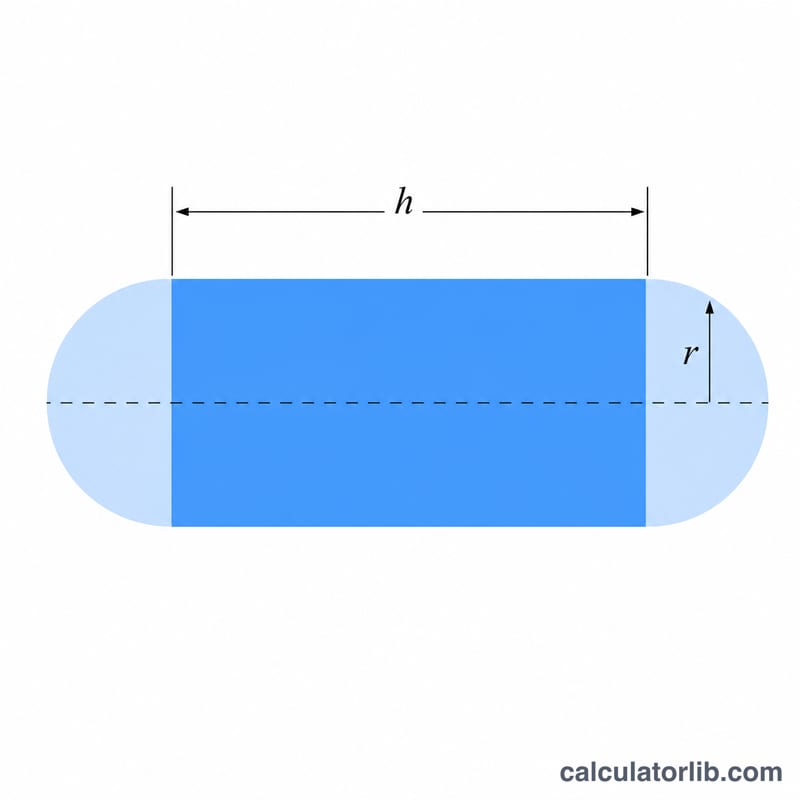
A capsule is a geometric shape made of a cylinder with a hemisphere capped on each end — exactly the silhouette of a pharmaceutical pill. This calculator works out the total volume of that shape from just two measurements: the base radius and the cylindrical height. It is useful for pharmaceutical formulation, packaging design, tank and pressure-vessel engineering, and any project that involves a rounded-end cylinder.
The Inputs You Provide
- Base Radius (r): the radius of the cylindrical body, which is also the radius of each hemispherical end. Both ends share this same radius.
- Height (h): the length of the straight cylindrical section only — not the total length of the capsule. The two hemispheres add their own length on top of this.
The Formula Explained
The calculator uses:
$$V = \pi r^{2}\left(\frac{4}{3}r + h\right)$$
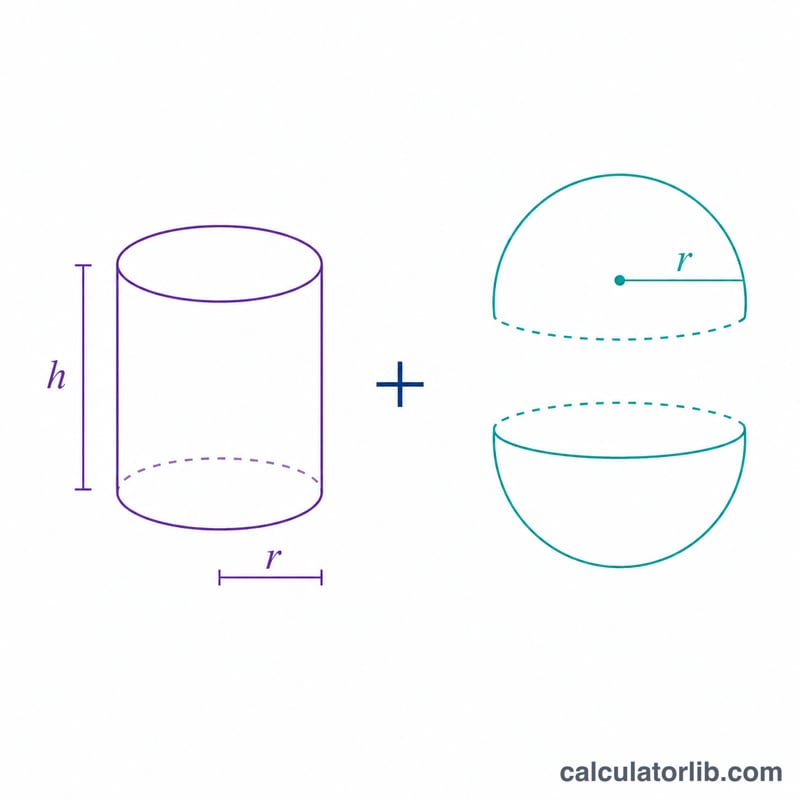
This combines two parts. The cylinder contributes \(\pi r^{2}h\). The two hemispheres together form one complete sphere, whose volume is \(\frac{4}{3}\pi r^{3}\). Factoring out \(\pi r^{2}\) gives the compact form above. The tool also reports the surface area using \(A = 2\pi r(2r + h)\), which adds the cylinder's lateral surface to the full sphere's surface.
Worked Example
Suppose a capsule has a base radius of \(r = 3\) units and a cylindrical height of \(h = 10\) units.
- Inner bracket: $$\frac{4}{3}(3) + 10 = 4 + 10 = 14$$
- Volume: $$\pi \times 3^{2} \times 14 = \pi \times 9 \times 14 \approx 395.84 \text{ cubic units}$$
- Surface area: $$2\pi \times 3 \times (2\times 3 + 10) = 6\pi \times 16 \approx 301.59 \text{ square units}$$
Keep your radius and height in the same unit, and the volume comes out in that unit cubed.
Standard Pharmaceutical Capsule Sizes and Volumes
Hard capsules (gelatin or HPMC) are made in standardized sizes. The table lists the typical nominal volume of each common size, from the largest (000) to the smallest (5) used for human medicine.
| Capsule size | Typical nominal volume (mL) |
|---|---|
| 000 | 1.37 |
| 00 | 0.95 |
| 0 | 0.68 |
| 1 | 0.50 |
| 2 | 0.37 |
| 3 | 0.30 |
| 4 | 0.21 |
| 5 | 0.13 |
These are approximate nominal fill volumes. They vary slightly between manufacturers, and the actual fill weight also depends on the powder's density and how it packs.
The calculator models a capsule as a cylinder of height \(h\) with a hemisphere of radius \(r\) on each end:
$$V = \pi r^{2}\left(\frac{4}{3}r + h\right)$$
Here \(h\) is the length of the straight cylindrical section only, not the overall length. Real capsules have slightly domed, tapered ends and a body and cap that overlap, so the formula is an approximation of the true shape.
Example: with \(r = 3\) mm and \(h = 10\) mm, \(V = \pi \cdot 3^{2}\left(\frac{4}{3}\cdot 3 + 10\right) = 9\pi \cdot 14 = 126\pi \approx\) 395.84 mm³, which is about 0.396 mL because 1 mm³ = 0.001 mL.
Volume Unit Conversions
The calculator returns volume in the cube of whatever length unit you enter. Use these relationships to convert the result.
| From | Equals |
|---|---|
| 1 cm³ | 1 mL |
| 1 mm³ | 0.001 mL |
| 1 in³ | 16.387 mL |
| 1 m³ | 1000 L |
| 1 L | 1000 cm³ |
| 1 US gallon | 3785.41 cm³ |
| 1 ft³ | 28.317 L |
Area conversions (for the capsule's surface area, \(A = 4\pi r^{2} + 2\pi r h\)):
| From | Equals |
|---|---|
| 1 cm² | 100 mm² |
| 1 in² | 6.4516 cm² |
| 1 ft² | 929.03 cm² |
| 1 m² | 10,000 cm² |
Note that US gallons are used in the United States; the imperial (UK) gallon is a different, larger unit.
Frequently Asked Questions
Is the height the total length of the capsule? No. The height (h) is only the straight cylindrical middle. The total end-to-end length equals \(h + 2r\), because each hemispherical cap adds one radius.
What happens if I set the height to zero? With \(h = 0\) the two hemispheres meet and the capsule becomes a perfect sphere, and the formula correctly reduces to \(\frac{4}{3}\pi r^{3}\).
What units does the result use? The calculator is unit-agnostic. Enter millimetres, centimetres or inches and the volume returns in those units cubed (mm³, cm³, in³). For pharmaceutical capsule sizing, working in millimetres gives volumes directly in mm³ (microlitres).