What Is a Cash Back Calculator?
A cash back calculator shows how much money you earn back from a purchase based on your card or program's reward rate. Many credit cards and loyalty programs offer a percentage of your spending back as cash, points, or statement credit. This tool turns that percentage into a real dollar figure so you can compare offers and understand your true cost.
How to Use It
Enter the total amount you plan to spend and the cash back rate offered (for example, 2 for a 2% card). The calculator instantly returns the cash back you earn and your net cost after the reward is applied. Use it to compare cards, plan large purchases, or check whether a higher-rate card is worth an annual fee.
The Formula Explained
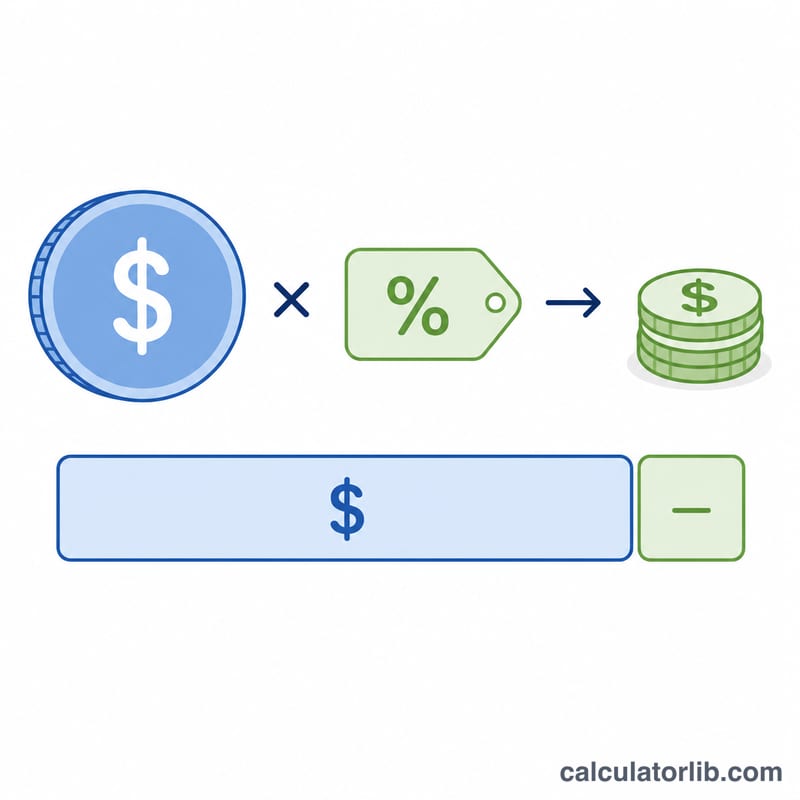
The math is simple: $$\text{Cash Back} = \text{Spend} \times \frac{\text{Rate (\%)}}{100}$$ Dividing the rate by 100 converts the percentage into a decimal. Multiplying by your spend gives the dollar reward. Subtracting that from your spend gives the net cost — what the purchase effectively costs you after rewards.
Worked Example
Suppose you spend $1,500 on a card offering 3% cash back. The reward is $$1{,}500 \times \frac{3}{100} = 1{,}500 \times 0.03 = \$45$$ Your net cost is $$1{,}500 - 45 = \$1{,}455$$ So that 3% card saves you $45 on this purchase.
Cash Back Across Different Spend Amounts and Rates
Cash back is calculated as \(\text{Spend} \times \frac{\text{Rate}}{100}\), and net cost is \(\text{Spend} - \text{Cash Back}\). Each cell below shows cash back / net cost in dollars, before any annual fee, spending cap, or tier limit.
| Spend | 1% | 1.5% | 2% | 5% |
|---|---|---|---|---|
| $500 | $5.00 / $495.00 | $7.50 / $492.50 | $10.00 / $490.00 | $25.00 / $475.00 |
| $1,500 | $15.00 / $1,485.00 | $22.50 / $1,477.50 | $30.00 / $1,470.00 | $75.00 / $1,425.00 |
| $3,000 | $30.00 / $2,970.00 | $45.00 / $2,955.00 | $60.00 / $2,940.00 | $150.00 / $2,850.00 |
| $10,000 | $100.00 / $9,900.00 | $150.00 / $9,850.00 | $200.00 / $9,800.00 | $500.00 / $9,500.00 |
Example of the substitution: for $1,500 at 2%, \(1500 \times \frac{2}{100} = 30\), so net cost is \(1500 - 30 = 1470\).
Cash Back Terms Defined
- Cash back rate: The percentage of a purchase amount returned to you as a reward, e.g. 2% means $2 back per $100 spent.
- Flat-rate card: A card that pays the same cash back rate on all eligible purchases, regardless of category.
- Tiered/category bonus rate: A higher rate paid on specific categories (such as groceries, gas, or dining), usually with a lower base rate on everything else. Bonus rates may have spending caps.
- Statement credit: A reward applied as a credit to your card balance, reducing what you owe rather than being paid out as a deposit or check.
- Net cost: The amount you effectively pay after rewards: spend minus cash back.
- Rotating categories: Bonus categories that change periodically (often quarterly), typically requiring activation and often capped per period.
- Annual fee: A yearly charge for holding a card. It reduces the real value of rewards earned.
- Effective rate: Net rewards after fees divided by spend: \(\frac{\text{Cash Back} - \text{Annual Fee}}{\text{Spend}}\), usually shown as a percentage.
Interpreting Your Cash Back Result
The figure this calculator returns is gross cash back: spend multiplied by the rate. It does not subtract an annual fee, and it does not apply spending caps, tier limits, minimum redemption thresholds, or exclusions (some programs exclude cash advances, balance transfers, or certain merchant types). Check your card's terms for these.
To see what you actually keep, use the effective rate:
$$\text{Effective Rate} = \frac{\text{Cash Back} - \text{Annual Fee}}{\text{Spend}} \times 100$$
Example: $6,000 of annual spend at 2% gives \(6000 \times \frac{2}{100} = \) $120.00. With a $95 annual fee, net rewards are \(120 - 95 = 25\), so the effective rate is \(\frac{25}{6000} \times 100 \approx 0.42\%\), well below the headline 2%.
Market context: In the US, which is where most cash back cards are marketed, flat-rate cards commonly offer about 1%–2% on all purchases, while bonus categories often pay about 3%–5%, frequently with caps or activation requirements. Rates and terms vary by issuer, country, and over time, so treat these as general ranges rather than guarantees.
This is general information, not financial advice.
FAQ
Does cash back reduce my balance? Usually it is applied as a statement credit or deposit, effectively lowering your cost — which is why we show net cost.
Are tiered or bonus rates included? This calculator uses a single flat rate. For category bonuses, calculate each category separately and add the results.
Is cash back taxable? In most cases, rewards earned from spending are treated as a rebate, not taxable income — but check your local tax rules and program terms.