What the Cone Slant Height Calculator Does
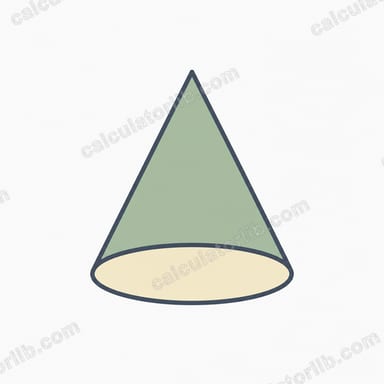
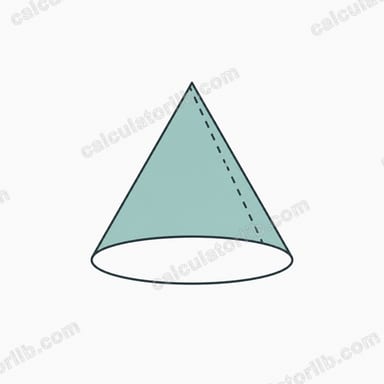
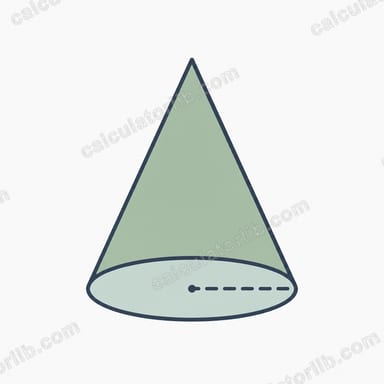
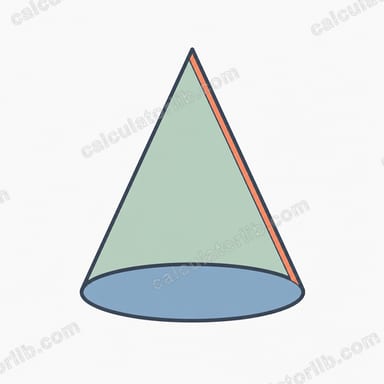
The Cone Slant Height Calculator works out the distance from the tip (apex) of a right circular cone down to the edge of its circular base — a measurement known as the slant height. You only need two values: the cone's vertical Height and its base Radius. From these, the tool instantly returns the slant height, and as a useful bonus it also calculates the cone's total surface area and volume.
The Inputs You Enter
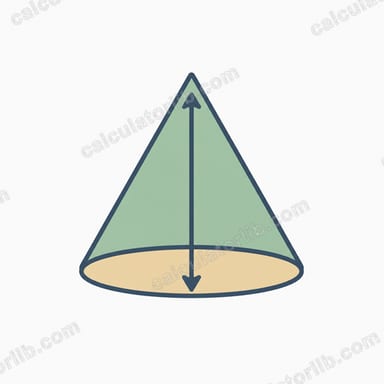
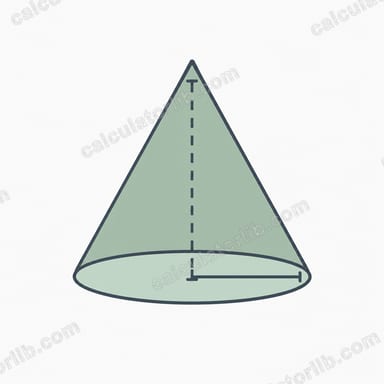
- Height: the perpendicular distance from the centre of the base straight up to the apex.
- Radius: the distance from the centre of the circular base to its edge.
Use the same unit for both fields (for example centimetres or inches), and the results will be returned in that same unit — with surface area squared and volume cubed.
The Formula Explained
The slant height is found using the Pythagorean theorem, because the height, radius and slant height form a right triangle:
l = √(h² + r²)
Here h is the height and r is the radius. The calculator also computes:
- Surface area = π × r × (r + √(h² + r²)) — base plus curved side.
- Volume = (1/3) × π × r² × h.

Worked Example
Suppose a cone has a height of 4 and a radius of 3.
- Slant height: l = √(4² + 3²) = √(16 + 9) = √25 = 5
- Surface area: π × 3 × (3 + 5) = π × 3 × 8 ≈ 75.40
- Volume: (1/3) × π × 3² × 4 = (1/3) × π × 36 ≈ 37.70
So a cone 4 units tall with a 3-unit radius has a slant height of exactly 5 units.
Cone Terms and Definitions
All formulas on this page assume a right circular cone: a cone whose base is a circle and whose apex lies directly above the center of the base. For oblique (slanted) cones, the slant height is not the same all the way around, and these formulas do not apply.
- Apex
- The pointed top of the cone, where all the lines from the base edge meet.
- Base
- The flat circular face at the bottom of the cone.
- Radius (r)
- The distance from the center of the base to its edge.
- Height (h), or altitude
- The perpendicular distance from the apex straight down to the center of the base.
- Slant height (l)
- The distance along the cone's surface from the apex to any point on the edge of the base. It is the hypotenuse of the right triangle formed by the height and the radius.
- Right circular cone
- A cone with a circular base whose axis (the line from the apex to the base center) is perpendicular to the base.
- Lateral surface area
- The area of the curved side of the cone only, excluding the base: \(L = \pi r l\).
- Total surface area
- The lateral surface area plus the area of the circular base: \(A = \pi r l + \pi r^{2} = \pi r (l + r)\).
- Pythagorean theorem
- In a right triangle, the square of the hypotenuse equals the sum of the squares of the other two sides. Here the legs are the height \(h\) and the radius \(r\), and the hypotenuse is the slant height: \(l^{2} = h^{2} + r^{2}\).
More Slant Height Examples
The slant height of a right circular cone is the hypotenuse of a right triangle whose legs are the cone's height \(h\) and base radius \(r\): \(l = \sqrt{h^2 + r^2}\). Surface area and volume use the same dimensions.
Example 1: h = 12, r = 5 (a 5-12-13 triple)
- Slant height: \(l = \sqrt{12^2 + 5^2} = \sqrt{144 + 25} = \sqrt{169} = \) 13.
- Lateral surface area: \(\pi r l = \pi \cdot 5 \cdot 13 = 65\pi \approx 204.20\) square units.
- Total surface area: \(\pi r (r + l) = \pi \cdot 5 \cdot (5 + 13) = 90\pi \approx 282.74\) square units.
- Volume: \(\tfrac{1}{3}\pi r^2 h = \tfrac{1}{3}\pi \cdot 25 \cdot 12 = 100\pi \approx 314.16\) cubic units.
Example 2: h = 7, r = 2.5 (non-integer result)
- Square each value: \(7^2 = 49\) and \(2.5^2 = 6.25\).
- Add: \(49 + 6.25 = 55.25\).
- Slant height: \(l = \sqrt{55.25} \approx \) 7.43 units.
- Lateral surface area: \(\pi \cdot 2.5 \cdot 7.433 \approx 58.38\) square units.
- Volume: \(\tfrac{1}{3}\pi \cdot 2.5^2 \cdot 7 = \tfrac{43.75\pi}{3} \approx 45.81\) cubic units.
Reverse cases: finding the radius or height
If the slant height and one other dimension are known, rearrange the Pythagorean relationship:
$$r = \sqrt{l^2 - h^2}, \qquad h = \sqrt{l^2 - r^2}$$
- Given \(l = 10\) and \(h = 8\): \(r = \sqrt{100 - 64} = \sqrt{36} = 6\).
- Given \(l = 17\) and \(r = 8\): \(h = \sqrt{289 - 64} = \sqrt{225} = 15\).
The slant height must always be larger than both the height and the radius; if it is not, the inputs cannot describe a real cone.
Frequently Asked Questions
What is the difference between height and slant height? The height is the straight vertical distance from base to apex. The slant height runs along the sloped outer surface from the base edge to the apex, so it is always longer than the height.
Can the slant height ever be shorter than the height or radius? No. Because it is the hypotenuse of a right triangle, the slant height is always greater than both the height and the radius individually.
Why does the calculator also show surface area and volume? The slant height is a building block for the surface area formula, so calculating all three together saves time on geometry homework, design and 3D modeling tasks.