What This Cube Root Calculator Does
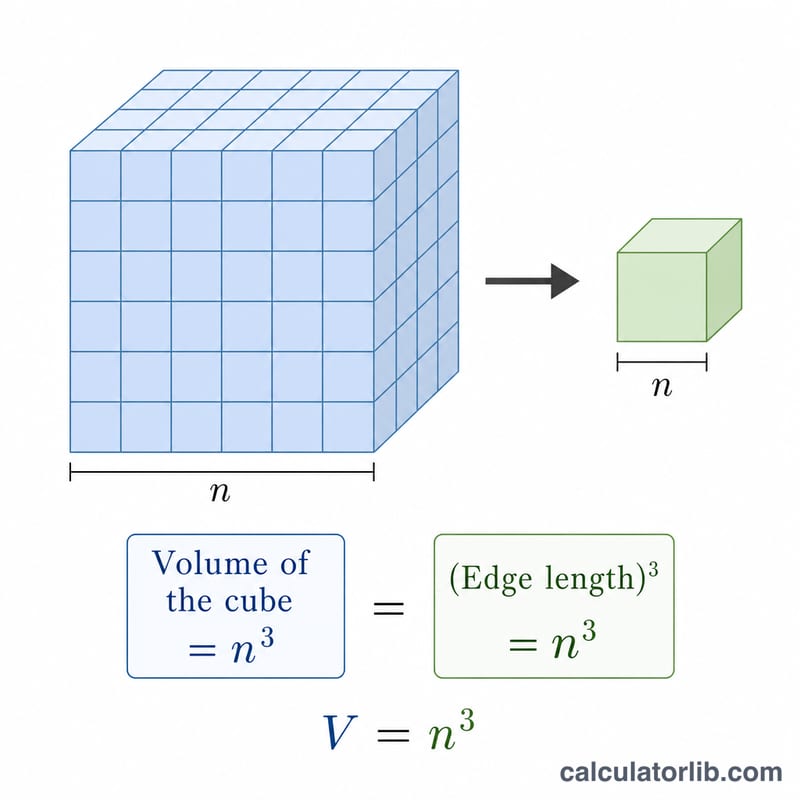
The Cube Root Calculator finds the real cube root of any number you enter, written mathematically as ∛x. The cube root of a number is the value that, when multiplied by itself three times, returns your original number. For example, the cube root of 27 is 3, because 3 × 3 × 3 = 27.
Unlike a square root, a cube root works for negative numbers too. There is exactly one real cube root for every real number, so this tool always returns a single, clear answer.
How to Use It
- Enter a number — type any value into the single input field. This can be a whole number, a decimal, or a negative number.
- The calculator instantly computes and displays the real cube root of that value.
That single input is all the tool needs. There are no extra settings, units, or rounding options to configure.
The Formula
The calculation is based on the standard cube root expression:
∛x
Behind the scenes, the calculator reads your input as a decimal number and applies the mathematical cube root function (the equivalent of Math.cbrt(x)). This method correctly handles negatives by returning a negative root, so ∛(−8) gives −2 rather than an error.
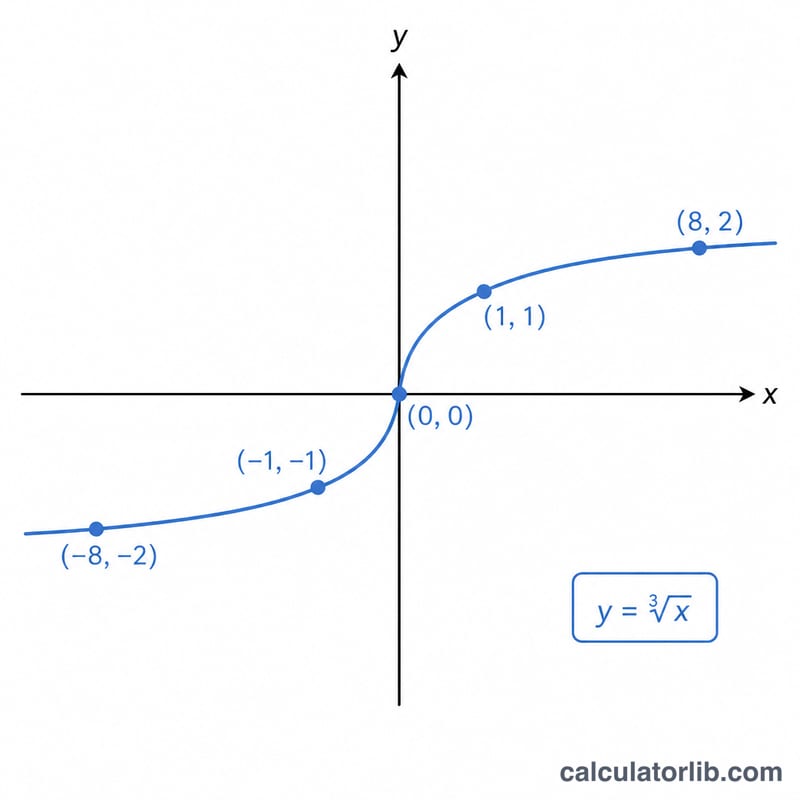
Worked Example
Suppose you enter 64 as your number. The calculator computes:
- Input number: 64
- Cube root: ∛64 = 4 (because 4 × 4 × 4 = 64)
Now try a non-perfect cube like 20. The calculator returns approximately 2.7144, since 2.7144 × 2.7144 × 2.7144 ≈ 20. For a negative input such as −27, the result is −3.
Common Cube Roots Reference Table
The cube root of a number \(x\), written \(\sqrt[3]{x}\), is the value that, when multiplied by itself three times, gives \(x\). For example, \(\sqrt[3]{27} = 3\) because \(3 \times 3 \times 3 = 27\). The table below lists the perfect cubes from 1 to 1000 (which have whole-number cube roots) along with several common non-perfect values whose cube roots are irrational and shown rounded to four decimal places.
| Number (x) | Cube Root (∛x) | Type |
|---|---|---|
| 1 | 1 | Perfect cube |
| 2 | 1.2599 | Approximation |
| 5 | 1.7100 | Approximation |
| 8 | 2 | Perfect cube |
| 10 | 2.1544 | Approximation |
| 20 | 2.7144 | Approximation |
| 27 | 3 | Perfect cube |
| 50 | 3.6840 | Approximation |
| 64 | 4 | Perfect cube |
| 125 | 5 | Perfect cube |
| 216 | 6 | Perfect cube |
| 343 | 7 | Perfect cube |
| 512 | 8 | Perfect cube |
| 729 | 9 | Perfect cube |
| 1000 | 10 | Perfect cube |
Unlike square roots, cube roots are defined for negative numbers as well: because a negative times a negative times a negative is negative, \(\sqrt[3]{-27} = -3\). In general, \(\sqrt[3]{-x} = -\sqrt[3]{x}\).
How to Calculate a Cube Root by Hand
You can estimate any cube root without a calculator using the perfect cubes as anchors, then refining the guess with a short iteration of Newton's method. The steps below find \(\sqrt[3]{50}\) as a worked example.
- Bracket the number between two perfect cubes. Since \(27 = 3^3\) and \(64 = 4^3\), and \(27 < 50 < 64\), the answer lies between 3 and 4.
- Make an initial estimate. 50 sits a bit past halfway from 27 to 64, so a reasonable first guess is \(x_0 = 3.7\).
- Refine with Newton's method. For \(\sqrt[3]{N}\) the update rule is $$x_{n+1} = \frac{ {2x_n + \dfrac{N}{x_n^2}}}{3}.$$ With \(N = 50\) and \(x_0 = 3.7\): $$x_1 = \frac{ {2(3.7) + \dfrac{50}{3.7^2}}}{3} = \frac{ {7.4 + 3.6523}}{3} = \frac{11.0523}{3} = 3.6841.$$
- Iterate once more for precision. Feeding \(x_1 = 3.6841\) back into the formula gives $$x_2 = \frac{ {2(3.6841) + \dfrac{50}{3.6841^2}}}{3} \approx \frac{ {7.3682 + 3.6837}}{3} \approx 3.6840.$$ The estimate has stabilized, so \(\sqrt[3]{50} \approx 3.6840\).
- Verify by cubing the result. Check that \(3.6840^3 = 3.6840 \times 3.6840 \times 3.6840 \approx 49.998\), which rounds to 50 — confirming the answer 3.6840.
Tip: Each Newton iteration roughly triples the number of correct digits, so two passes from a sensible starting guess are usually enough for four-decimal accuracy. Starting closer to the true value (using the bracketing step) reduces the number of iterations you need.
Frequently Asked Questions
Can I find the cube root of a negative number?
Yes. Every real number has exactly one real cube root, including negatives. Entering −125 returns −5.
What if my number isn't a perfect cube?
The calculator still works — it returns a decimal approximation. For instance, ∛10 ≈ 2.1544.
Does it give complex roots?
No. This tool returns only the single real cube root, which is what you need for most everyday math, geometry, and volume problems.